Argentine writer and journalist Martín Caparrós was interviewed by AS, where he shared his thoughts on the 2026 World Cup: the final, the hostility towards Argentina on social media, and the nationalism surrounding the tournament.
First of all, Mr. Caparrós, how are you doing?
Very well. I'm in good shape. It's just the peak of summer, and the days are a bit trying. I can still write. As long as I can write, everything else can slowly adapt.
Doesn't it feel like the World Cup arrived almost without warning? We always feel as though the World Cup has nothing to do with us...
But once the tournament starts, we get immersed in it like children. Why do we always say that this World Cup is boring and not as good as the last one, yet in the end, we still watch and enjoy the matches?
Yes, that is very intriguing. We always treat the World Cup with a certain feigned indifference or skepticism. For at least three consecutive World Cups, we have had this sentiment: the Russia World Cup, the Qatar World Cup, and this one. This mindset toward the last three is somewhat related to the choice of host cities.
FIFA has become adept at choosing increasingly unsatisfactory host locations. The United States does not seem like an easy place for foreign fans to attend matches. But the actual experience of each tournament always overturns our predictions. We may not expect to be swayed by the World Cup’s overwhelming marketing tactics, but in the end, we become fully invested.
You don’t agree with the idea of national unity, and you even sarcastically call the World Cup “a grand nationalist carnival.” This national narrative makes us align with many compatriots we wouldn’t otherwise interact with; simply because of shared nationality, we can cheer for a goal together. Why does this phenomenon occur? How can football bridge political and ideological divides?
It is truly remarkable. Generally speaking, there are very few strong arguments supporting the concept of a "homeland." Most of those arguments are rooted in opposition to other countries. Of course, wars, unfair treatment, and various international threats continuously reinforce this concept of homeland.
Because we are attacked as a whole, we must unite to defend ourselves. Football, in essence, is a playful replication of this antagonistic conflict. To paraphrase Carl von Clausewitz, it is war by other means. It may look like a colossal confrontation between two nations, but in the end, it is just twenty players from each side trying to kick the ball into the opposing goalkeeper's net.
It is remarkable that we elevate such a trivial matter, unrelated to our personal lives, to such an important level. We implicitly assume that these two dozen players represent the entire nation, projecting all of the nation's honor, along with our personal joys and sorrows, onto them. I find this extremely surprising, but putting my surprise aside, the reality is that this logic works — and it works very powerfully.
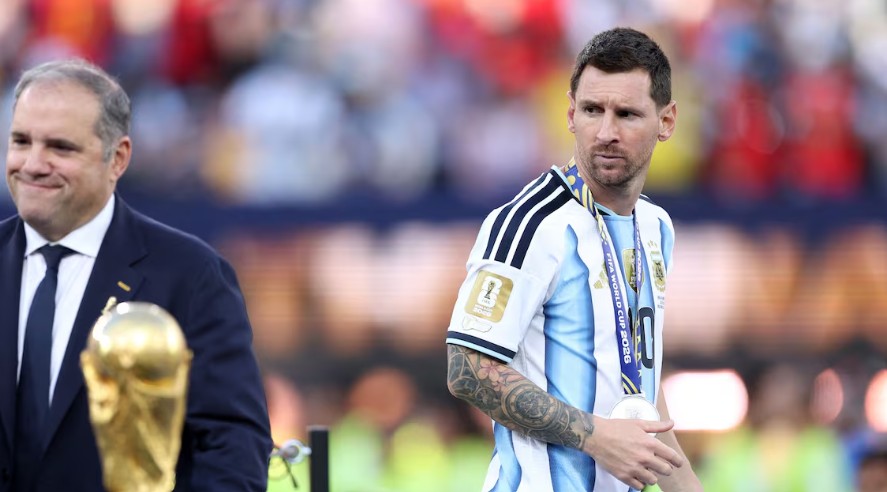
A country that encompasses everything is condensed into 22 players on a football field. After the World Cup final, many Argentine netizens on social media said, “Football is the best thing we’ve ever had,” reducing the entirety of Argentina to football. Do you think the World Cup reinforces stereotypes about countries and their fans? Do fans intentionally reduce an entire country to their preconceived national image?
Indeed. What is interesting is that these national images are not static. During the Qatar World Cup, Argentina was the “good guy,” a beloved team, and people hoped that Messi, who was nearing retirement, would find joy while facing stronger opponents. Four years later, the external interpretation has completely changed. People always try to see a team as a microcosm of a country, but the fact that this interpretation can shift so dramatically shows that this logic is flawed.
The German team used to be steady, reliable, and precisely engineered, reflecting perceptions of German industry. But now the German team is performing poorly, unable even to reach the quarter-finals. Should we therefore conclude that German industry, engineering, stability, and reliability no longer exist? Frankly, this is complete nonsense.
You've probably heard the various conspiracy theories circulating in Argentina about Spain winning the championship. Why do conspiracy theories always captivate such a large audience? Why do many people, in order to defend their country, go so far as to call their once incredibly proud national players cowardly, bought off, or complicit?
Yes, to a large extent, it can be summarized in a single word: opportunism. That is to say, people cannot understand what is happening before their eyes, so they look for simple, cheap explanations. These claims have no factual basis and therefore cannot be genuinely refuted, as they are purely fabricated. For example, it is hard for someone else to prove that I was not standing on top of this pine tree yesterday. Others can say, "That's too strange," but they cannot prove I was not there. The same applies to these conspiracy theories. Let me tell you something I am a little ashamed to admit.
During that Argentina match, from before the game until after it ended, I never thought the players had been bought off. Of course, I thought such a thing was impossible, but Messi was in very poor form at the time, and he clearly had physical problems. In the first 15 minutes of the match, he barely touched the ball and did not actively try to get involved, and that was when I noticed something was wrong.
By the 20th minute, that feeling had grown even stronger. Argentina had a free-kick about thirty or forty meters from the Spanish goal, on the left side, in what was one of the few times they advanced into the opponent's half in the first half. Messi should have taken it, but he simply stood aside, and De Paul eventually took the shot. I immediately thought he must have had a muscle injury or was in pain, because even if he was tightly marked, unable to get the ball, or unable to run, he would not normally avoid taking a free-kick he almost always took.
I always thought that related news might eventually be made public, but this is not a conspiracy theory. In the end, people just want an explanation and cannot understand why Messi's performance was so limited in such an important match for him. However, these conjectures do not change one fact: the Spanish team was far stronger than Argentina, and their victory was well deserved. Argentina's performance throughout the tournament was unsatisfactory.
This is also very intriguing: Argentine media and fans deliberately avoid it, but their poor performance was clearly visible. After Argentina played a few matches, I wrote several articles pointing out the team's worrying condition, but many Argentine media outlets and a large number of fans were eatic about the national team defeating opponents such as Cape Verde.
The scene was very strange, as if we were watching two completely different matches. Football creates this slight cognitive dissonance, making people ignore the reality unfolding before their eyes.
Perhaps the Argentine media is also indulging in a heroic narrative. They deliberately exaggerate the epic sense of this team overcoming adversity rather than focusing on the actual match performance. Do you know where the problem lies?
This heroic narrative requires a poor match performance as its backdrop. Only in dire situations, such as being down 0-2 against Egypt, can a heroic story take root. If the game goes smoothly with an easy 3-0 victory, there is no need for a heroic narrative. So it is ironic that this heroic narrative, which people champion, would be completely unnecessary if the team played a little better.
Aside from the narrative of paid hype, do you sense strong animosity toward Argentinians from the outside world? Could these stereotypes about Argentine fans move from the internet into reality and escalate into violence?
This surge in public opinion against Argentina is just a fleeting trend. After the World Cup, most people around the world do not really care about Argentina. The whole world is not constantly watching Argentina, eager to target Argentinians. Thinking that way is actually projecting an Argentine mindset onto the outside world.
Putting these stereotypes aside, the storm will soon subside, and there are many other things in the world to occupy people's attention. However, among the various comments circulating on social media, one thing surprised me: the large number of racism-related accusations. Argentina certainly has many things that can be criticized; the country has failed in almost every aspect over the past 50 years, and it has now elected a president, Javier Milei, who has become a laughingstock worldwide.
Reaching this point did not happen out of nowhere; countless citizens cast their votes. This, in itself, is a sign of the country's deep predicament, extending beyond economic problems and social exclusion.
But among Argentina's various problems, racism is not particularly prominent. Of course, like almost all countries, we have racist tendencies to some extent. However, many of these accusations come from the United States, where, by contrast, just 60 years ago, African Americans could not marry white people, did not have the right to vote, and could not even ride the same bus. I think people should examine themselves before accusing others.
I really can’t understand this, and I’ve written about Argentina’s demographic composition. Almost all of us are mixed-race. The root of racism is often the idea of pure bloodlines—the claim that “my bloodline is pure, others are not, so I despise them.” But in Argentina, there are no pure-blooded groups; everyone is essentially mixed-race, so the breeding ground for racism is inherently very weak.
Many accusations of racism and hostility toward Argentinians actually come from other Latin American countries, such as Mexico, Peru, and Chile. As a result, the sense of identity within the Latin American community seems to have fractured.
Yes, I thought this situation was a thing of the past. For decades, Argentinians have been unpopular in Latin America because they have always considered themselves superior. This sense of superiority partly stemmed from Argentina's genuinely developed advantages in the past.
It may not sound good, but Argentina once had the best public education and public healthcare in all of Latin America, and it also produced a large middle class that other regions did not have. Its Gross domestic product was also much higher than that of neighboring countries. A segment of Argentinians, who were better educated and economically better off, developed a sense of superiority, and it was natural for other countries to resent this.
But for at least the past 50 years, these advantages have been eroding. Other Latin American countries have been developing, while Argentina has continued to decline. In terms of actual data, the gap between Argentina and other Latin American countries has become negligible. I thought this was already a consensus.
Ten years ago in Chile, I drew criticism for writing an article in which I said that Chile had taken on the role of the “resented nouveau riche” in Latin America. I don’t know whether those words made local people comfortable at the time, but that was the reality. Now, however, I find that old prejudices have not dissipated as much as I had imagined.
Argentina is in decline, and perhaps some Argentinians still cling to old attitudes, simply unwilling to accept that we no longer have anything to boast about. This is only one possibility, and I cannot draw a definitive conclusion.
AF's PC site is now live! Browse full news, comments, match details, and stats on your computer. Visit: www.allfootballapp.com
 Argentinien
 Deutschland
 Spanien
 Lionel Messi
 Inter Miami
Alle Kommentare (28)