In the Champions League group stage opener on September 9, Real Madrid defeated Inter 2-1 at home. Ahead of the match, The Athletic published a tactical analysis examining Real Madrid's setup and playing style throughout the game.
After major Champions League encounters, extreme conclusions are often drawn.
Yet in a low-scoring sport like football, the picture on the pitch is typically more complex and nuanced. Real Madrid's high press in their 2-1 opening victory over Inter exemplifies this perfectly.
Facing former manager José Mourinho's Inter, Real Madrid used their high press to score twice, but Inter also breached their defense on multiple occasions.
Real Madrid employed a hybrid formation during their press. When Inter built play down the right flank, Trent Alexander-Arnold and Brahim Díaz operated in a zonal defensive role protecting the center. As Inter shifted the ball left, Real Madrid quickly switched to man-to-man pressing.

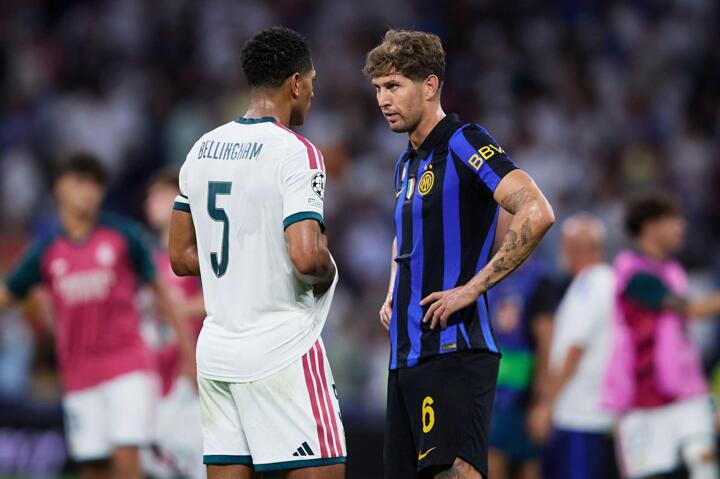
In this scenario, Federico Valverde, Vinícius, and Bellingham marked Nicolò Barella, Benjamin Pavard, and Çalhanoğlu respectively, with Alexander-Arnold marking Curtis Jones and Ibrahima Konaté maintaining a tight defensive line.
As Kylian Mbappé initiated the press on Bisseck, the Inter defender passed back to the goalkeeper, who shifted the attacking focus leftward.

Moments later, when Inter looked to attack down the left, Brahim Díaz stepped forward. Simultaneously, Ibrahima Konaté advanced to tightly mark striker Lautaro Martínez, and Real Madrid initiated full man-to-man pressing.
When Jones passed back to Martínez and the goalkeeper distributed to centerback Alessandro Bastoni, Real Madrid's man-to-man press strategy began functioning in earnest.
Brahim Díaz pressed the left centerback, Denzel Dumfries advanced to press Carlos Augusto, and Mbappé marked Bisseck while positioning himself to intercept a backpass. Real Madrid's other players closed down their respective marks.
Under intense pressure, Bastoni passed to Augusto, whose long ball was headed clear by Hoilund.

Both of Real Madrid's goals that evening stemmed from this high press tactic, yet Inter's mistakes may have been avoidable.
In the buildup to the opening goal, as Jones advanced with possession on the right, Alexander-Arnold and Brahim Díaz took their zonal defensive positions while Carvajal, Bellingham, Valverde, and Hoehlund respectively marked Diuf, Çalhanoğlu, Thuram, and Nicolò Barella. The latter two Real Madrid players exchanged marking assignments as Inter's midfielders shifted positions.
This limited Jones's forward pass options. Alexander-Arnold quickly pressed his fellow countryman, whose error led to a further mistake from Bisseck.
Positioned tightly, Brahim Díaz seized the opportunity sharply, providing an assist for a one-on-one chance that Mbappé converted for 1-0.

Real Madrid's second goal also emerged from high pressing.
At this point, Vinícius, Valverde, and Bellingham marked Bisseck, Barella, and Çalhanoğlu respectively, while Mbappé pressed the goalkeeper directly.
Martínez distributed to winger Benjamin Pavard, who found Bastoni, triggering Real Madrid's man-to-man press again. Brahim Díaz charged at Inter's left centerback, Dumfries advanced to press Augusto, and Valverde believed his pace was sufficient to intercept a pass to Barella.
Inter passed back to Martínez, but Valverde pressed the goalkeeper directly, effectively cutting off the pass lane to Barella.
Under Real Madrid's all-encompassing man-to-man defense, Martínez had no options, panicked, and lost possession, allowing Valverde to score.

"Valverde's goal was no accident—it was the perfect realization of our tactical system and strategy in that moment," Mourinho said after the match.
Real Madrid's high press and aggressive ball recovery created two clear chances for Bellingham and Mbappé in the 47th and 67th minutes respectively. However, their system was also repeatedly undone by Inter's fluid buildup play from the back.
In the example below, when Inter had possession on the right flank, Alexander-Arnold and Brahim Díaz did not mark Jones and Bastoni.
But as Inter shifted the ball left, Dumfries remained distant from Augusto, and Alexander-Arnold chose to block the pass lane to Martínez, leaving Jones completely unmarked—a defensive misjudgment by the former Liverpool player. The defensive system should have maintained man-to-man marking, as evidenced by Konaté's tight coverage of Inter's central striker.
Consequently, Bastoni easily found the unmarked Jones, and Inter smoothly advanced the ball.

In another example below, Bellingham marked Çalhanoğlu while Mbappé pressed Inter's goalkeeper while cutting off the pass lane to Bisseck, with Real Madrid's left-side players also pushing forward.
Once the ball reached Diuf, Mbappé no longer had the angle to intercept a pass to Bisseck. At this point, Mbappé should have exchanged marks with Bellingham.
Instead, the French captain stopped his movement, Bellingham hesitated while watching Çalhanoğlu, and Real Madrid fell into a passive two-on-one situation.
Due to Mbappé's positioning error, Bellingham could not mark Bisseck, allowing Diuf to find him in the space behind the centerbacks.
Even when Mourinho's team initiated man-to-man pressing, their movements were sometimes still too slow.
Bastoni distributed to winger Augusto, and Dumfries advanced to press the left-back, but Alexander-Arnold remained significantly distant from his mark, Jones.
Next, Konaté could not tightly mark Martínez, allowing Inter to penetrate Real Madrid's defensive block. Valverde had to drop back to maintain his position. The problem was that Sušić, Valverde's original mark, had run forward, forcing Carvajal to cover for him, leaving Diuf unmarked near the touchline.

Jones sensed the shift in play and quickly passed to Diuf, allowing Inter to penetrate Real Madrid's penalty area with ease.
Because Real Madrid could not prevent Inter's buildup from the back, Simone Inzaghi's side dominated the second half at the Bernabéu and created multiple chances.
So was Real Madrid's high press a success or failure? What is clear is that the team created four clear-cut chances and converted two of them.
Mourinho's fifth match in charge presented a stern test of Real Madrid's longstanding defensive fragility.
While the aggressive high press demonstrated progress, the structural organizational weaknesses when losing possession still revealed old problems.
Yet the truth often lies somewhere between these two extremes.
AI翻訳。
AFのPCサイトが新登場!パソコンでニュース、コメント、試合詳細、詳細データをご覧いただけます。アクセス:www.allfootballapp.com
 Inter Mailand
 Real Madrid
 Cristian Chivu
 José Mourinho
 Hakan Çalhanoğlu
 Nicolò Barella
 Benjamin Pavard
 Trent Alexander-Arnold
 Kylian Mbappé
 Federico Valverde
 Ibrahima Konaté
 Alessandro Bastoni
 Brahim Díaz
 Josep Martínez
 Vinicius Junior
 Y. Bisseck
 Jude Bellingham
Alle Kommentare