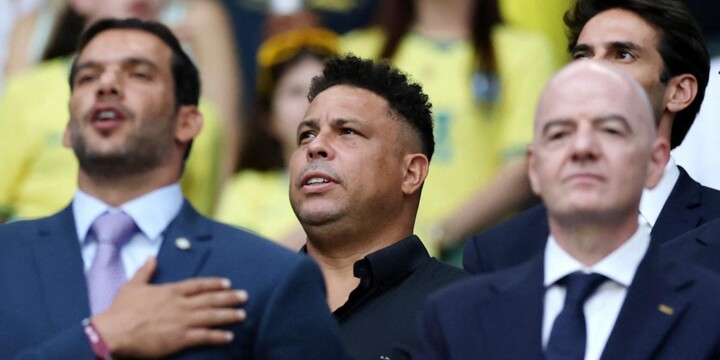
During the World Cup, Brazilian legend Ronaldo gave an exclusive interview to L'Équipe, where he addressed many topics.
On his sudden illness during the 1998 World Cup
Ronaldo said: "Regarding the 1998 incident, all I remember is lying in my room after eating... when I woke up, I was surrounded by the medical team and some teammates. Later, they sent me to a clinic for examination, and the results were taken to Zagallo. Only then did the doctor allow me to play."
Did you feel you could play at that moment?
Ronaldo said: "I insisted on playing! My biggest fear at the time was the world seeing me as someone who backed down at the last minute. I don't regret playing, but I was only 21 years old then, extremely anxious, and felt I was under pressure with no emotional support around me. In the '90s, mental health was still a taboo subject."
Very few players like you changed their playing style after suffering serious injuries. How did you adapt to this change?
Ronaldo: "In the first half of my career, I had incredible physical power—I could sprint at full speed over long distances and then stop suddenly. Obviously, serious injuries forced me to completely change that style. My knees could no longer withstand explosive sprints and extended running. To remain a player who made a difference, I had to rebuild everything."
Ronaldo continued: "I quickly realized that during the first half of my career, I had been training incorrectly, and it cost me dearly. Continued serious injuries and chronic pain forced me to retire early, in 2011 at age 34. But in 2002, I was actually at my most efficient. I could still execute precise acceleration, more accurate shots, and better manage my physical energy."
You were part of Brazil's great tradition of center forwards, with Romário before you and Adriano after. Now Brazil no longer produces this type of striker. How do you explain that?
Ronaldo said: "Football tactics have changed; we can't expect the new generation to completely replicate the playing styles defined by previous generations. For example, modern forwards need to do more off the ball, which fundamentally changes the individual characteristics of the old 'goal machine.' Not to mention the excessive pressure placed on players, which directly affects mental health. However, I must admit that we Brazilians do need to start cultivating and protecting this type of decisive, prolific striker again."
Traducido por IA.
¡El sitio web de AF ya está disponible! Consulta noticias, comentarios, detalles de partidos y estadísticas en tu ordenador. Visita: www.allfootballapp.com
 Brasil
 Ronaldo
 El Mundial
Todos los comentarios (5)
Hoy 05:25
Hoy 05:25
Hoy 05:25
Hoy 05:25
Hoy 05:25