DALLAS, USA, June 28 (Xinhua) -- All group stage matches of the FIFA World Cup in the USA, Canada, and Mexico concluded on June 27. Every World Cup leaves behind statistics—some marking new records, others reflecting team performance. With the advent of the first AI-powered World Cup, some figures are also changing how fans perceive players. Which of these numbers impressed you most?
Records by the Numbers
--3
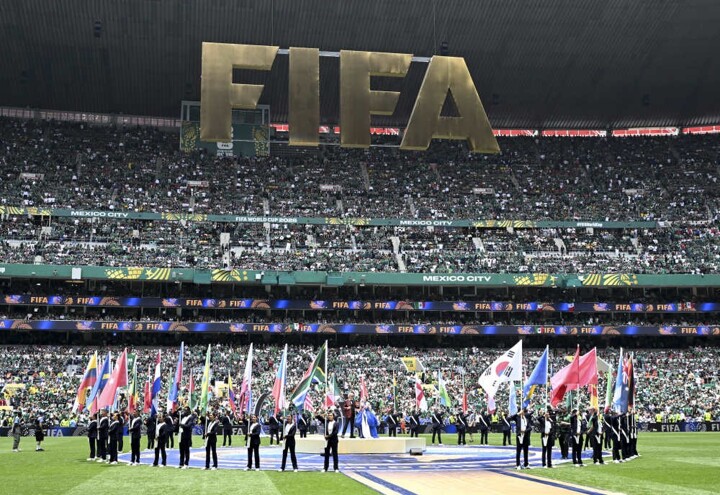
This is the first World Cup jointly hosted by three countries, and the third time Mexico has hosted the tournament, after 1970 and 1986. Mexico City Stadium (formerly Azteca Stadium), which witnessed two generations of "football kings," Pelé and Maradona, reach their peak, became the first stadium to host the World Cup opening match on three occasions.
--215
Across 80 group stage matches of the World Cup, a total of 215 goals were scored. In the 59th match of this World Cup, American player Folau Tostoi scored the tournament's 173rd goal, breaking the all-time record for total goals in a single World Cup. The previous record was 172 goals across 64 matches at the 2022 Qatar World Cup. The average goals per match in the 2022 Qatar World Cup was approximately 2.69, while this tournament reached an average of 2.99 goals per match.
--19
Before this World Cup, Messi had 13 goals in World Cup history. In the group stage's first round, Messi scored three goals, becoming the oldest player to complete a hat-trick in World Cup history at 36 years and 357 days, equaling German legend Klose's record of 16 goals. In the second round of the group stage, Messi scored two goals, moving to the top of the all-time World Cup goalscorer list with 18 goals. In the final group match, Messi, entering as a substitute, scored another goal, extending his record to 19.
--6
Cristiano Ronaldo also set a goalscoring milestone, netting two goals in his second group stage match and becoming the first player in history to score in six consecutive World Cups. He set a new all-time goals record for Portugal in the World Cup with 10 goals. The 41-year-old Portuguese captain also became the oldest player in World Cup history to score two goals in a single match, and the second-oldest goalscorer overall, surpassed only by Cameroonian legend Roger Milla. Ronaldo, alongside Messi and Mexican goalkeeper Ochoa, also became one of only three players in history to participate in six men's World Cups.
--1
Cape Verde, achieving a "small nation miracle," advanced to the knockout stage by finishing second in their group with three draws, becoming the first nation since Slovakia in 2010 to qualify from the group stage on their World Cup debut. With a population of just over 500,000, Cape Verde became the smallest country by area and population to reach the knockout stage in World Cup history.
Additionally, teams such as South Africa, Canada, Bosnia and Herzegovina, Egypt, Côte d'Ivoire, and the Democratic Republic of the Congo also achieved historic advances, qualifying for the World Cup knockout stage for the first time.
--74
On June 24, South Africa defeated South Korea 1-0, advancing to the World Cup knockout stage for the first time in their history. This victory also made South Africa's veteran Belgian coach Hugo Broos the oldest head coach to win a match in World Cup history at 74 years and 75 days.
--426,834
On June 16, a total of 281,223 spectators attended four World Cup matches, breaking the single-day attendance record of 277,070 set in 1994. On June 25, the six matches of the final group stage round pushed the single-day World Cup attendance record to 426,834.
Tactics by the Numbers
Some numbers reveal the tactical styles of different teams.
--10
In this World Cup, the three teams with the most goals are France, the Netherlands, and Germany, each with 10 goals. Among them, the Netherlands was most efficient, taking only 40 shots. France took 48 shots and Germany 53. France had 20 shots from outside the box, Germany 16, while the Netherlands only 9. Notably, France and the Netherlands had expected goals (xG) of just 4.96 and 4.66 respectively, yet both scored 10 goals each, demonstrating that their star players capitalized on low-probability chances.
--26%
During the group stage, Japan had the highest shot efficiency, scoring 7 goals from 9 shots on target out of 27 attempts, with a conversion rate of 26%. Additionally, all 7 of Japan's goals came from assists, highlighting their excellent teamwork and understanding.
--4%
Looking at various offensive statistics, Turkey's performance should be considered decent, ranking second in shots with 70, third in total distance covered, and among the top ten in passes. However, their goalscoring efficiency is genuinely concerning, having scored only 3 goals with a shot conversion rate of just 4%. Of 70 shots, 33 were long-range attempts from outside the box, ranking first—which indirectly reflects Turkey's frustration when unable to break down defenses. This low offensive efficiency led to Turkey's early elimination in the group stage.
--2,191
Unsurprisingly, Spain, known for its "tiki-taka" tactics, became the team with the most passes in the group stage with 2,191 passes, of which 2,013 were successful, achieving a 92% pass completion rate, also ranking first. Spain's 62% possession also led the tournament.
--358,610.48
The total distance covered by the USA team across three matches reached 358,610.48 meters, ranking first among all 48 teams. In several other running-related statistics, the USA ranked first in high-speed running, third in sprints, and fourth in average running speed. This was likely a key factor in the USA team finishing first in their group.
--206
According to the data, Paraguay was the team with the strongest defensive aggression in this World Cup. In "direct defensive pressure applied," a key metric for measuring defensive intensity, Paraguay ranked first with 206, significantly ahead of Ecuador (168) in second place. In the "forcing opponent errors" statistic, Paraguay also ranked second with 150 instances, behind only Egypt (155).
This highly aggressive defense also resulted in Paraguay receiving 7 yellow cards, tied for first with Curaçao. Thanks to their aggressive defensive approach, Paraguay, which scored only 2 goals, successfully advanced and will face the offensively powerful Germany in the knockout stage.
Stars by the Numbers
As the first AI-powered World Cup, FIFA also introduced an official player power ranking for the first time. This ranking was developed by Arsène Wenger, FIFA's Chief of Global Football Development, using official match data and calculated by a football AI algorithm, scoring players across different dimensions such as attacking, creativity, and defense.
--8.37
In attacking rankings, contrary to most expectations, the top spot went to German forward Deniz Undav. He scored 8.37 points, slightly ahead of Messi's 8.33. Undav played a total of 106 minutes across 3 matches, scoring three goals from just 5 shots while providing 2 assists, with a 60% shot conversion rate. His exceptionally high efficiency is the primary reason Undav topped the list.
--8.02
In creativity rankings, French winger Ousmane Dembélé occupied the top spot with 8.02 points. He is also the only player with a creativity score above 8 points. Dembélé had 3 assists across 3 matches, completing 184 passes with an 85% success rate. He was the player with the highest total distance covered for France, reaching 30,215.05 meters. His 156 sprints also ranked first on the team.
--8.12, 7.26
Also noteworthy is French captain Kylian Mbappé, who is the only player ranked in the top five in both attacking and creativity metrics, with 8.12 points in attacking (third place) and 7.26 in creativity (fifth place). Mbappé contributed 4 goals and 2 assists across 3 matches, with 9 shots on target from 16 attempts. His expected goals (xG) was only 1.72, yet he scored 4 goals, demonstrating his individual ability.
--7.30
In defensive rankings, Canadian defender Derek Cornelius, with 7.30 points, surpassed "Ballon d'Or" winner and Spanish midfielder Rodri (7.29 points) to claim the top spot. This was somewhat surprising, but statistics such as winning 13 aerial duels in 251 minutes and an 87% pass completion rate from 124 passes are sufficient to demonstrate his toughness and consistency.
Traducido por IA.
¡El sitio web de AF ya está disponible! Consulta noticias, comentarios, detalles de partidos y estadísticas en tu ordenador. Visita: www.allfootballapp.com
 El Mundial
Todos los comentarios (2)
Hoy 12:37
Hoy 12:36