After leading his team to a 2-1 defeat against England in the Round of 16 at the World Cup and failing to advance, Democratic Republic of Congo coach Dusabre attended the post-match press conference.
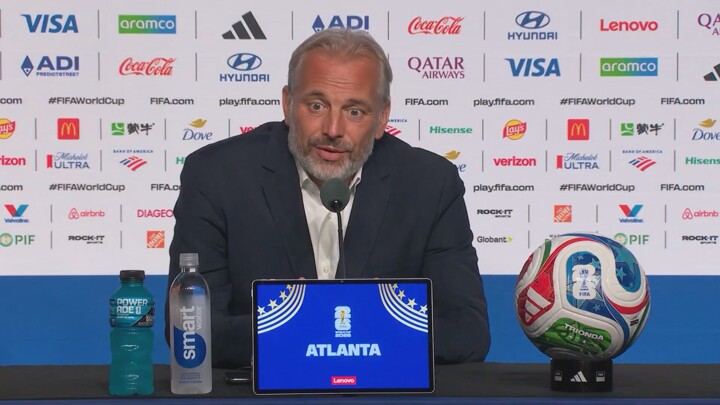
Coach, although your team played very well today, this is obviously a frustrating result. After the final whistle, we saw you all gather in a circle. We saw Cédric Bakambu give a powerful speech, we saw captain Chancel Mbemba speak, and we saw you speak as well. I'd like to know what you told your players after that match, and what you want to say to the 116 million Congolese people around the world who watched your match and were proud of you.
We gathered and I simply thanked them—thanked them for believing in this plan from the beginning and then implementing it successfully at one of the world's greatest tournaments. Although we could be somewhat disappointed with how today's match developed overall, I think we played excellent football, especially in the first half.That's what I told them.
And I think that for our fans and for Congo, when we play for the national team, we have a responsibility to leave something for the world when we depart from this tournament. I believe everyone can see that Congolese football has reached a certain level and also demonstrates great spirit, discipline, and resilience—qualities that perfectly reflect the country we represent.
Coach, first of all, congratulations to the Democratic Republic of Congo on your performance in this tournament. You just spoke about the legacy you're leaving, and I have a question about that. Regarding the match itself, perhaps we missed those final 15 minutes. Can I ask just one question? Fine, I'll get straight to the point. Ultimately, we missed those final 15 minutes—those crucial final 15 minutes. Could your team have done a better job maintaining the result against England?
I don't know if it was possible, but we certainly would have liked to. We tried, we tried by bringing on fresh players. Today we... As a coach, the first thing I analyze is the football itself. Tactically, we used our three formations very well in this tournament—whether the 4-3-3, 3-5-2, or 4-4-2. These are the tactical systems we've been working with for four years. I think they worked very well, especially in our offensive organization in the first half.
But after that, we must also admit that we gave the opposition some chances. And we made England doubt themselves—they had to rely on perhaps one of the world's best strikers to score goals. This is often what happens when you face such a strong national team.
So we did what we needed to do, and I believe throughout the tournament, we weren't far from reaching 100% of our level. For us, this was already a victory in itself. It also shows some of our young players that they have a long road ahead, and they've made a good start. They've all gained valuable experience, and this is the first World Cup for all of them—both staff and players. That's why we must affirm their progress and congratulate my players.
Now that you've faced England, played against them, and seen their performance firsthand, based on what you've observed, where do you think they stand among the favorites to win this World Cup?
I don't know. Normally I focus on my own team. We saw that we could cause them problems, but they also know how to respond, and that's the mark of strong teams, great teams. So today's result is what everyone saw. Therefore, we should congratulate our opponents and wish them luck in the upcoming matches. As for what they lack or where they performed well, I think their coaching staff will analyze that.
Good evening, Coach. First, congratulations to our team on your performance, because no one had high hopes for us before, but you said before this match that we had nothing to lose. Seeing your team's performance today, do you feel more proud or more disappointed now?
Yes, leaving an extraordinary tournament like the World Cup, of course we are disappointed. So first and foremost, we are disappointed. But, as I said, I believe we did what we needed to do at this World Cup. We scored five goals; unfortunately, we also conceded five. But overall, we still competed well against four teams that are clearly above us in the FIFA rankings.
Hi, Thomas Tuchel sat here yesterday and said he thought you'd play with a five-man defense and use defensive counter-attacks, but in fact you played with a four-man defense and played very exciting possession-based, passing football at the start. Why did you decide to adopt this style of play? Was there a particular match that inspired you to use this formation?
Yes, we wanted—when we had possession—to stretch the width of the pitch, which is one of the reasons we played with a four-man defense and positioned our midfielders near the sideline. It was to create space. We knew we had a very technical player in midfield, so we would have possession; that's one reason.
The other reason was to better control the midfield and cut off England's connection through Anderson. He was very influential in England's offensive organization, so we decided to have our forwards press him, similar to how Jordan Ayew was used by Ghana. So that's it, that's the choice we made.
At this point, the Congolese Football Federation's press officer announced that Dusabre had just lost his father: "Thank you, but we also want to announce that the coach has just lost his father, so we extend our deepest condolences to him."
Traducido por IA.
¡El sitio web de AF ya está disponible! Consulta noticias, comentarios, detalles de partidos y estadísticas en tu ordenador. Visita: www.allfootballapp.com
 RD Congo
 Nottingham Forest
 Inglaterra
 Bayern München
 Harry Kane
 Elliot Anderson
 Sébastien Desabre
 El Mundial
Todos los comentarios