According to The Sun, Carrick has insisted that Manchester United's start to the season isn't bad, much like Solskjaer once did.
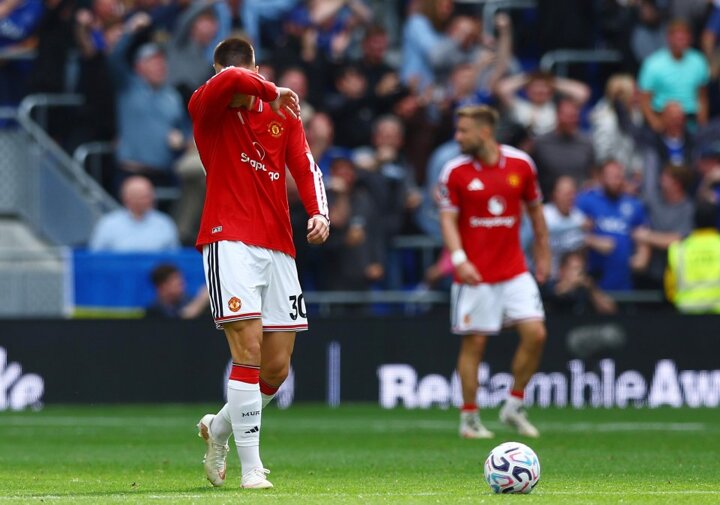
Carrick has stressed that Manchester United's beginning to the season is "not bad," but the evidence suggests otherwise.
In an interview before Everton, Carrick claimed that Manchester United's start wasn't "bad." No one had used that word, but Carrick interrupted the journalist anyway, who had pointed out that Manchester United had collected only four points from matches against Hull City, Ipswich, and Everton.
Carrick's interjection seemed to reveal his true thoughts: he didn't believe Manchester United had made a good start to the season.
When the fixtures were announced, Hull City and Ipswich—both newly promoted—were considered opponents Manchester United would almost certainly beat. Beyond the two promoted sides, Everton was also mired in mounting tensions between ownership and supporters ahead of the match, with the club's transfer deadline day activity chaotic.
Moyes had barely enough personnel to field a complete team. Everton was so chaotic at one point they even attempted to sign Zirkzee.
Despite this, Everton remained more aggressive in attack than Manchester United. They created the best first-half chances and had twice as many shots on target as Manchester United.
Beyond the results, Carrick's press conferences have also been concerning. Sir Alex Ferguson once said he had to manage two matches a week: a football match and a press conference. Carrick clearly doesn't share that view.
Carrick rarely says anything memorable and seldom gives direct answers.
No one questions his character. Carrick is as genuine as he was as a player, which is one reason Manchester United's leadership values him—he's the polar opposite of Amorim, especially when a microphone is placed in front of him.
This approach worked last season, when Manchester United won 12 of 17 matches and lost only 2. It was always assumed he would adjust once Manchester United hit a rough patch, but he hasn't.
Last Friday, Carrick was asked a relatively straightforward question: will Manchester United strengthen their defence next summer?
Carrick replied: "Things aren't always that simple."
Fans don't want to hear that, and neither do journalists. Such evasiveness recalls Solskjaer.
Manchester United has been here before. In 2018, a stubborn Portuguese manager clashed with club leadership and was subsequently replaced by a club legend who was delighted to get the job.
Blind obedience didn't take Solskjaer far, and his tenure ultimately ended without a trophy.
Carrick and Solskjaer are close. They were teammates and later coached together for nearly three years, and even competed for the Manchester United manager's role in January.
Between them, they accumulated 23 years of experience as Manchester United players, so they see things the same way. But that may not deliver the success Manchester United needs now.
Solskjaer's greatest frustration at a press conference came when reminded that Robin van Persie had mentioned in January 2020 that Solskjaer always smiled after losing to Arsenal.
Carrick is slightly different. When it was suggested that Middlesbrough supporters would be surprised by his record at Manchester United last season, he grew somewhat defensive: "We won quite a few matches."
This season, Carrick was mildly irritated when Jan Aage Fjørtoft highlighted the lack of "passion" in Manchester United's opening defeat to Hull City. Subsequently, when a journalist described the team's performance as "passive," Carrick disagreed with that too.
Manchester United was indeed too passive. They only began attacking actively in the second half, after Everton equalized. The team only reacted after being provoked, and that must change.
Carrick's press conferences must change as well. For weeks, he has repeated that he "never said" things nobody was accusing him of saying.
Carrick once stated: "In terms of our financial situation and what we can do, that's how it is." When Manchester United's financial constraints were raised again during the transfer window, Carrick emphasized that he hadn't used the word "restrictions." It's a cautious response from a cautious person.
Carrick sometimes needs to protect himself first. Manchester United wanted a defender this summer, specifically a left-back, but ultimately didn't sign one. He can't be blamed for that.
Manchester United's defensive problems should be primarily attributed to current leadership. Manchester United signed Yoro, de Ligt, and Mazraoui under the Ineos era, renewed Maguire's contract, and brought in several other defenders.
No one expects Carrick to completely let loose and question his superiors. But when he proactively states that Manchester United's start isn't "bad," he's actually putting himself in the firing line.
Solskjaer never deflected blame onto others. Pogba and his late agent Raiola constantly undermined his authority, and Solskjaer's description of Pogba as having a "good heart" likely only emboldened them further.
Manchester United players found Solskjaer too easy-going. Long after leaving Manchester United, Solskjaer admitted the dressing room was full of "fragile egos."
During a training camp in Ireland last month, Carrick briefly displayed a firmer tone. When discussing the need for more signings, he used words like "push" or "push hard" eight times.
Carrick had barely faced the media for three months before that, leaving several questions unanswered. It was his best performance since taking over Manchester United on January 13. In the more relaxed environment of Carton House, he also appeared more at ease, despite Amazon's cameras being present.
Since then, Carrick has reverted to his old habits, just as Manchester United has. That's a bad sign.
Traduit par IA.
Le site web d'AF est désormais en ligne ! Actualités complètes, commentaires, détails des matchs et statistiques sur votre ordinateur. Visitez : www.allfootballapp.com
 Manchester United
 Michael Carrick
 Ole Gunnar Solskjaer
Todos los comentarios