On August 22, 2024, in the opening round of the Premier League, a shock result emerged: Hull City defeated Manchester United 2-0 at home. The Athletic's reporter Liam Twomey wrote an article providing a detailed tactical analysis of Hull City's victory over Manchester United.
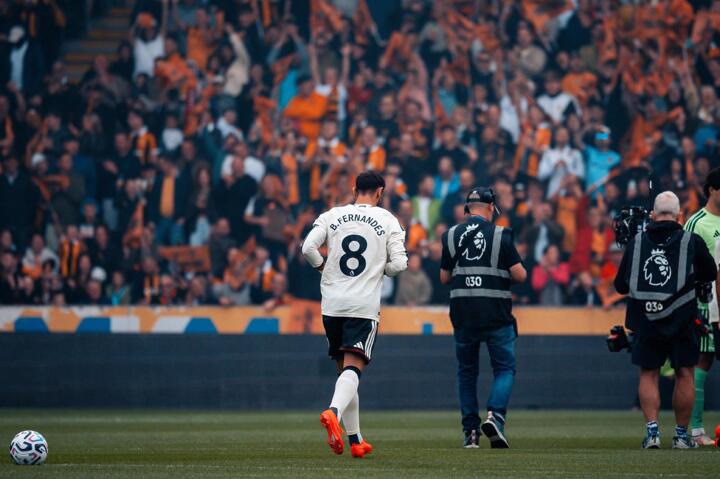
As one of the opening weekend's biggest surprises, Hull City's home victory over Manchester United, who finished second last season, was thoroughly convincing.
Hull City had already led 2-0 by the 38th minute and controlled the match comfortably in the second half, securing a dominant win. For the Championship playoff winners facing Manchester United, such a start was remarkable. Notably, according to Transfermarkt's market value assessment, Hull City possess the lowest-valued squad in the entire Premier League.
The term "tactical masterclass" is often overused, but Sergei Yakirovic's game plan and his team's execution on the pitch clearly achieved its intended effect.
First, let's examine the formation. Although Hull City possessed the ball for just 29% of the match, they maintained a 5-4-1 shape when defending. The three-man defense comprising Semir Adjei, John Egan, and Mohamed Balogun was extremely effective in aerial duels and box defense, forcing Manchester United to push more play down the flanks.
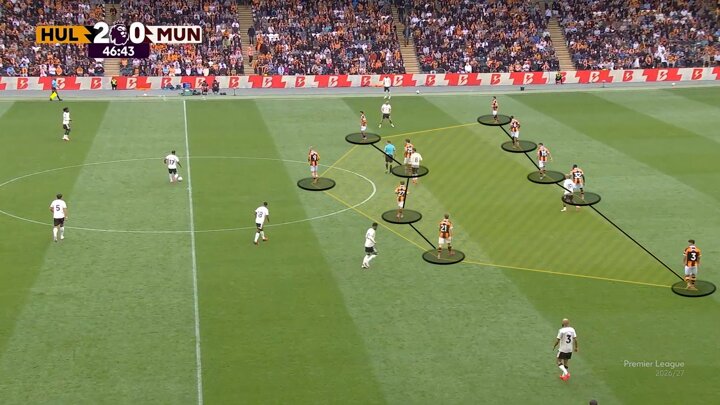
Why choose a five-defender formation? Yakirovik explained at the post-match press conference: "Because Manchester United pressed high, especially their left-back Luke Shaw. Additionally, they tried to create midfield overloads. Our main task was to block those gaps between the lines."
Last season, Hull City primarily used a 4-2-3-1 formation, finishing sixth, 11 points off the playoff places. However, they occasionally switched to 3-4-3 or 3-5-2, including in the playoff final against Middlesbrough at Wembley. Hull City subsequently returned to the Premier League after a 10-year absence.
In this match, Hull City made it difficult for Matheus Cunha to receive the ball, creating significant problems for Manchester United. As a false nine in Manchester United's 4-2-3-1, he was essential for linking play and activating their wingers. Manchester United's most dangerous first-half attacks, orchestrated by Michael Carrick (captain), involved long balls to wingers Patrick Dorgu and Bryan Mbeumo. However, Hull City had both numerical superiority and a height advantage in defense, perfectly suited to countering this style of attack.
A key detail: particularly after Marcus Rashford replaced Dorgu as left winger in the second half, Hull City's back five remained high. They didn't drop too deep too early, preventing Manchester United from pinning them deep in their own box. Rashford made several forward runs, but poor timing on passes or runs meant he never created a clear chance.
Later, after Cody Drameh replaced right wing-back Lewis Coyle, Hull City maintained their defensive line and successfully caught Rashford offside on multiple occasions.
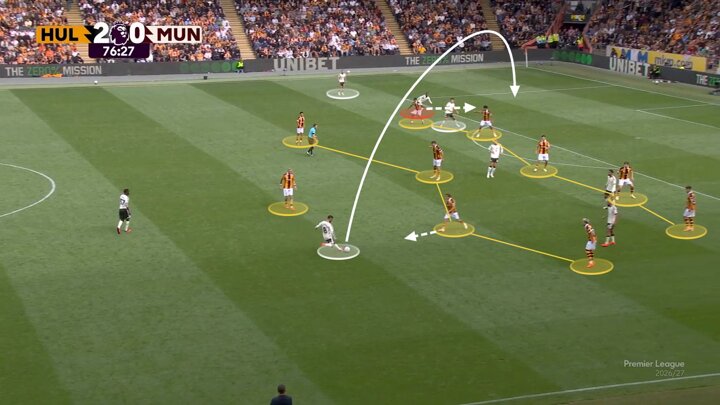
Coyle said in his post-match TNT Sports interview: "We knew exactly what we needed to do with our deep defense, and our training paid off. You have to do this against top teams." He also highlighted Oliver McBurnie's defensive contribution—the Scottish striker marked Manchester United's defensive midfielder Santos tightly throughout, cutting off passing lanes.
On Manchester United's half, Hull City pressed aggressively several times, especially after set pieces. They employed man-to-man marking, with midfielders Regan Slater and Matt Crooks tightly marking their direct opponents. Manchester United's new midfielders Youri Tielemans and Santos were substituted on 67 minutes, demonstrating how effectively Hull City had restricted them.

Manchester United's struggles against stubborn defensive teams are not a new problem since Michael Carrick (captain) took over. From Matchday 22 last season (Carrick's first league match), Manchester United won 12 games but dropped points in 5 matches: draws away to Bournemouth, West Ham, and Sunderland, plus defeats to Newcastle (2-1) and Leeds (1-2). Strictly speaking, these opponents wouldn't be considered elite.
This match clearly demonstrated what happens to Manchester United's play when opponents defend well and Bruno Fernandes can't perform at his level. Manchester United lacked a tactical alternative plan and looked helpless except for bringing on Benjamin Sesko and repeatedly crossing to him. Carrick acknowledged after the match: "We really struggled when facing teams with different systems, and we must find solutions."
However, Hull City's performance also deserves praise. They transitioned from patient 5-4-1 defense to aggressive pressing the moment the opponent regained possession, recording 17 tackles throughout the match and winning the majority of ground and aerial duels.
Yakirovik stated: "After we win the ball, we move forward very directly and quickly. In transitions, we try to switch play to the other side because our wing-backs are completely free, giving us a numerical advantage in their box." Hull City displayed these characteristics throughout last season as well.
The 14th-minute attack provides a perfect example: after winger Elliott Stroud won an aerial duel against Noussair Mazraoui, Hull City exploited the 5-on-4 advantage created by their wing-back system to launch an attack. With Mazraoui out of position, left wing-back Ryan Giles, receiving a pass from McBurnie, quickly burst into the vacated space.
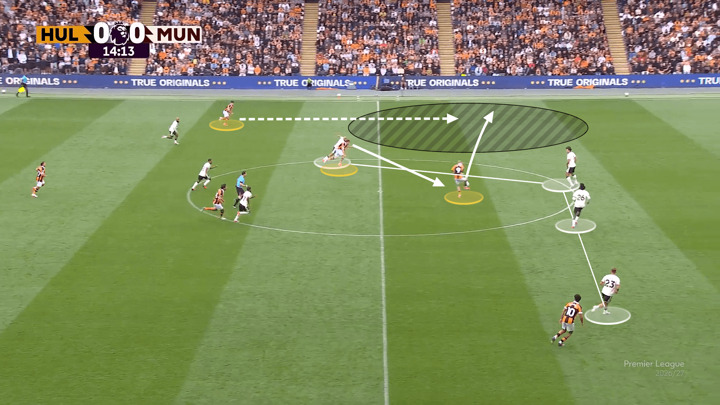
Hull City players in orange and black then flooded forward, creating a 2-on-1 opportunity for Giles and three teammates. Giles found McBurnie, whose header forced Manchester United goalkeeper Altay Bayindir to make a brilliant save.
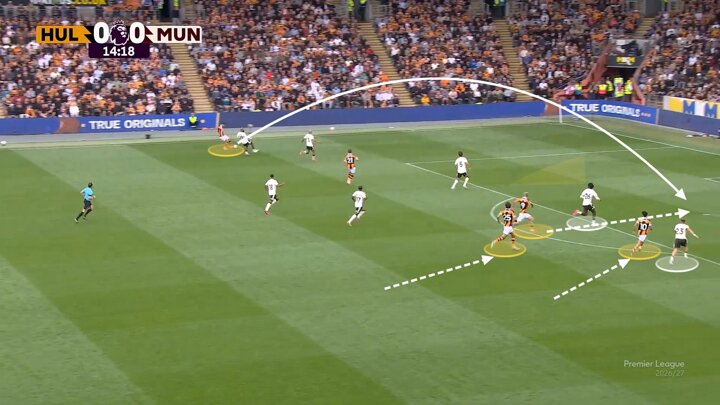
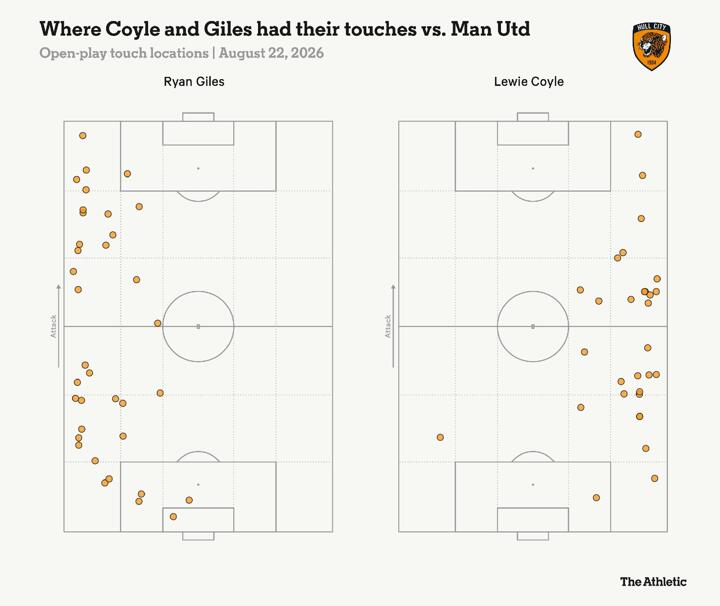
Giles delivered 8 crosses and made 4 clearances, performing excellently in both attack and defense. Coyle, meanwhile, frequently pushed forward as well, creating serious problems for Luke Shaw.
Hull City repeatedly attacked down the flanks and maintained pressure, eventually taking the lead in the 17th minute, which was highly indicative of their approach. The goal contained all the key elements mentioned earlier: Slater's corner came to the near post, John Egan flicked it on with his head, and McBurnie swept it in at the far post. McBurnie thought he'd scored; although Bayindir blocked the shot, Semir Adjei quickly followed up to secure Hull City's 1-0 lead.
In many respects, Yakirovik has built a modern Premier League team: strong from set pieces, dominant in physical battles, direct in attack, efficient in transitions, and tactically flexible enough to adapt.
They also possess excellent technical and tactical ability. The second goal came from a Slater free kick, with Balogun heading it in. Earlier, Mohamed Balogun had threaded a through ball between Tielemans's legs at the edge of the box, and the Manchester United midfielder fouled him, giving Hull City a central free-kick opportunity.
The season is long, but it's worth noting that West Ham, fighting for survival in 2024-25, finished 18th with 39 points, the highest point total for a relegated team in 15 years. Hull City have a long road ahead, but their performance and result in this match proved they're capable of establishing themselves in the Premier League. Meanwhile, Michael Carrick's Manchester United face a reality check: can they truly break down defensively organized opponents?
Переведено ИИ.
Сайт AF теперь доступен! Читайте полные новости, комментарии, детали матчей и статистику на компьютере. Посетите: www.allfootballapp.com
 Manchester United
 Hull City
 Michael Carrick
 John Egan
 Luke Shaw
 Semi Ajayi
 Bruno Fernandes
 Youri Tielemans
 Oli McBurnie
 Noussair Mazraoui
 Lewie Coyle
 Marcus Rashford
 Regan Slater
 Matheus Cunha
 Senne Lammens
 Bryan Mbeumo
 Konstantinos Tzolakis
 Ryan Giles
 Andrey Santos
 Nobel Mendy
Tous les commentaires