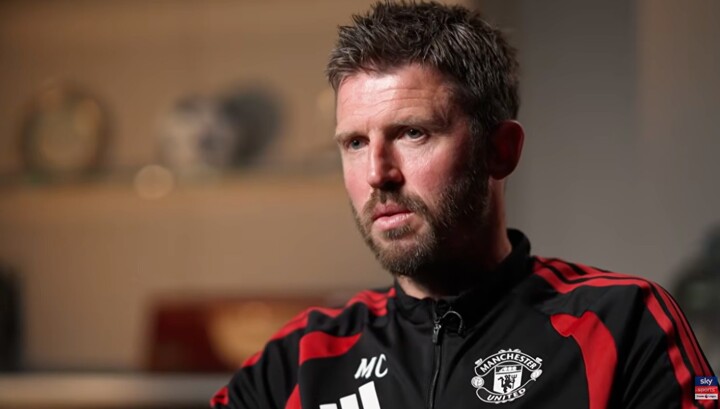
Manchester United manager Carrick was interviewed by Sky Sports. In the Unpacked series, he answered 15 questions about a Premier League manager's day-to-day work, discussing team talks during breaks, training schedule arrangements, pre-match preparation, relationships with players and staff, and how midweek matches affect training plans, among other topics. This article is the second part of that interview.
Do you still participate in team training now? If so, do you ever step into your old playing position?
Carrick: No. Honestly, I don't miss playing football that much, and I don't have a strong urge to get involved in training. There might be occasional moments when I need to participate, but basically not now. Either way, too much time has passed. It's not like the first or second year after retirement, when I might still have been able to manage it.
But I think people need to move forward and do what their current role requires. The players also don't want me constantly hanging around them, insisting on getting involved, and then telling them: "Lads, this is how we used to do it back then, you should play like this." I don't think that would be effective. So I'm very clear about my role now—it's completely different from before—and I'm very comfortable in this position.
On the training ground, does the head coach have the final say on what players eat?
Carrick: In this regard, many people are far more professional than I am. What's best for players to eat, when to eat, and how much each person should eat—all of this is tailored to each player's specific situation to find what works best for everyone. On nutrition, we have nutritionists, chefs, and an entire kitchen team. I think the service they provide to the players is excellent.
So I certainly wouldn't interfere in these matters. I think it's also part of people management—not getting involved in everything, but rather trusting each other and learning to hand things over to others, trusting that they can do their job well. Because in their respective fields, they know far more than I do.
Is ketchup allowed here?
Carrick: Yes, it's allowed. I don't think it's a problem.
Before the start of a new season, do you have one-on-one conversations with each player individually?
Carrick: I wouldn't say I have to have one-on-one conversations with everyone, no. I'm still relatively flexible and will decide what to do based on what's needed at different times. Sometimes it's a team meeting, sometimes I'll speak with someone individually. But from a team perspective, I think it's important for everyone to sit down and clarify what we're going to do next.
It's not always about setting targets for how many points we should get, but rather making sure everyone understands what kind of team we want to be and what we can achieve. I think all of this is very important.
When do you and the coaching staff usually start planning preseason preparation?
Carrick: A lot of planning happens months in advance, and some things are even planned almost a year ahead, like where to go, what matches to arrange, or where to tour. It doesn't feel like long ago, but when you think about it, it's actually quite a while. Many preseason matches used to be played locally, but now teams travel all over the world. So a lot of the arrangements depend on what the tour looks like and exactly where we're going.
But as for what kind of team you want during training, how training sessions are structured, what areas you want to work on, and what you want the players to experience and accomplish throughout preseason preparation—that's usually planned at the end of the previous season. So in the summer, there isn't actually much that needs to be done in a short time, because basically everything is already arranged beforehand.
Do you usually have a fixed routine the night before a match?
Carrick: Actually, I don't have a fixed routine the night before a match. Sometimes I'm at home. When I'm at home, I used to be basically the kids' taxi driver. Now my daughter drives herself, so I have one less job. But while I'm at home, I'm basically a dad, trying to switch off from work. If we're away and staying in a hotel, I'll have dinner with staff and players, and then have some quiet time to myself.
I think by the night before a match, our work is basically done. We'll have another meeting the next day, but I think it's good to be able to truly step away from work at certain points, and that time is mine.
On match day, who is responsible for making sure all players board the team bus on time?
Carrick: Acar is our team operations manager and is also responsible for team organization and coordination. I'm very pleased to have him on the team because he helps arrange many things, so I don't have to handle much myself. He oversees all sorts of matters, and I have to say he does an excellent job with this.
What do you usually do on the team bus?
Carrick: Actually, nothing too exciting. I might listen to some music, but most of the time, we coaches sit downstairs on the bus, gathered around a table chatting. Sometimes we'll talk about the match, but you know what we're like as a staff—sometimes we might talk about things completely unrelated to football. Everyone just chats casually, letting their minds temporarily escape from football, because you usually spend too much time thinking about football.
By that point, most of the preparation is actually already done. When we arrive at the stadium, we then look at information like both teams' lineups. So sometimes, on the bus, it's really just a process of relaxing a bit and temporarily stepping away from the match.
If there's a midweek match, how do you adjust your training schedule?
Carrick: This might be one thing that people outside the game don't fully realize, but midweek matches have a very significant impact on the full week's schedule. This includes how rest days are arranged—but it's not just about rest days; more importantly, it's about what kind of training, how long to train, who participates in training, and what each individual can do specifically.
Can they train on the pitch, do they need recovery work, can they only participate in part of the training session; who has just played, who needs a bit of extra work; who will play in the next match, and who might play in the match after that. So sometimes, you actually create individual arrangements for every player across the entire squad, so that everyone's physical condition can be maintained in the appropriate range.
Related reading:
Diterjemahkan oleh AI.
Situs web AF kini hadir! Lihat berita lengkap, komentar, detail pertandingan, dan statistik di komputer Anda. Kunjungi: www.allfootballapp.com
 Manchester United
 Michael Carrick
Tous les commentaires