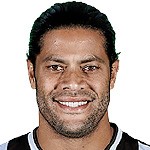
Brazilian striker Hulk was a guest on Romário's show, where he had a lengthy conversation with Romário. In this interview, Hulk discussed his playing experiences in Japan, Porto, Zenit, China, and Atlético Mineiro. This is the first part of the exclusive interview.
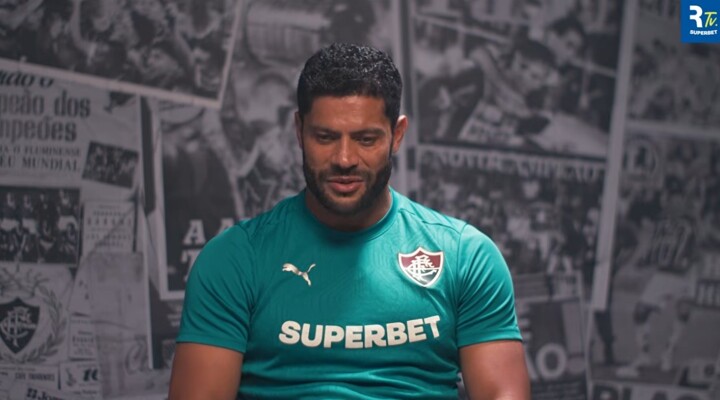
My friend, I'm pleased you could join us. Let me start by asking: you left Brazil very young to play in Japan. How did you adapt at that time?
For me, it was genuinely very daunting at the time. My career was just beginning, and I didn't even speak Portuguese very well yet, and I was going to Japan. But once I got there, I felt very positive about it. That country gave me everything I needed, and I adapted quickly. For me at that time, the experience was very good.
Does Japanese football resemble European football more, or Brazilian football?
I think the technical level of Brazilian football is already very high now. It wasn't like that before—we had more space to play, so there was a lot of transition between attack and defense. When I arrived in Japan, their matches had a lot of transition too. So compared to European football, there are still differences.
Did your experience in Japan help you better handle the pressure of playing in Europe? Were you more relaxed and calm when you arrived in Europe?
I think when we arrive in Europe, we tend to be calmer. I think it's different from our own country; there's more pressure playing in Brazil. Especially when you leave Brazil very young, I often say that once you're there, you receive full support from the coaching staff, and they help you adapt. I joined Porto in 2008, and the manager at that time was Jesualdo Ferreira. He helped me a lot and made things much easier for me.
You won 11 titles in 5 years at Porto. Do you think that was the best period of your career?
I think that even if it wasn't the best period, it was certainly one of the best. We won the Europa League and the Primeira Liga unbeaten. I also received my first call-up to the Brazilian national team in 2009. So it was a very special period. I think it may have indeed been one of the best periods of my career.
You must have worked with many Portuguese coaches. These Portuguese coaches have indeed entered our football in great numbers, particularly Brazilian football. There's also Mourinho, who is one of the most famous among them. Do you think there's a difference between Portuguese coaches and our coaches?
I don't think so. I think each one has their own way of reading the game, and different philosophies and coaching styles. I think it's more a matter of the times.
There was a time when Brazilian coaches were very popular. Vanderlei Luxemburgo coached Real Madrid, and Luiz Felipe Scolari was also a highly respected coach who coached Chelsea and went to many places around the world. When Argentina won the World Cup, many Argentine coaches also began to stand out.
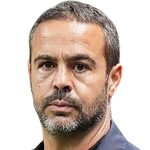
And now, I think Portuguese coaches are indeed very prominent, especially in Brazilian football. I think this is linked to their achievements. For example, Abel Ferreira won important titles after coming here. And also the coach now at Cruzeiro, who previously coached Botafogo and won the Copa Libertadores—I can't remember his name right now.
Artur Jorge.
Jorge, yes, Artur Jorge. So these achievements bring credibility to Portuguese coaches and also increase their value. I think now is the moment when Portuguese coaches are valued in Brazilian football.
They're indeed very popular now.
Yes, very popular. Very popular, really very popular.
After Mourinho left to coach in England, did he ever consider taking you there? Why didn't that ultimately happen?
I was at Porto for four years, and almost every transfer window, there was an opportunity to move to England, but Porto always kept me. They didn't want to sell me—they simply didn't want to sell. During the 2010/11 season, we won the Europa League, won the Primeira Liga unbeaten, and won almost everything. That year was truly incredible.
After that, Porto sold Radamel Falcao to Atlético Madrid, and then received an offer for me from Manchester City. If they had sold me at that moment, the offer was €60 million. I only found out about it later.
But Porto said they wouldn't sell me. They wouldn't sell because they had just sold Radamel Falcao and didn't need to raise more money by selling players.
The following year, I remember André Villas-Boas went to... was it from Chelsea to Tottenham, or to Chelsea?
Chelsea.
Yes, it was Chelsea. He wanted to sign João Moutinho and James Rodríguez at that time, if I remember correctly.
No, it was João Moutinho and Álvaro Pereira.
Yes, I believe that's correct. Anyway, he ultimately failed to recruit them. Then the European transfer window closed. And at that point, the only player who received an offer from Russian football was me. The European window had already closed, but in Russia, there was about a week left.
I received an offer from Zenit. At that time, I seriously considered this option because I had already negotiated a contract extension with Porto, and I also knew that the club had rejected an offer for me to go to England the previous year.
So I thought: "My friend, I think it's time to leave now." I could still play in the Champions League and go to a completely different league. Of course, I had originally had the opportunity to play in England.
When you went to Russia, was that market very attractive in all respects at that time? Not just economically. Was Russian football also beginning to attract more attention in Europe at that moment?
I think so. Because they invested a lot of money at that time. For example, they also signed Belgian player Axel Witsel, and many other famous players. Samuel Eto'o also went to Russia, so there were indeed many big names going there at that moment.
At the same time, we could also play in the Champions League, and Zenit was also a very strong team at that time. So these factors weighed heavily, and it wasn't just for economic reasons.
Did you experience racism in Russia? How did you handle that situation at the time?
It was very difficult, really difficult. Because when I arrived in Russia, a certain jealousy began to appear in the dressing room. The local Russian players were somewhat resistant to our arrival because of the salaries of Axel Witsel and mine, and our transfer fees.
So it started to create an uncomfortable atmosphere in the dressing room. I even offered to leave, but the president didn't allow it.
In some matches, opposing supporters also targeted me, chanting racist chants. That period was really difficult, and I suffered a lot. Later, I prayed to God, hoping he would give me enough wisdom to know how to handle the situation.
Later, something happened that even surprised me a bit. Once, I went to take a corner, and the supporters started doing that again. But for some reason, I suddenly started blowing kisses to the stands and laughing.
Did this kind of thing happen elsewhere later? Or did it never happen again after experiencing racism in Russia? That is, was it mainly during that period in Russia?
That time in Russia was the last. I experienced it once in Portugal too, but I didn't even hear it myself at that time; I only found out later by watching the video. I believe it was even in a match where I scored. But after leaving Russia, it never happened again.
Traduit par IA.
Le site web d'AF est désormais en ligne ! Actualités complètes, commentaires, détails des matchs et statistiques sur votre ordinateur. Visitez : www.allfootballapp.com
 Cruzeiro
 Fluminense
 Manchester City
 Japon
Japon
 FC Porto
 Zenit
Zenit
 Hulk
Hulk
 Artur Jorge
Tous les commentaires