According to AS, Mourinho experimented with Bernardo Silva and Güler in defensive midfield, but the results were disappointing.
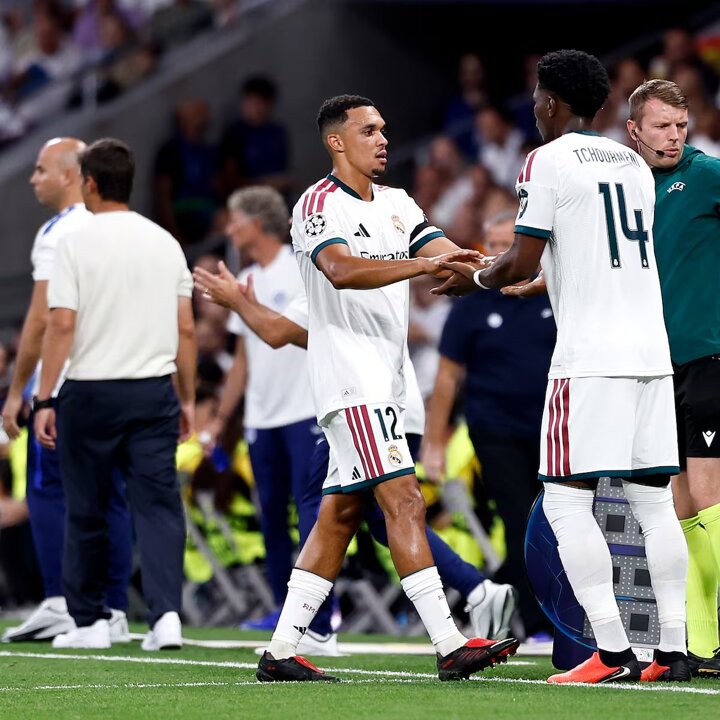
Top-level football often punishes such innovations, especially against Inter Milan, and provides little encouragement to continue using Bernardo Silva or Güler as defensive midfielders.
The defensive midfield position is currently in the spotlight. The Spanish national team, Barcelona, and Rodri—who won the Ballon d'Or and is openly discussing his future this summer—have made this position and its tactical importance a hot topic. Atlético Madrid has also joined the conversation due to Koke's contract renewal. For Real Madrid, the pursuit of Tchouaméni, pride in Valverde's return to form, and various experiments stemming from injuries and Camavinga's inconsistent performances at the start of this season have kept the topic prominent. Mourinho, searching for an emergency solution, has tried using Bernardo Silva, Arda Güler, and even Trent in this position. He is aware that these players have different responsibilities and that young players are still developing. The results were roughly as expected: not everyone can play defensive midfield. Standing in this position requires countless strengths and virtually no obvious weaknesses. The very definition of a midfielder demands this: "A team member whose main task is to stop the opponent's progress in midfield and assist in both defense and attack." This sounds simple, but it is difficult in practice. Take Trent, for example; his trial as a defensive midfielder against Inter Milan was unsuccessful, despite his excellent footwork and impressive physical condition. He did not score or provide assists as usual. Only one of his four crosses was accurate. He lost the ball 7 times out of 35 touches, some dangerously, with an 83% pass success rate, only 11 touches in the opponent's half, and contributed 2 tackles and 3 dribbles. There was no indication he ventured near the opponent's penalty area. A few days later, Bernardo Silva's appearance led to his subsequent removal from the starting lineup. As for Güler, he too paid the price earlier for a passing error in that "Kroos territory." Such experiments remind us not to force players into mistakes on this path, but to return to natural defensive midfielders. At the same time, they remind the Portuguese coach that this commanding position carries significant responsibility. His assistant, Miguel Porlán Noguera, could easily offer a masterclass on this. In the 1980s, when La Liga was dominated by Real Madrid's golden era, a bold coach pushed a legendary right-back to central midfield. Although the defender temporarily filled this position twice and performed calmly, the experiment was quickly halted. Dressing room leaders advised the Welsh coach to stop experimenting. The corrected result was: another league title and 107 goals scored.
Bernd Schuster knows well what it means for a coach to move a player to a different position. He proved that the midfield profession belongs to only a few people, because achieving the perfect versatility of Stones, Lahm, or Kimmich is not easy: "This is a very interesting topic. I played midfield in Germany, at Real Madrid, and finally at Leverkusen, but was sometimes asked to play sweeper. Also for the national team, because after legends like Beckenbauer retired, people wanted to find a new Kaiser, though Uli Stielike actually did better in that regard. In the league, Toshack tried for a while. All coaches have the same idea: to play the ball more systematically from the back. In my era, the style of play like Milla, Guardiola, and Busquets was not common; everyone mostly played long balls and then fought for second balls."
"The difference between playing different positions is huge," Schuster admitted. He also explained why: "If you are a midfielder and have played center-back before, you will initially be more lost until you gradually adapt. You need to accumulate game experience. You have to touch the ball twice as much, and you cannot lose it. You must have broader vision; everyone will look for you the way they look for Redondo. You receive more stimuli, you have to filter passes, organize distribution, push forward into the box. Center-back is completely different—you always face the situation directly. Defensive midfield is with your back to goal, and even if you are as talented as Ramos or Trent, this is difficult. Of course, it is worse to be a defensive midfielder and then switch to center-back. I have encountered this situation. No one is behind you; you have to be tough enough because you cannot lose challenges, and for me, I was not fast enough to catch up with opponents. Not everyone can perform equally well in both positions."
This century, only Beckham successfully transitioned to a position in front of the defensive midfielder at Real Madrid, aided by his determination—he was first moved wide by Capello, then removed from the squad. Since then, such attempts have been costly. Some results have already shown this, and more importantly, most players have not truly established themselves in their new roles. Sergio Ramos lasted only a brief time as a central midfielder, despite the club's widespread attempts. Luxemburgo was the first to try this "magic square," which was eventually completely dismantled. López Caro also kept trying until stopped. Even Ancelotti, during his first spell at Real Madrid, saw Ramos as the team's brain, but the club could neither buy nor develop such a player.
Mourinho also witnessed how his decision to place Pepe in midfield during a Champions League Clásico disrupted the team's rhythm and further agitated observers as part of his obsessive plan to restrict Messi. This bold adjustment had already been leaked to the media hours earlier. He also used Albiol at times because the latter had also been an organizer in the past. However, "the Special One" did not give up. He later tried a similar approach at Chelsea, placing Kurt Zouma in central midfield to restrict Fellaini. So the old saying holds true: if there's a first time, there will be a second and third time. Given the opportunity, Huijsen will always emerge amid various speculations. Now it remains to be seen whether this experiment will bear fruit as expected or at least spark discussion. Will the award even recognize this idea with a Ballon d'Or one day? Only Spain's 2024 leader, Sammer (1996), and Matthäus (1990) have won the Ballon d'Or in this position, because Modrić (2018) and Nedvěd (2003), although they also stood on that "line," actually belonged to a different, more attacking type of midfielder. At Real Madrid, there are also many examples to draw from, such as Sanchís; these encourage continued experimentation. Nevertheless, the more common route is the opposite: stepping back from midfield to defense. Hierro did this, and Illgner followed suit (he once said, "I will prove myself as a midfielder," but eventually returned to his original position). From Casemiro to Tchouaméni, they are all attempting this transition. And Tchouaméni is now ready, like Pitac, to end the uncertainty brought by these experiments.
Alfredo Di Stéfano remains the primary role model worth referencing daily; he played almost every position, including midfield. In a 1949 match between River Plate and Boca, he even wore a goalkeeper's jersey and kept a clean sheet while filling in for an injured keeper. Pirri still stands as an exemplary figure; he earned honors as a player, then technical secretary, and later doctor. This decorated individual played 562 games for Real Madrid, sometimes scoring directly from attacking midfield by rushing forward, scoring like a true number nine on another occasion, standing in front of Zoco or Camacho as an organizer, or playing like a sweeper or center-back. He was, is, and always will be the best example. The same applies to Tchouaméni and his successors.
AF's PC site is now live! Browse full news, comments, match details and stats on your computer. Visit: www.allfootballapp.com
 Real Madrid
 José Mourinho
 Bernardo Silva
 Arda Güler
Tous les commentaires (4)