Beijing time (CEST) June 30, 04:30, World Cup knockout stage, Germany vs Paraguay. Before the match, Havertz and head coach Nagelsmann attended a press conference.
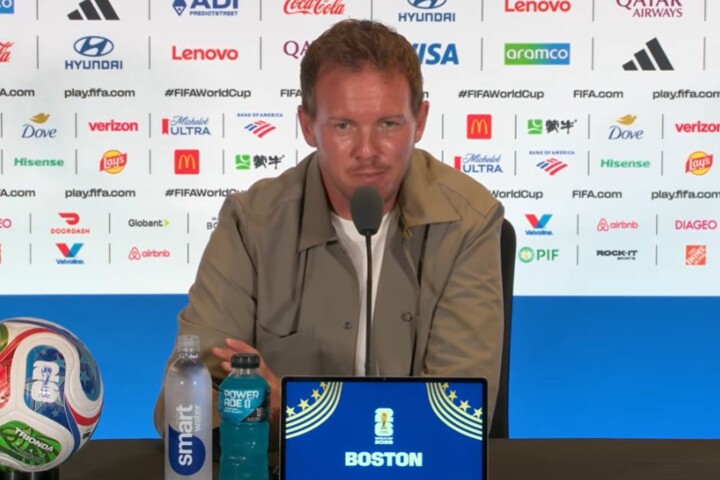
Good evening. Tomorrow is a knockout match against Paraguay. What are your thoughts on the opponent?
Good evening. I think the biggest reference point is their opening phase in the group stage. They played with great confidence, very aggressively, and attacked the opponent's goal fiercely. Unfortunately from their perspective, they missed some clear opportunities early on, and then became somewhat disorganized as the match progressed.
However, I think this is an important reference for us, because it shows what they're capable of. They were in a very difficult qualifying group with points nearly equal to the top team in South American qualification, and they conceded very few goals. Their strength lies in defensive football, and they do it very well. In attack, they're always very direct in matches, fighting hard for second balls, and they'll try to use their physical confrontation effectively to get into the game, with many sharp second balls as well. In short, this is a tough opponent that will bring many challenges for us tomorrow.
After the Ecuador match, there was much discussion about mentality, attitude, and other issues. As a coach, how much do you allow the team to self-correct, or do you have other methods?
I observe performance in training, and I've said this repeatedly—it hasn't changed in recent weeks. During my time as national team coach, we've had only one poor training session. There's always pressure in training, as Havertz just mentioned, and today's final training session was also very intense.
Of course, preparation before a major tournament is different, but during the tournament, training is serious business. Tomorrow is a knockout match, a special match. For me, there's never any indication that the team doesn't want to win. We always give our best, try to create chances, including the substitutes who came on against Ecuador—their task wasn't easy when they entered because we didn't control the game as we wanted, and the same applies to players who haven't had much rhythm. They also want to win. So I simply focus on training performance, and I can tell everyone that the players have worked hard and will give their best tomorrow.
You've received many suggestions from home and experts about how to set up the lineup, regarding players like Kimmich and Undav. We see that Bowen seems to be back in training. Besides Schlotterbeck's injury, will you change the starting lineup, or return to the original setup?
I said before the last match that I think everything is debatable. Ultimately, we have to communicate with the players and coaching staff and make a decision, and the same applies for tomorrow. There are tactical considerations, and there may be some adjustments tomorrow, but it's also possible to keep the original starting lineup unchanged, which is also debatable.
I won't reveal the details—you'll see it when the squad list comes out tomorrow. This isn't about keeping secrets, but about not making the opposing coach's job too easy the night before the match.
Given the increasing prevalence of low-block defenses at this World Cup, as seen with Côte d'Ivoire and Ecuador, and Germany's expertise in central attacking play, how do you break down such defenses?
I think the key against Paraguay tomorrow is that we must consistently find the right positions to score and be able to control possession and positioning in those situations. I'm confident we can play a good match tomorrow. We at least played well in the second half against Ecuador, but the first half wasn't good enough because we didn't consistently find the right positions throughout the 90 minutes, which will be the main challenge tomorrow.
We see from the data that Germany has many penetrating passes into the attacking third and scores many goals, but when it comes to winning the ball back after losing it, Germany ranks first among the top teams. How do you achieve better balance?
We need to find the right combination in our positioning, both to threaten the goal and to recognize opponent pressure. Like in the first half against Ecuador, in many cases it's not about direct shots, but about controlling the ball and preparing to enter the attacking third. This involves where we pass the ball—without going into too much detail—but how we move in different positions according to opponent pressure. These decisions require patience, which we sometimes have, but the players are always active and want to score many goals or create many chances, and sometimes we need to handle it more calmly.
Forward runs are very important. Havertz is one of the most diligent, but we also need more players to make long runs even under pressure, to force the opponent to defend, ideally to score but also to control the game. If we make the right decisions, the likelihood of losing possession will definitely decrease.
Germany, entering the knockout stage, is usually considered a favorite to win the championship. How do you handle these expectations? At the same time, other teams like France are favored more than Germany—does this help?
I don't think it helps much, because at least when it comes to the German national team, it's always about winning, winning every match, and the same applies for tomorrow. Dealing with expectations means having good confidence and a good plan, giving a good plan to the players. If you win, everything is perfect; if you lose, it's bad. Just win tomorrow.
As national team coach, this is your first time leading a team in the World Cup knockout stage. Do you feel you need to prove something to critics in Germany? How much pressure do you feel? This is a knockout match, and if you lose tomorrow, criticism might be even greater. Does this affect you?
Actually, I only care about the team and our success. As a team, we have a very good internal relationship, and we need to bring this good atmosphere onto the pitch and do our best to win.
I don't feel the need to prove anything to anyone, except to the players—I need to be emotionally engaged on the sideline, as I demand from the players, and do my best to help them, both during the match and in preparation.
But I don't feel the need to prove anything to others as a national team coach. If all the fans support us, we'll be very pleased; if experts and critics say good things after the match, we'll also be pleased. But fundamentally, we've prepared well and can play a good match. Regarding the personal impact on me, I think, like anyone else, you could answer that question yourself. I think I've said everything that needs to be said.
Diterjemahkan oleh AI.
Situs web AF kini hadir! Lihat berita lengkap, komentar, detail pertandingan, dan statistik di komputer Anda. Kunjungi: www.allfootballapp.com
 Arsenal
 Jerman
 Paraguay
 Julian Nagelsmann
 Kai Havertz
Semua Komentar (1)
Hari ini 14:51