On August 22, 2024, in an opening-weekend upset, Hull City defeated Manchester United 2-0 at home. Prior to the match, Liam Tharme, a journalist from The Athletic, published an in-depth tactical analysis examining why Hull City won against Manchester United.
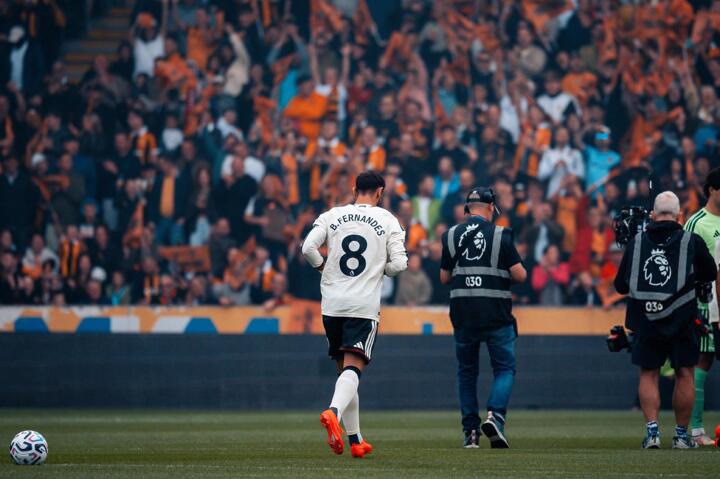
As a stunning opening-week result, Hull City's home victory over Manchester United—the 20-time Premier League champions—was highly impressive.
Hull City led 2-0 from the 38th minute and controlled the game calmly in the second half, ultimately securing a commanding victory. For the Championship play-off winners, facing Manchester United, who finished third last season, represented an impressive start—particularly noteworthy given that according to Transfermarkt's player valuations, Hull City has the lowest squad value in the entire Premier League.
The phrase "tactical masterclass" is often overused, but Serge Jakirovic's tactical setup and his team's execution on the pitch were precisely what was needed.
First, consider the formation. Although Hull City possessed the ball just 29% of the time, they maintained a disciplined 5-4-1 shape when defending. The back three of Cody Drameh, John Egan, and Juma Yasser Noor performed brilliantly in aerial duels and box defense, forcing Manchester United to attack more from the wings.
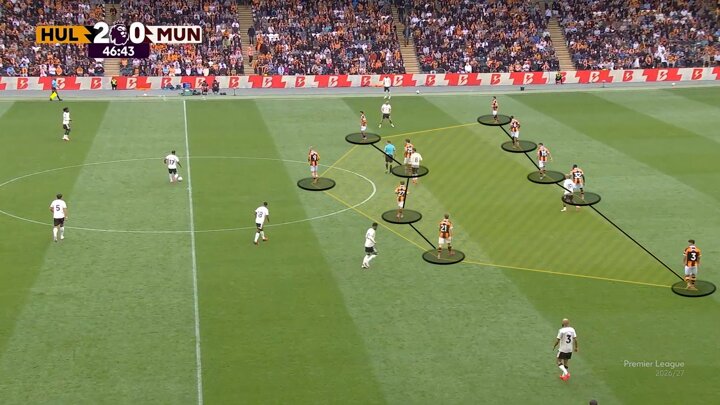
Why deploy five at the back? Jakirovic said in his post-match press conference: "Because Manchester United press very high, especially Luke Shaw on the left. Additionally, they try to gain numerical advantage in midfield. Our primary task was to close gaps between our defensive lines."
Hull City primarily used a 4-2-3-1 formation last season, finishing sixth, 11 points shy of automatic promotion. However, they occasionally switched to a 3-4-3 or 3-5-2, including in the Championship play-off final at Wembley against Middlesbrough, through which Hull City returned to England's top flight after a 10-year absence.
In this match, Hull City made it extremely difficult for Matheus Cunha to receive the ball, which created significant problems for Manchester United. As the "false nine" in their 4-2-3-1, Manchester United needed him to link play and activate the wings. In the first half, Manchester United manager Michael Carrick's most dangerous attacking moves involved sending the ball deep to wingers like Patrick Dorgu and Bryan Mbeumo. However, Hull City enjoyed both numerical superiority in the area and aerial dominance in defense, perfectly suited to their playing style.
Crucially, even after Marcus Rashford replaced Dorgu on the left wing in the second half, Hull City's back five maintained a high line. They didn't retreat too quickly, preventing Manchester United from pressing them deep into their defensive third. Rashford attempted several forward runs but couldn't create chances due to poor timing or positioning.
When Cody Drameh replaced Lewie Coyle at right wing-back, Hull City maintained their defensive shape and successfully contained Rashford's attacking runs.
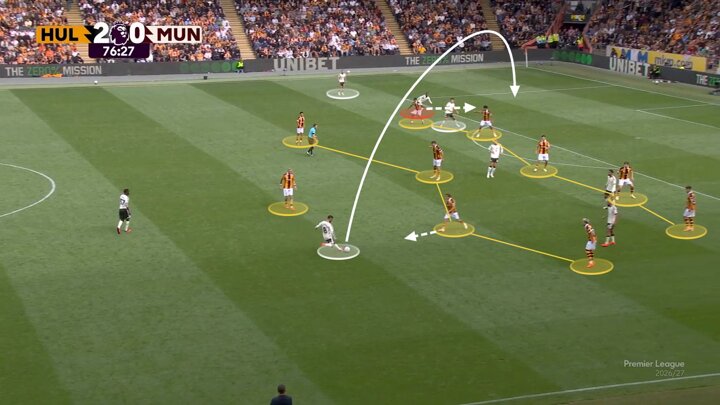
Coyle told TNT Sports after the match: "We knew exactly what we had to do in defense, and we've practiced this extensively. Against top teams, you must execute it." He also praised Ollie McBurnie's involvement in defensive work—the Scottish forward closely marked midfielder João Santos throughout the match, preventing him from receiving the ball.
In Manchester United's half, Hull City pressed aggressively, particularly after set pieces. They employed a man-marking approach, with midfielders Regan Slater and Matty Crooks each neutralizing direct opponents. Manchester United's new midfield pairing of Youri Tielemans and João Santos was substituted in the 67th minute, demonstrating how effectively Hull City suffocated them.

Manchester United's difficulty in breaking down a compact defense isn't new under Michael Carrick. Since round 22 of last season (Carrick's first league match in charge), Manchester United won 12 matches but dropped points in 5: draws against Bournemouth, West Ham United, and Sunderland, and losses to Newcastle United and Leeds United. None of these opponents were title contenders.
This match clearly showed what Manchester United looks like when opponents set up defensively well and Bruno Fernandes can't make an impact. Manchester United lacked tactical alternatives and appeared out of ideas—their only option seemed to be sending in Benjamin Sesko and crossing repeatedly. Carrick acknowledged after the match: "We certainly exposed problems when facing a team with a different system, and we need to find solutions."
However, Hull City's performance also deserves praise. They switched from patiently defending in a 5-4-1 block to aggressive pressing when Manchester United played the ball back to midfield, making 17 interceptions throughout the match and winning most ground and aerial duels.
Jakirovic said: "After winning the ball back, we pushed forward directly and quickly. In transition, we tried to switch play to the other flank because our wing-backs were unmarked, giving us a numerical advantage in the box." Hull City possessed these qualities last season as well.
The attack in the 14th minute exemplifies this well: after Elliot Stroud won an aerial duel against Nousair Mazraoui, Hull City launched an attack exploiting their five-versus-four numerical advantage created by their wing-back system. Mazraoui was beaten, and left-back Ryan Giles, receiving from Ollie McBurnie, drove into the space quickly.
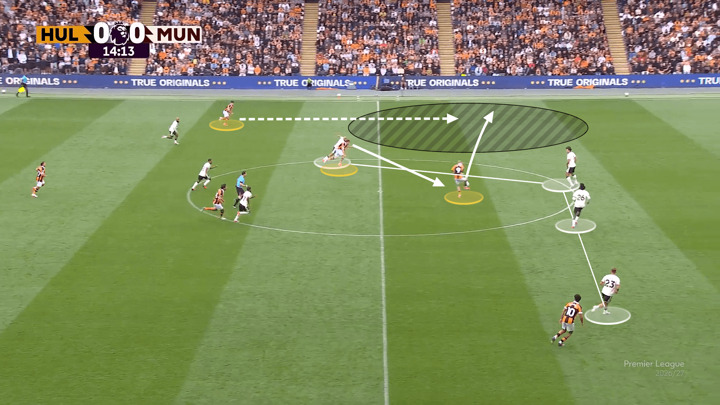
Hull City's orange-and-black players surged forward, creating a two-on-one attacking opportunity for Giles and two teammates. Giles found Ollie McBurnie, whose header was excellently saved by Manchester United goalkeeper André Onana.
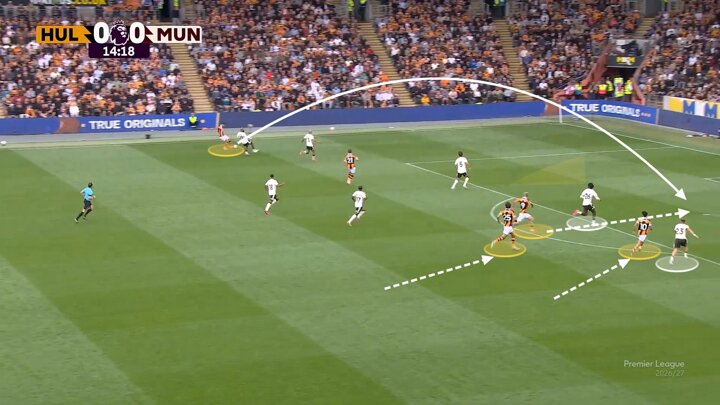
Giles attempted 8 crosses and made 4 clearances throughout the match, performing excellently in both attack and defense. Coyle on the other flank frequently pushed forward as well, creating constant problems for Luke Shaw's defense.
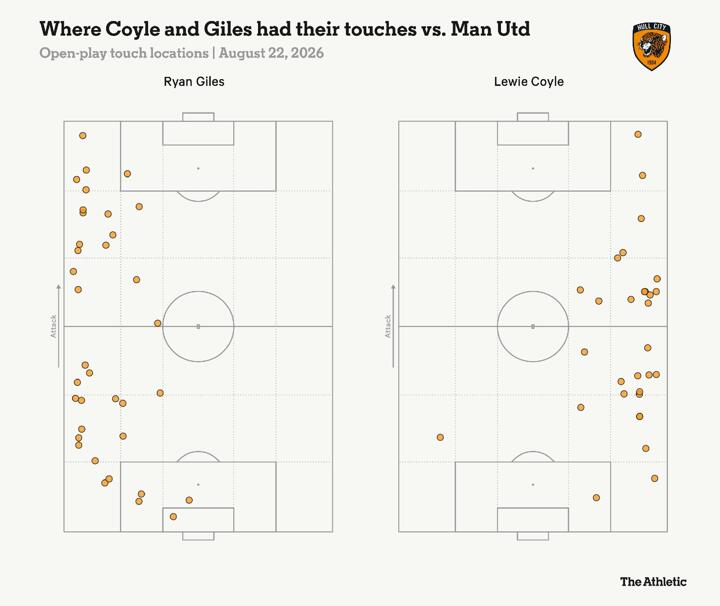
Hull City attacked repeatedly down the left and maintained pressure. They finally broke through in the 17th minute in telling fashion. The goal involved all the key elements mentioned: Slater sent a corner to the near post, John Egan flicked it on, and Ollie McBurnie slid in at the far post. McBurnie's initial attempt was saved, but Junior Ajayi reacted quickly to tap in, giving Hull City a 1-0 lead.
In many ways, Jakirovic has built a modern Premier League team: strong from set pieces, excellent in one-on-one defending, direct attacking play, efficient in transition, and tactically flexible.
They also demonstrated excellent technical and tactical execution. The second goal came from a Slater free kick, with Juma Yasser Noor heading in. Before that, Mohamed Belloumi had threaded a through ball past Youri Tielemans near the box, and the Manchester United summer signing committed a foul, giving Hull City a central free-kick opportunity.
The season is still long, but it's worth noting that in the 2024-25 battle to avoid relegation, West Ham United finished 18th with 39 points—the lowest points total for a relegated team in 15 years. Hull City still faces challenges ahead, but with this performance and display, they've proven they have every capability to make an impact in the Premier League. Meanwhile, Michael Carrick's Manchester United faces a hard truth: can they truly break down defensive blocks?
แปลโดย AI
เว็บไซต์ AF เปิดตัวแล้ว! ดูข่าว ความคิดเห็น รายละเอียดแมตช์ และสถิติครบถ้วนบนคอมพิวเตอร์ของคุณ เยี่ยมชม: www.allfootballapp.com
 Manchester United
 Hull City
 Michael Carrick
 John Egan
 Luke Shaw
 Semi Ajayi
 Bruno Fernandes
 Youri Tielemans
 Oli McBurnie
 Noussair Mazraoui
 Lewie Coyle
 Marcus Rashford
 Regan Slater
 Matheus Cunha
 Senne Lammens
 Bryan Mbeumo
 Konstantinos Tzolakis
 Ryan Giles
 Andrey Santos
 Nobel Mendy
Semua Komentar