According to Bild, with the start of the new Bundesliga season, artificial intelligence has also become an important tool for club management. With the help of cameras and sensors, large amounts of data such as shots, successful tackles, and pass completion rates are collected. Munich-based company Gamecode.AI also gathers extensive raw data and positioning information.
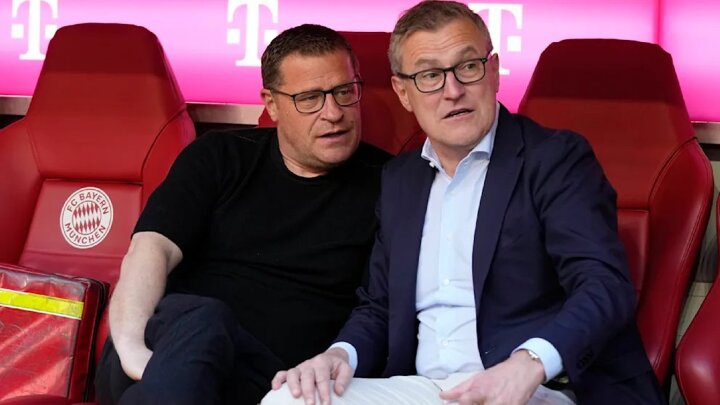
One of the company's founders and CEO is Tobias Haupt. The former goalkeeper and football manager previously led the German Football Association's academy for an extended period and collaborated with former German national team coach and current Barcelona head coach Hansi Flick. Additionally, Tobias Schweinsteiger, brother of World Cup winner Bastian Schweinsteiger, works as Head of Football Operations at the company.
The company focuses on off-the-ball movement, measuring how star players read the game and make appropriate decisions. In short, Gamecode.AI measures whether a star player is intelligent enough in their game awareness.
The company began offering its cloud-based Gamecode tool on a subscription basis early on. One of the early users was former Borussia Dortmund coach Edin Terzic, who will become head coach of Spanish club Athletic Bilbao starting in the summer of 2026.
Bild has learned that besides Terzic, executives, coaches, and scouts from top clubs in the Bundesliga, Premier League, MLS, and Swiss leagues also use this system. Another new product is an AI WhatsApp chatbot designed to help sporting directors and scouts find players.
At an event in Munich, Bild met with this AI robot. Bild asked: "Please give me the top five right-backs whose playing style is most similar to Konrad Laimer's and who would suit Bayern Munich's playing style."
To answer, the robot uses custom metrics aligned with each club's philosophy, tactics, and financial conditions, while accessing over one billion data points. When analyzing financial feasibility, the AI uses market values and financial data from transfermarkt.de (a website that, like Bild, is part of the Axel Springer SE group).
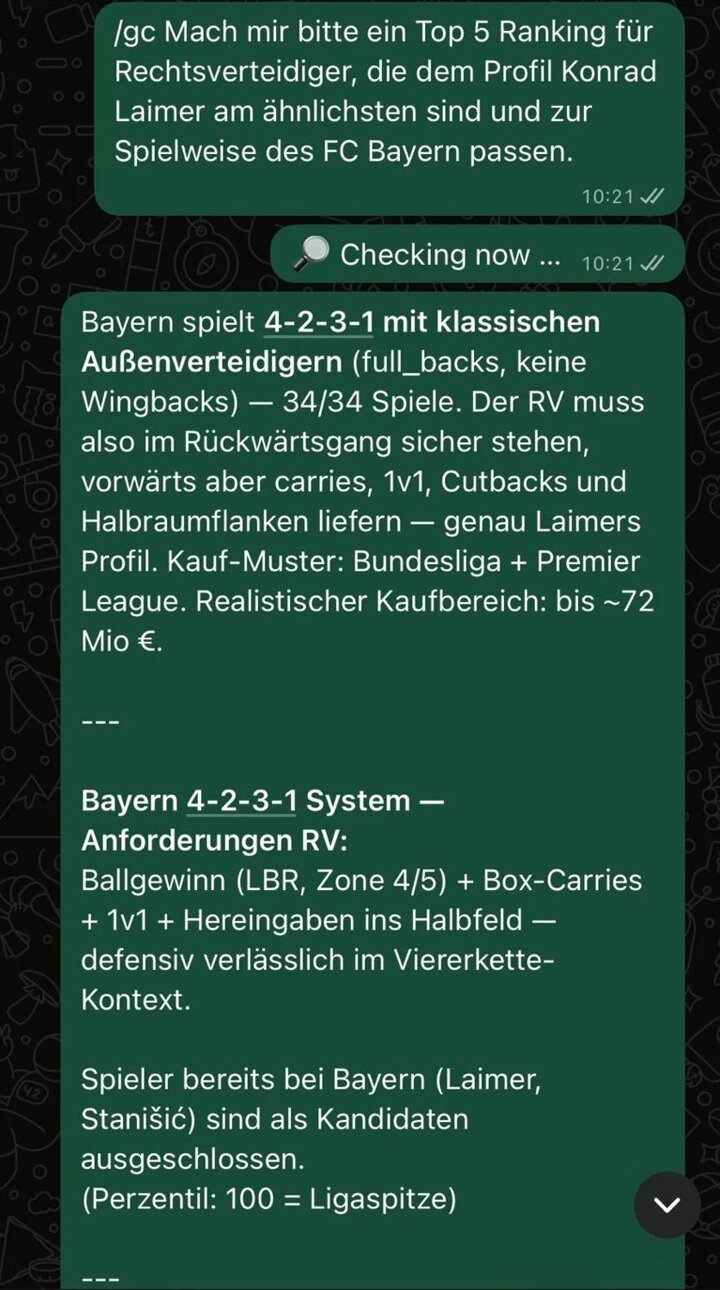
The answer was: "Bayern Munich plays in a 4-2-3-1 formation, using traditional wing-backs (...). Therefore, the right-back must be sufficiently strong defensively and offensively provide dribbling, one-on-one ability, cut-backs, and crosses from wide areas — characteristics that define Laimer. Transfer model: Bundesliga + Premier League. Realistic transfer fee range: up to approximately 72 million euros."
Specific candidates proposed by the robot included right-backs Michael Kayode (22, Brentford), Pedro Porro (25, Tottenham Hotspur), Dodô (27, Fiorentina), Nunes (27, Manchester City), and André Rațiu (25, Rayo Vallecano).
For example, when evaluating Kayode, it rated him as "realistic" and "very suitable." It also noted: "World-class at regaining possession, elite one-on-one ability (...). His pressing characteristics surpass everyone on this list." Additionally, it added: "Slight decline in market value (from 40 million euros to 35 million euros)." This means the robot considers Kayode the strongest potential successor to Laimer on this list.

It should be noted that the robot did not use metrics developed by Bayern Munich when answering this question, as such information is naturally not public.
Can algorithms truly find better players, or will they ultimately just provide another reference point for people in football? What is certain is that in this multi-billion-euro transfer market, more and more clubs are using artificial intelligence. Whether they can make better decisions with it remains to be seen on the pitch.
Diterjemahkan oleh AI.
Situs web AF kini hadir! Lihat berita lengkap, komentar, detail pertandingan, dan statistik di komputer Anda. Kunjungi: www.allfootballapp.com
 Werder Bremen
 Bayern Munchen
 Stuttgart
 Bayer Leverkusen
 Borussia Dortmund
 Schalke 04
 Hamburger SV
 Freiburg
 Borussia Monchengladbach
 Mainz 05
 Eintracht Frankfurt
 FC Koln
 Augsburg
 Hoffenheim
 Elversberg
 Paderborn
 Union Berlin
 RB Leipzig
Semua Komentar