Before the second half of the Premier League season began, The Athletic published an article discussing Wirtz's situation, noting that he is a player who needs a specific environment to perform well, but Liverpool has been in poor form over the past year.
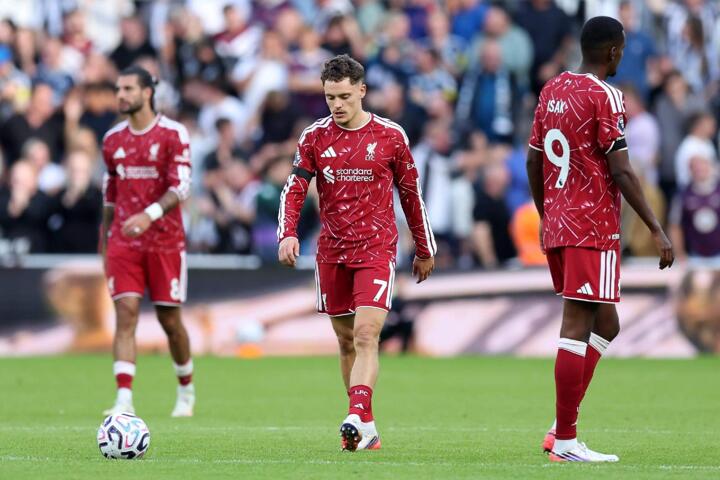
In the new season, old problems persist. Wirtz's performance at Liverpool has drawn criticism.
There is no doubt that since his £116 million transfer from Leverkusen to Liverpool last summer, Wirtz has not lived up to expectations. He must also take responsibility for his struggles in his debut season. Moving from the Bundesliga to the Premier League is inherently challenging, and he understood what might happen when he joined.
However, this narrative is also somewhat unfair. Wirtz is often portrayed as the sole underperformer in an otherwise healthy team, but this is clearly not the case. Compared to Klopp's great teams and the squad that won the Premier League title in Slot's first season, Liverpool has played awkwardly and fragilely over the past 13 months, lacking identity, fluidity, and confidence.
In such conditions, how many players in world football could still perform well? Strikers sometimes can, because their role—receiving and converting chances—is relatively straightforward and binary, just with more pressure. But few players can be pushed into midfield and then expected to perform independently of team mood or chemistry.
Rhythm is equally important.
Memories of Wirtz in Germany are almost universally similar. He always drove forward with the ball, always with the ability to accelerate further. His game relied heavily on instinct, quick judgment, and telepathy with teammates. His touch was light and natural then, whereas now he plays slower, more cautiously, and less certain about what he's doing.
In Liverpool's 2-2 draw with Newcastle United last weekend, a clear attacking move unfolded in the second half. Wirtz collected the ball near the halfway line, drove forward, and attempted a through ball to Gakpo in the middle, pushing toward the penalty box. Gakpo failed to anticipate the pass, didn't start moving in time to get into a shooting position, and reacted one beat too late. The ball was intercepted, and the attack broke down.
It doesn't matter who should be blamed for this failed attack. Should Gakpo keep pace with his teammate, or should Wirtz have passed to his feet, as the Dutch player prefers? That's not the main point. What matters more is that Liverpool's attacks, especially those centered around Wirtz, too often break down like this. Someone tries, but the effect always falls slightly short.
This is not Wirtz's sole responsibility, nor is it Gakpo's fault—it's more like a mismatch where neither party gets what they need. And this is the context that should inform any evaluation of the situation.
Before his high-profile move to Anfield, Wirtz's environment at Leverkusen was perfect. He had a double pivot led by Xhaka in front of him, capable of consistently delivering penetrating passes. On the wings were the fullback duo of Grimaldo and Frimpong, who not only posed individual threats but created space for Wirtz through their movement and positioning, or provided passing lanes he could exploit.
Furthermore, Alonso's Leverkusen often used the center-forward as a playmaker rather than just a target man. Whether Boniface or Schick, players in this role frequently dropped deep, vacating the penalty box in established play, drawing opposing defenders with their movement, or creating link-up opportunities for Wirtz.
The point is not that Liverpool should play like Leverkusen. Nor is it that Slot should tailor a new team specifically around one player. In modern football, would that truly work? The real insight is that Wirtz is a player shaped by his environment at Leverkusen, and the same applies at Liverpool, only with entirely different results.
Moreover, it would be foolish to draw conclusions about Slot's future in England after his first official match as manager. The Premier League is never short of players whose performance improves or deteriorates after a change of environment.
Even within Liverpool, one could think of Robertson and Henderson's careers, whose success came precisely from their high compatibility with that particular team and era. Then look at the transfers of Núñez or Naby Keïta, who ultimately failed to meet expectations.
Premier League teams always rely heavily on combination and chemistry, not just individuals. Torres and Gerrard. The trio of Roberto Firmino, Salah, and Mané—a perfectly balanced combination that was ideally suited to Klopp's style of play.
Looking further afield, consider the changes in Dembélé's career over recent years. He was marginalized at Barcelona but became a Ballon d'Or winner at Paris Saint-Germain three years later. Or look at Kane's clear improvement at Bayern Munich after Luis Díaz moved to the Bundesliga last summer.
Individual talent alone is never enough; the key is placing a player in the right environment.
Barcola will likely join Liverpool in the coming days, which will further change the team's internal chemistry. He will benefit some new teammates and affect others. But until Slot truly brings all these pieces—both existing and incoming—together into a cohesive team, no one knows who will play what role and to what effect.
This, of course, includes Wirtz, regardless of his transfer fee.
Diterjemahkan oleh AI.
Situs web AF kini hadir! Lihat berita lengkap, komentar, detail pertandingan, dan statistik di komputer Anda. Kunjungi: www.allfootballapp.com
 Liverpool
 Florian Wirtz
Semua Komentar