On September 7, according to local time, The Guardian argues that although Manchester United's new attacking line boasts exceptional individual talent, it currently lacks cohesion and fluidity in attack. Cunha, playing as a false nine, must adapt to Bruno Fernandes occupying his familiar areas, Mbeumo preferring to cut infield, and Rashford's explosive runs not yet creating consistent threats, leaving the team controlling possession but struggling to truly dominate opponents.
Here is The Guardian's analysis:
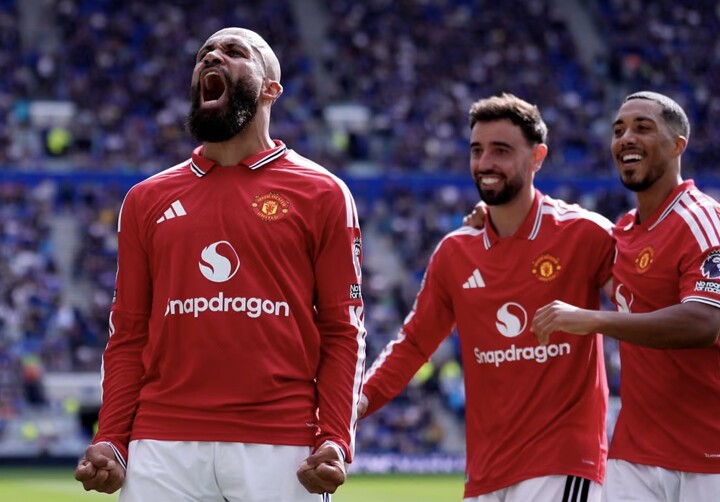
"Tunnel vision" gave Mbeumo a few seconds of intense focus. He completely ignored nearby teammates in red shirts, while Everton players in blue seemed to form a protective barrier around him. In a team sport, this could be seen as selfish, but sometimes the most satisfying outcome comes precisely from such "selfishness" — when the ball hits the back of the net, Manchester United is equally delighted by this focus and determination.
This is Manchester United's new attacking line. Although Rashford played for Barcelona last season, with the others having played together for a year, they should have developed stronger cohesion. Bruno Fernandes, as the number 10, initiates attacks, while Matheus Cunha, Mbeumo, and Rashford attempt to create a complex "formula" to break down defenses through individual skill, tactical freedom, and instinctive coordination. However, this formula still has a long way to go.
For this system to work, everyone must understand their own responsibilities and those of their teammates. When football is played at Premier League pace, any hesitation or lack of conviction can prematurely end an attack. Instinct is a vital weapon in every striker's arsenal, but ironically, this instinct develops through extended time playing together on the pitch — it doesn't automatically appear simply because a player carries a high transfer fee.
Flexibility can be an extremely potent weapon, bewildering opponents: they constantly must think about whom to mark, and a moment of lost focus can leave them vulnerable to a sudden run. This is the idea Carrick is currently implementing by having Cunha play as a false nine, allowing the Brazilian forward to move freely and find positions where he believes he can do the most damage.
During his time at Wolves, Cunha liked to drop deep and operate in lower positions. He was particularly skilled at carrying the ball for a short distance before striking curling shots from around 20 yards out into the corner of the goal. That was perhaps his ideal playing style at Manchester United, but now Bruno Fernandes occupies the areas Cunha was accustomed to, forcing Cunha to adapt his play, and when he does, Manchester United loses a player who can consistently threaten the back line.
Mbeumo likes to cut in from the right wing; he's not really comfortable beating the fullback on the outside, going to the touchline, and then finding teammates. In contrast, Rashford is better able to penetrate right-backs from both directions. In this match, he troubled temporary fullback Meighan Lell: the English forward, starting from a stationary position, burst past his opponent with sheer power. But such instances don't occur frequently.
Although Manchester United controlled possession more and consistently pushed Everton into their own half, Pickford was never truly threatened for long stretches. Even with Bruno Fernandes' confidence in this match, he couldn't always spark the magic to change the game or play teammates into better positions, because teammates weren't always where he expected them, and sometimes they didn't read the runs their captain wanted them to make. Passes going astray happened far too often, whether through-balls into empty space with no one to receive them, or balls simply going straight out of play. Manchester United suffered from these issues repeatedly. This was far from a display of precision.
There were a few moments in the second half when everything clicked. Rashford crossed to the far post, Mbeumo flicked it back for Bruno Fernandes, whose subsequent volley hit the crossbar — this came in the 8th minute, and it provided a glimpse of the understanding developing among Manchester United's attacking players. But such coordinated moments were too rare, and the entire attack lacked the necessary impact.
With Mbeumo scoring in the 47th minute, that goal should have delivered a confidence boost like an adrenaline shot, but it didn't have the desired effect. They remained a quartet of attackers relying on moments of brilliance rather than sustained pressure and match control. With Cunha playing as a striker and the team lacking an attacking focal point, Everton genuinely had little to worry about for a long time, until Sesko came on.
Sesko entered and became the attacking focal point the team had been missing. His goal came from a typical intelligent Bruno Fernandes pass: the captain played a teammate making a run down the wing, who then delivered a perfect cross to the 6-foot-5 (approximately 1.96m) Sesko, who headed it in. It was a simple, near-perfect piece of play, like something from a different era, yet still effective today.
This attack was built on everyone understanding their role and executing it perfectly, while also knowing where others would be at the crucial moment. Bruno Fernandes could anticipate that Luke Shaw would burst into the space on the wing, and Shaw didn't need to think about where Sesko would wait for his cross.
The positive aspect of the second half was that it demonstrated Manchester United's tactical flexibility. They can change their approach during a match and see whether opponents can adapt in time. When an opponent is already worn down by one style of play, switching from speed and movement to physical confrontation isn't always easy to deal with. The starting players brought a complex attacking approach, while Patrick Doku and Sesko brought a more direct style of play.
Bruno Fernandes, Mbeumo, Rashford, and Cunha are all top-class players, and their track records prove it, but exceptional individual ability doesn't necessarily mean they can form a cohesive unit. As they spend more time together on the pitch, these four players will gradually learn each other's characteristics, and playing twice a week will also help them build rhythm.
If the team's attacking cohesion doesn't improve, Carrick has every reason to revert to Plan B — a more direct, less fashionable approach.
Website AF đã ra mắt! Xem tin tức đầy đủ, bình luận, chi tiết trận đấu và thống kê trên máy tính. Truy cập: www.allfootballapp.com
 Manchester United
 Everton
 Michael Carrick
 Bruno Fernandes
 Marcus Rashford
 Matheus Cunha
 Bryan Mbeumo
 Benjamin Sesko
Tutti i commenti