In the fourth round of the Premier League, in the Manchester derby, Manchester United lost 0-1 to Manchester City's 10 men at home. After the match, TA analyzed the game.
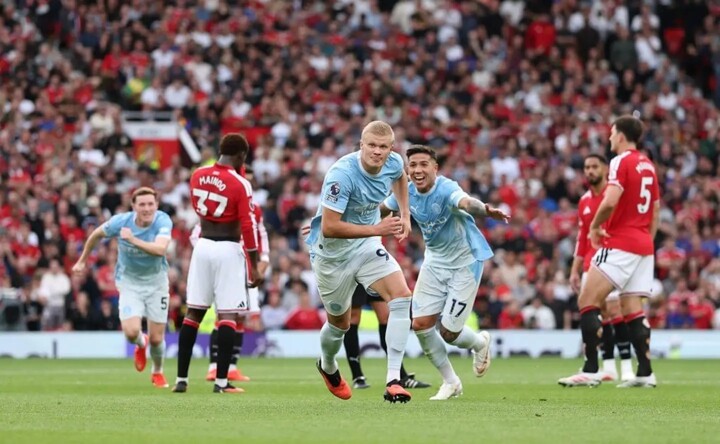
Should Haaland's goal have been disallowed?
Setting aside the objective positions of Haaland and Doku, there is also subjective judgment in this decision: Enzo from Manchester City dove toward the ball, which then reached the goal line.
If he had touched the ball, he would have been in an offside position. But he didn't touch it, though some argue he was in Lisandro Martinez's line of sight, affecting Martinez's ability to control the ball.
Manchester United had grounds to protest, but Martinez could always see the ball, and for VAR to intervene, the evidence would need to be more conclusive.
On the pitch, the assistant referee at the time likely wasn't seriously considering Enzo's involvement, as he was confident Haaland was offside.
Therefore, VAR effectively asked the referee to assess whether there was a clear error by the official at Old Trafford, when in fact no clear decision had yet been made.
In such situations, the more reasonable approach would be a pitchside review, allowing the referee to watch the entire incident. However, match officials are under considerable pressure to make quick decisions, and VAR should only intervene when absolutely necessary.
Had Oliver watched all the replays, he would likely have allowed the goal, but this is an extremely tight decision, and either outcome could be justified.
VAR reviewed the referee's decision to disallow the offside goal and determined that Haaland was in an onside position, recommending the goal stand.
VAR also determined that although Fernandes was in an offside position, he didn't touch the ball.
What was Foden thinking? Was Fernandes fortunate?
Foden became the second player to be sent off in the first month of this Premier League season for a retaliatory kick to an opponent's torso.
In the first round, Aston Villa's João Gomes kicked Rutter and was sent off after a VAR review. This time, referee Michael Oliver witnessed the offense directly and correctly showed a red card.
Foden must feel treated unfairly that Bruno Fernandes, the "victim," went unpunished, but he cannot complain about his own result.
Last season, Sunderland's Régis Le Bris and similar incidents also resulted in red cards; notably, on one of those occasions, Aston Villa's Cash was the victim.
The question about Fernandes is whether he should have been punished for his actions, or whether Foden overreacted and fell into a trap.
This depends on whether Oliver saw the entire incident clearly and judged Fernandes to be at fault, or whether he only saw Foden's kick, missing the instigation.
A yellow card for Fernandes would have been fair; however, in this situation, VAR cannot intervene to correct a potentially missed yellow card.
A controversial derby decided by strange circumstances
This 199th Manchester derby was ultimately decided by two highly controversial moments. The first was Foden's straight red card, which ironically seemed to help Manchester City more than Manchester United. Fernandes fouled from behind and then kicked Foden as he fell.
Foden angrily kicked back at the Manchester United captain; this action clearly wasn't forceful enough to actually injure Fernandes, but it made it very easy for referee Michael Oliver to show a red card. The strangest part of this sequence is that Fernandes miraculously escaped punishment without injury.
As for the other major point of contention, it will continue to spark debate in the coming days. Haaland appeared to be in an offside position when he received Gvardiol's cross, and when the linesman raised his flag, the Manchester City striker seemed to accept the decision. However, a VAR review followed.
The review showed that Doku kept Haaland in an onside position. But one question remained unanswered: wasn't Fernandes, who attempted to intercept Gvardiol's cross before it reached Haaland, in an offside position? The answer is both yes and no. The final decision was that Fernandes was not interfering with play. At the very least, it was an extremely confusing moment.
How did Manchester United perform against 10-man Manchester City?
Manchester United are not accustomed to dominating possession against Manchester City, and with City down to 10 men, they clearly lacked ideas.
In past victories against their cross-town rivals, Manchester United have relied on smooth and efficient counterattacks. This time, Carrick's tactical setup was clearly designed around this approach, as he started the more agile Cunha as a center-forward rather than traditional striker Sesko.
After Foden was sent off, this counterattacking style quickly lost its effectiveness as Manchester City retreated into a compact defensive formation. Manchester United initially struggled to adapt to the situation, simply passing the ball slowly around the pitch, allowing Manchester City to easily maintain their shape. Maguire's tentative long-range attempt was most telling; the ball rolled slowly along the ground because he had few options due to the lack of coordinated movement in the front line.
However, they accelerated in the second half, particularly through Mainoo, who constantly drove forward with quick one-touch passes and strong dribbling. Mainoo nearly scored with a curling shot that hit the post. It was Haaland's decisive finish that ended Manchester United's mounting momentum, and the team's attacks became disjointed again.
Overall, striking statistics summed up Manchester United's afternoon. Despite hitting the post twice, after the red card, Manchester United managed only one shot on target—Fernandes' effort in the 70th minute.
What was Enzo's role in Manchester City's performance?
Manchester City's 10-man display in the second half will likely remain vivid in the minds of traveling fans for a long time, and supporters will view everyone in this victory as heroes. No one disappointed; Fernandes reclaimed possession throughout midfield, Ndiaye proved an inspired center midfield adjustment, Haaland elevated his intensity in the second half, and the back four also performed brilliantly.
If anyone best embodied this fierce battle and the "dark arts" necessary when playing with one fewer player, especially when you feel the red card was unjust, it was certainly Enzo.
He was everywhere in midfield, winning loose balls, linking attacks, slowing the tempo when needed, and also giving himself some breathing room by holding his face and falling to the ground, and getting into a dispute with Maguire—both received yellow cards as a result, so Michael Oliver clearly understood that this approach was effective.
Fernandes was substituted in the closing 10 minutes and had to walk a long way around the pitch, past Manchester United fans. Depending on whether he was helping Manchester City maintain possession and catch their breath or attempting to disrupt the situation, these fans at one point wanted to both calm him and provoke him.
Manchester City fans sang his name throughout the match, singing the "Zombie" song first performed in Porto. His performance in this match will also earn him a place in Manchester City's historical memory, just like his teammates.
How widespread was the protest inside and outside Old Trafford?
Police estimated around 500 fans participated in protests at the intersection of Sir Matt Busby Way. The demonstration was organized by the "1958" group to oppose the club's ticketing policies.
Manchester United has faced fierce criticism over its handling of ticket touts, with nearly 700 season-ticket holders initially banned and then required to go through an appeals process to retain their seats. Another 1,000 were permanently punished. Ticket prices have also increased.
Outside Old Trafford, fans held banners reading: "You've taken everything from fans and banned us without reason." They also lit red, green, and gold flares and chanted demands for the Glazer family to leave, with Ratcliffe also targeted.
Later, as Ratcliffe sat in the executive box at Old Trafford, fans displayed another banner in the Stretford End. It read: "The way you treat us is a disgrace." This banner was displayed behind the player tunnel as they entered the pitch, designed to maximize the impact of the protest.
This was an action by the TRA (The Red Army) organization. Over the past decade, the group has been dedicated to improving the stadium atmosphere. They also lowered flags that typically decorate the Stretford End.
Diterjemahkan oleh AI.
Situs web AF kini hadir! Lihat berita lengkap, komentar, detail pertandingan, dan statistik di komputer Anda. Kunjungi: www.allfootballapp.com
 Manchester United
 Manchester City
 Michael Carrick
 Enzo Maresca
 Harry Maguire
 Bruno Fernandes
 Elliot Anderson
 Marcus Rashford
 Erling Haaland
 Phil Foden
 Lisandro Martínez
 Matheus Cunha
 Josko Gvardiol
 Iliman Ndiaye
 Benjamin Sesko
 Kobbie Mainoo
 Enzo Fernández
 Patrick Dorgu
 Sir Jim Ratcliffe
Tutti i commenti