According to analysis and predictions from the Opta supercomputer, Barcelona is most likely to dominate La Liga again, while Sevilla faces a risk of relegation.

This weekend, the 2026-27 La Liga season will kick off.
Barcelona will begin the new season as defending champions, but their old rivals Real Madrid have brought back a familiar "nemesis" as coach, which will undoubtedly add more spice to the El Clásico and the inevitable title race between the two teams.
Meanwhile, three familiar teams return to Spain's top flight after a long absence, all of whom had previously dropped to the Spanish third division.
So, how will this season's title race, Champions League qualification battle, and relegation fight unfold? The Opta supercomputer ran 10,000 simulations of the entire season, and here are the results.
Title Race
Will Barcelona achieve a third consecutive league title? The Opta supercomputer clearly thinks they will. Last season, Barcelona successfully defended their title by taking full advantage of Real Madrid's rather chaotic 2025-26 season, and they did so in an ideal manner. On May 10, Barcelona defeated Real Madrid 2-0 in El Clásico at Camp Nou, securing the title three rounds early, ultimately finishing 8 points ahead of their rivals and claiming their 29th La Liga championship.
If Barcelona achieves a third consecutive title in the 2026-27 season, they will claim their 30th La Liga title in club history, continuing to chase Real Madrid's record of 36 titles. In 10,000 season simulations by the supercomputer, Barcelona has a 45.6% chance of winning the title.
Real Madrid has been working to rectify problems this summer. Last year, they chose the then-hot Xabi Alonso, but this time they opted for a more "mature and reliable" direction, bringing back José Mourinho for his second stint as coach.
The Portuguese coach is a renowned figure in football, but he has been away from the highest level for some time, with his last three jobs being at Roma, Fenerbahçe, and Benfica. While these clubs are significant in their own right, Real Madrid is clearly on another level.
Real Madrid's expectation is likely that an experienced coach like Mourinho can manage the big-name players in the dressing room without implementing anything too revolutionary in terms of playing style. His pragmatism might ultimately be a better fit for this star-studded team.
Last season, there were reportedly several points of conflict within Real Madrid, so it's understandable that the decision-makers felt it necessary to hire an authoritative and respected coach rather than someone known for tactical genius. This approach worked when Carlo Ancelotti coached Real Madrid; can "the Special One" have a similar impact?
This is certainly not unimaginable. In the Opta supercomputer's simulations, Real Madrid has a 31.0% chance of winning the title.

However, Barcelona's own performance, much like Mourinho, might have a significant impact on this outcome.
Last season, Barcelona won the title easily, and they might even be on the verge of signing Rodri. Since suffering an ACL injury in 2024, Rodri hasn't returned to his best at club level, but this summer he led Spain to a World Cup victory and rightfully won the Golden Ball for the tournament's best player.
Rodri is the closest player in modern football to peak Busquets. It is reported that after he decided to prioritize Barcelona over Real Madrid's interest, Barcelona seems set to place him at the core of Flick's midfield system.
The supercomputer's data cannot account for player transfers, but if Barcelona does sign Rodri, many would find it hard not to fancy them.
In the supercomputer's simulations, no other team has a title-winning probability of 10% or more.
Champions League Qualification Battle
It can largely be assumed that two of the Champions League spots will be occupied by Barcelona and Real Madrid. In the latest simulations, both teams have over an 81% chance of finishing in the top four, and this doesn't even consider the possibility of a fifth-place team qualifying for the Champions League again.
Unsurprisingly, Atletico Madrid's simulations for Champions League qualification through a top-four finish come next, with a probability of 48.6%. After all, Atletico has not finished outside the top four since the 2011-12 season.
Beyond that, the situation is less clear.
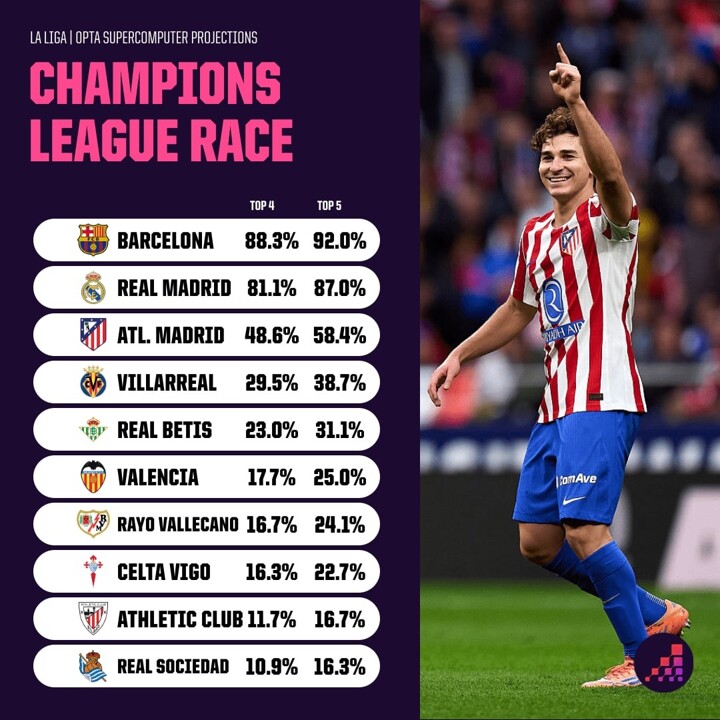
The supercomputer favors Villarreal and Real Betis more, with probabilities of 29.5% and 23.0% respectively to finish in the top four. Having finished third and fifth last season, both teams will participate in the Champions League this season.
However, it should be noted that Villarreal will undergo a period of transition. Marcelino left after the 2025-26 season; his successor, Iñigo Pérez, previously did excellent work at Rayo Vallecano and is highly regarded in Spain, but there's no guarantee everything will go smoothly.
As for Real Betis, they haven't participated in the Champions League since the 2004-05 season. It's difficult to predict how they will balance their league campaign with their Champions League journey.
Following them, five more teams have at least a 10% chance of qualifying for the Champions League through a top-four finish.
Valencia's probability is 17.7%, next in line, which might surprise some. Since finishing fourth in the 2018-19 season, Valencia has alternated between ninth place and the bottom half of the table each season. In the 2025-26 season, they finished ninth, and according to this pattern, they should fall into the bottom half in the 2026-27 season, but perhaps they can finally break this trend.
Next is Rayo Vallecano, with a probability of 16.7%. They reached the 2025-26 Europa Conference League final, ultimately losing 0-1 to Crystal Palace. But as mentioned earlier, they lost their coach Iñigo Pérez this summer, who moved to Villarreal, and there is also uncertainty about their home stadium arrangements.
Last month, local Madrid authorities temporarily suspended Rayo Vallecano's lease of the Vallecas stadium after an audit revealed "frustrating stadium maintenance conditions." Initially, there were talks that the stadium might be closed for 2 to 6 months, and the Rayo Vallecano president believed that if this happened, the team would be doomed to relegation. Since then, as Rayo Vallecano opened the stadium for cleaning work, the related discussions seem to have cooled down, but due to these issues and concerns about the pitch condition, it still seems unlikely that the Vallecas stadium will host the team's first home game of the new season on August 20.
Any time away from their home stadium will inevitably affect Rayo Vallecano's ability to earn points, but the supercomputer cannot incorporate this factor into its calculations.
From a realistic perspective, the European hopes of Celta de Vigo, Athletic Club, and Real Sociedad might be more practical than Rayo Vallecano's. Celta de Vigo finished sixth last season, and their probability of finishing in the top four is 16.7%; Athletic Club's is 11.7%; and Real Sociedad's is 10.9%.
Relegation Battle
The relegation battles in the past two La Liga seasons have been intense. In the 2024-25 season, five teams finished no more than 2 points above the relegation zone; in the 2025-26 season, 13th-placed Sevilla was only 1 point above Mallorca, who occupied the last relegation spot.
Mallorca was relegated despite earning 42 points. In a 38-game La Liga season, there has only been one previous instance of a team being relegated with more points, excluding playoff relegated teams.
It's clearly too early to say that this season will be a repeat, but given the trend of the past two seasons, a third consecutive tense relegation battle would not be surprising.
The Opta supercomputer believes that a well-known team might become a casualty.
Sevilla has been involved in tough relegation battles in the past two seasons. In the 2024-25 season, they narrowly avoided relegation with 41 points, just ahead of Leganés with 40 points. If Leganés had defeated Sevilla away in the 34th round that season, which they should have, their positions would have been swapped.
In the latter half of last season, Sevilla seemed to be silently heading towards relegation, but from April 11, they won 4 of their 6 games, thus barely holding onto their position despite losing the last two rounds.
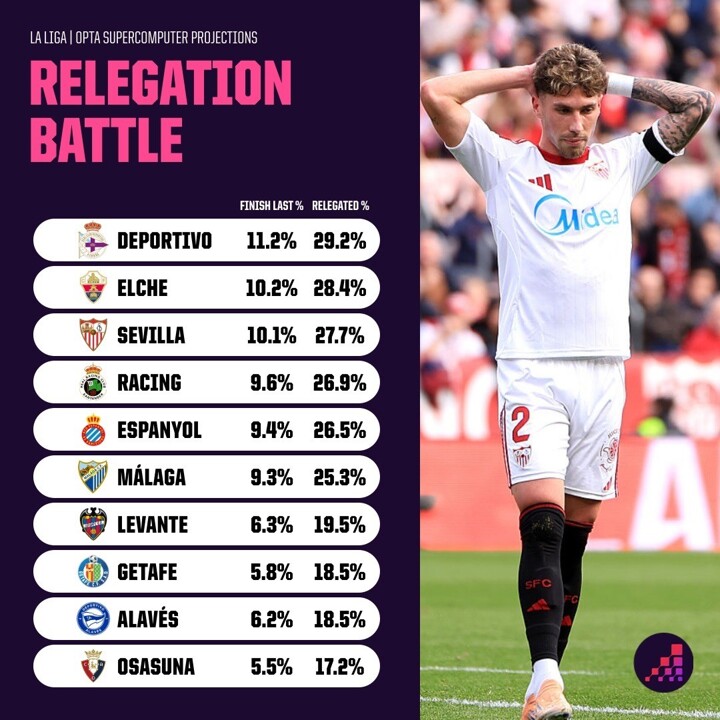
However, the supercomputer believes Sevilla might not escape this time. They are relegated in 27.7% of simulations, making them the third-biggest favorite for relegation. Coupled with Sevilla's severe financial problems—their La Liga salary cap was second-lowest in the league according to the latest data as of March 2026—and boardroom turmoil, as well as the possibility that they may have to promote a large number of young players from their B team, which was relegated to the fourth division last season, the team's prospects are even bleaker.
Another team that knows the taste of bleak prospects after a period of glory is Deportivo La Coruña. They are now also known as A Coruña, after the city's name in the local Galician language.
Deportivo La Coruña returns to La Liga for the first time since the 2017-18 season. Since then, they even spent four years in the Spanish third division.
Last season, Deportivo La Coruña finished second in Segunda División, successfully achieving promotion. However, they are considered the top relegation favorite by the supercomputer, being relegated in 29.2% of simulations.
Deportivo ranked behind Segunda División champions Racing Santander, who have been absent from La Liga for even longer.
Racing Santander last played in La Liga in the 2011-12 season. The following season, they were relegated to the third division.
In fact, since being relegated from La Liga 14 years ago, Racing Santander has spent seven seasons in the third division and seven seasons in Segunda División, an equal amount of time.
The supercomputer estimates Racing Santander's relegation probability at 26.9%, slightly lower than Sevilla, Deportivo La Coruña, and Elche. Elche's relegation probability is 28.4%. But Racing Santander is considered the fourth-biggest relegation favorite, meaning they are expected to be in a fierce battle to stay up.
Málaga is the third and final promoted team, having secured promotion by defeating Almería in the playoffs. Málaga also ends a long absence from the top flight, having last played in La Liga in the 2017-18 season, when they were relegated along with Deportivo La Coruña. Just in the 2023-24 season, Málaga was playing in the third division.
In the supercomputer's simulations, Málaga is the team among the three promoted clubs with the fewest relegations, with a probability of 25.3%. Espanyol's relegation probability is 26.5%, also slightly higher than "Anchovy Army" Málaga.
However, in 10,000 simulations, each team won the title at least 140 times. So, yes, we mean: it is indeed possible.
AF's PC site is now live! Browse full news, comments, match details and stats on your computer. Visit: www.allfootballapp.com
 バレンシア
バレンシア
 レアル・マドリー
 バルセロナ
バルセロナ
 デポルティーボ・ラ・コルーニャ
 アスレティック・ビルバオ
 アトレティコ・マドリー
 セビージャ
セビージャ
 オサスナ
オサスナ
 ビジャレアル
 マラガ
マラガ
 ベティス
ベティス
 レアル・ソシエダ
 ラシン・サンタンデール
 エスパニョール
 セルタ・デ・ビーゴ
 レバンテ
レバンテ
 アラべス
アラべス
 ヘタフェ
ヘタフェ
 エルチェ
エルチェ
 ラージョ・バジェカーノ
すべてのコメント (27)