7 September: The Guardian believes that while Manchester United's new attacking quartet possesses outstanding individual abilities, it currently lacks sufficient chemistry and attacking cohesion. Cunha, playing as a false nine, must adapt to Bruno Fernandes occupying his familiar spaces. Mbeumo prefers to cut infield, and Rashford's breakthrough runs failed to pose a consistent threat, resulting in the team dominating possession but struggling to truly overwhelm their opponents.
Here is The Guardian's analysis:
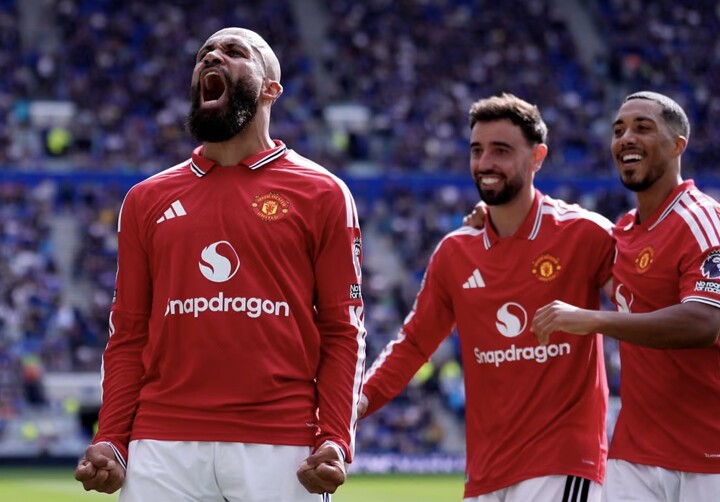
Mbeumo's "tunnel vision" allowed him a few seconds of intense focus, completely ignoring his teammates in red shirts while Everton players in blue shirts seemed to be escorting him. In team sports this might be seen as selfish, but sometimes the most satisfying moment is precisely this kind of "selfishness" – when the ball hits the net, Manchester United too celebrates this concentration and determination.
This is Manchester United's new attacking quartet. Rashford played last season for Barcelona, but since the others have been playing together for a year, they should have a stronger understanding. Bruno Fernandes is the number 10 orchestrating attacks, while Mbeumo, Cunha and Rashford attempt to create a complex formula that throws defensive lines into disarray through individual ability, tactical freedom and instinctive cooperation. Yet this formula is far from perfect at the moment.
For this system to work, each player must understand their own role as well as those of their teammates. When football is played at the high speed of the Premier League, any hesitation or uncertainty can kill an attack before it even begins. Instinct is a crucial part of every attacker's arsenal, but ironically, this instinct must be cultivated through many hours of playing time together on the pitch – it does not emerge automatically simply because a player is expensive.
Fluidity can be an extremely aggressive weapon that confuses opponents: they must constantly think about who to mark, and a moment of inattention can leave them surprised by a sudden run. This is precisely the idea Carrick is currently implementing by playing Cunha as a "false nine," allowing the Brazilian to move freely and find positions where he can do the most damage.
During his time at Wolves, Cunha preferred to drop deep and operate in deeper positions. He was particularly skilled at curling shots from 20 yards into the corner after a short dribble. This was actually his ideal way of playing at Manchester United, but now Bruno Fernandes occupies the space Cunha was familiar with, forcing him to change his style of play, while simultaneously Manchester United lacks a player to consistently threaten the last line of defence.
Mbeumo prefers to cut infield from the right side, and he does not feel comfortable beating full-backs on the outside, driving to the byline and then looking for teammates. Rashford, by contrast, is more capable of beating right-backs from both directions. In this match, he put temporary substitute defender Meilin under pressure: the English striker burst from a standstill and used his explosive power to sprint past his opponent. But such moments were not frequent.
Although Manchester United had more possession and often pushed Everton back into their own half, Pickford was rarely seriously tested. Even though Bruno Fernandes was full of confidence in this match, he could not always provide the decisive spark or deliver the ball to better-positioned teammates because teammates were not always where he expected them, and sometimes did not understand the runs he wanted them to make. The problem of passes not reaching their intended area occurred too often – whether passes into space that nobody ran to or simply sending the ball out of play. Manchester United had similar issues throughout. This was by no means a masterclass in precision.
There were moments in the second half when everything clicked. Rashford played the ball to the far post, Mbeumo headed it to Bruno Fernandes, whose volley then hit the crossbar – this was in the 78th minute and showed that a connection between Manchester United's attacking players seemed to be gradually developing. But such combinations were too few, and the entire front line lacked sufficient cutting edge.
Given that Mbeumo scored in the 47th minute, this goal should have provided a much-needed confidence boost, but the expected effect did not materialise. They remained an attacking quartet that relied on brilliant individual moments rather than sustained pressure and control. With Cunha playing as a striker and lacking an offensive focal point, Everton had little to fear for a long time until Sesko came on.
Sesko came on and became the offensive focal point the team had previously lacked. His goal came from a typical intelligent pass by Bruno Fernandes: the captain played the ball to a teammate making an overlap run, who then perfectly delivered the ball to the 1.96-metre tall Sesko, who headed it in. This was an almost textbook simple combination, like from a different era, yet still effective today.
This attack was based on each player knowing their role and executing it perfectly, while also knowing where every other player would be in that crucial moment. Bruno Fernandes could anticipate that Luke Shaw would burst into space down the wing, and Shaw did not need to think about where Sesko would be waiting for his cross.
The positive aspect of the second half was that it demonstrated Manchester United's versatility. They could change their approach during the match to test whether opponents could adjust in time. When opponents are already tired of one style of play, switching from pace and movement to physical confrontation is not always straightforward. The starting players brought a complex attacking approach, while Patrick Doku and Sesko brought a more direct style of play.
Bruno Fernandes, Mbeumo, Rashford and Cunha are all world-class players, and their track records prove it, but outstanding individual ability does not necessarily mean they can form a coordinated and unified whole. As they accumulate more minutes together, these four will gradually learn each other's characteristics, and playing twice a week will also help them build rhythm.
If the team's attacking cohesion does not improve, Carrick has every reason to revert to the more direct and less fashionable Plan B.
Übersetzt von KI.
Die AF-Website ist jetzt online! Vollständige Nachrichten, Kommentare, Spieldetails und Statistiken auf dem Computer. Besuchen Sie: www.allfootballapp.com
 マンチェスター・ユナイテッド
 エヴァートン
 マイケル・キャリック ()
 ブルーノ フェルナンデス
 マーカス ラッシュフォード
 マテウス・クーニャ
 ブライアン・エンベウモ
 ベンヤミン・シェシュコ
すべてのコメント