On September 9, 2024, in the opening match of the Champions League group stage, Real Madrid defeated Inter Milan 2-1 at home. Following the match, The Athletic published an in-depth tactical analysis examining Real Madrid's setup and approach during the game.
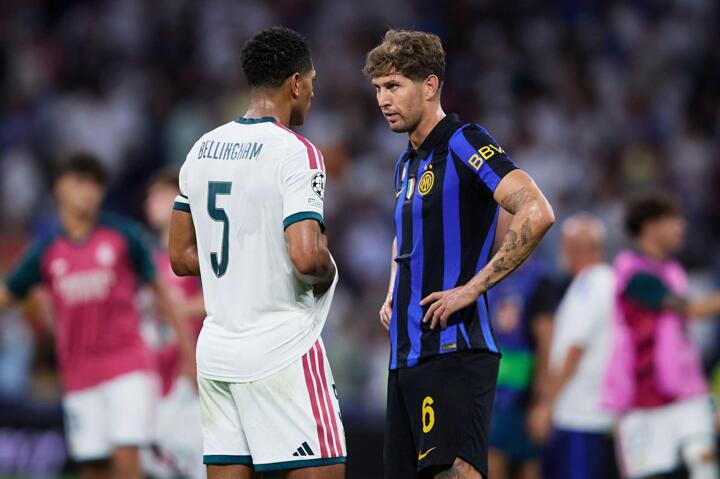
After a significant Champions League match, it's easy to draw extreme conclusions.
However, in a low-scoring sport like football, the reality on the pitch is typically more complex and nuanced. Real Madrid's high-pressing approach demonstrated in their 2-1 victory over Inter Milan in the opening round is a perfect example.
In this encounter between Mourinho and his former club, Real Madrid scored twice using high-pressing tactics, but Inter Milan also breached their defensive line on several occasions.
Real Madrid employed a hybrid pressing setup: when Inter Milan attacked down the right flank, Alexander-Arnold and Brahim used zonal coverage to protect the center; when the Italian side switched play to the left, Real Madrid quickly shifted to man-marking.

In this scenario, Valverde, Vinícius, and Bellingham marked Barella, Pavesat, and Çalhanoğlu respectively, Alexander-Arnold marked Curtis Jones, and Konatetat maintained a narrow defensive line.
Mbappé initiated the press, closing down Bisseck, who played a back pass to the goalkeeper, who then shifted the attacking focus to the left flank.

Seconds later, when Inter Milan launched an attack down the left, Brahim stepped up; simultaneously, Konatetat advanced to tightly mark Inter Milan's striker Lautaro Martinez, and Real Madrid began executing their man-marking system.
When Jones played a back pass to José Martínez, and the goalkeeper then distributed the ball to Bastoni on the flank, Real Madrid's man-marking was in full effect.
Brahim pressed the left center-back, Dumfries pushed forward to close down Carlos Augusto, Mbappé marked Bisseck and covered passing lanes, and other Real Madrid players retreated toward their respective marks.
Under intense pressure, Bastoni passed to Augusto, whose long pass was cleared by Hüjsen with a header.

Both of Real Madrid's goals that evening came from this high-pressing approach, though Inter Milan's mistakes might have been avoidable.
Leading up to the first goal, when Jones advanced down the right wing, Alexander-Arnold and Brahim held their zonal positions, while Cucurella, Bellingham, Valverde, and Hüjsen marked Diouf, Çalhanoğlu, Thuram, and Barella respectively. Two Real Madrid players later switched marking duties due to shifting Inter Milan midfielder positions.
This limited Jones's forward passing options, and Alexander-Arnold immediately pressed his English counterpart, whose mistake led to another error from Bisseck.
Brahim, in a narrow position, quickly capitalized on the opportunity, assisting Mbappé for a clear chance to make it 1-0.

Real Madrid's second goal also stemmed from a high press.
At this moment, Vinícius, Valverde, and Bellingham were marking Bisseck, Barella, and Çalhanoğlu, while Mbappé directly pressed the goalkeeper.
José Martínez distributed to Pavesat on the flank, who then found Bastoni, triggering Real Madrid's man-marking system again. Brahim rushed toward Inter's left center-back, Dumfries pressed Augusto, and Valverde gambled that his pace was quick enough to cut off a pass to Barella.
Inter Milan played another back pass to José Martínez, but Valverde advanced to close down the goalkeeper directly, cutting off the pass to Barella.
With Real Madrid's full-court man-marking system applied, José Martínez had no options (as shown below); he panicked and made a mistake, allowing Valverde to steal the ball and score.

"Valverde's goal wasn't a coincidence; it was a perfect illustration of our tactical system at that moment," Mourinho said after the match.
Real Madrid's high press and aggressive pressure without the ball created two additional clear chances for Bellingham and Mbappé in the 47th and 67th minutes. However, their system was also broken down by Inter Milan's flexible build-up play from the back on multiple occasions.
In the example below, with the ball on Inter's right flank, Alexander-Arnold and Brahim don't mark Jones and Bastoni.
However, when Inter switched play to the left, Dumfries remained some distance from Augusto, and Alexander-Arnold chose to block the pass to José Martínez, leaving Jones completely unmarked.
This was a positional error in Alexander-Arnold's defensive judgment, as the defensive system should have maintained man-marking in this situation, evidenced by Konatetat closely marking Inter's center-forward.
Consequently, Bastoni easily found the unmarked Jones, and Inter Milan progressed the ball forward smoothly.

In another example below, Bellingham marked Çalhanoğlu, Mbappé pressed Inter's goalkeeper while covering Bisseck's passing lane, and Real Madrid's left-side players pressed their opponents.
When the ball reached Diouf, Mbappé's angle to block Bisseck's passing lane no longer existed, and he should have switched marking duties with Bellingham at this moment.
But the French captain stopped moving, and Bellingham hesitated when tracking Çalhanoğlu, as he was caught in a two-vs-one situation.
Mbappé's positional error prevented Bellingham from marking Bisseck, and Diouf subsequently found the unmarked Bisseck behind the center-back.
Even when Mourinho's team was ready to execute their man-marking system, their movements were sometimes too slow.
Bastoni passed to Augusto on the flank, Dumfries pushed forward to press the left-back, but Alexander-Arnold was still quite far from his man Curtis Jones at this moment.
Next, Konatetat failed to tightly mark José Martínez, allowing Inter Milan to penetrate Real Madrid's defensive line, forcing Valverde to drop back and maintain his position.
The problem was that Sučić, whom Valverde originally marked, pushed forward, meaning Cucurella had to cover for him, leaving Diouf unmarked near the sideline.

Curtis Jones recognized the shifting play and immediately redirected the attack toward Diouf, allowing Inter Milan to easily penetrate Real Madrid's penalty area.
Real Madrid's inability to prevent Inter Milan's build-up from the back allowed Chivu's side to attack through Real Madrid's midfield at the Bernabéu and create multiple chances.
So, was Real Madrid's high press a success or failure? Ultimately, it helped the team create four clear-cut chances and converted two of them.
Mourinho's fifth match in charge presented a serious test of Real Madrid's persistent defensive weaknesses.
The strong high-pressing approach showed improvement from the team, but the weak organizational structure without the ball continued to highlight the same old problems.
However, the truth often lies between these two extremes.
Website AF đã ra mắt! Xem tin tức đầy đủ, bình luận, chi tiết trận đấu và thống kê trên máy tính. Truy cập: www.allfootballapp.com
 インテル
インテル
 レアル・マドリー
 クリスティアン・キヴ
 モウリーニョ
 チャルハノール
 ニコロ・バレッラ
 バンジャマン パヴァール
 トレント アレクサンダー=アーノルド
 キリアン ムバッペ
 フェデリコ・バルベルデ
 イブラヒマ・コナテ
 アレッサンドロ・バストーニ
 ブラヒム・ディアス
 ジョゼップ・マルティネス
 ヴィニシウス
 ヤン・アウルル・ビッシェック
 ベリンガム
ベリンガム
すべてのコメント