Infantino's plan to sell FIFA shares to private investors (including Kushner) has sparked strong opposition, putting his presidency at risk, The Athletic reports.
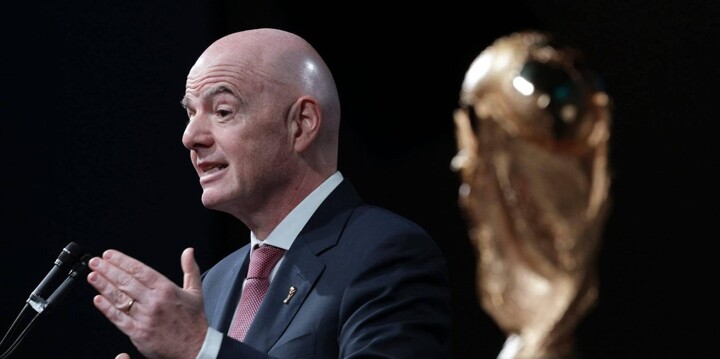
Infantino had originally planned to announce this proposal at the Waldorf Astoria in New York, on the eve of the FIFA World Cup final. The night before, he had shared the stage with the former US President at Trump Tower, calling the 2026 FIFA World Cup "the greatest human, social and cultural event humanity has ever witnessed." In front of billionaires, Trump family members, and football executives, Infantino's control over football seemed unshakeable. He posted on social media that he had secured commitments from over 200 of the 211 member associations to support his re-election in 2027, with the African, Asian, and South American football confederations all unanimously backing him.
Despite scandals during the FIFA World Cup, such as visa denials, Trump's interference, and multi-state investigations into FIFA's ticketing operations, the event generated $15 billion in revenue, silencing those uneasy with Infantino's leadership. He was so confident that he did not hold the customary closing press conference after the event. Last Sunday, he lashed out on social media at the scrutiny and criticism of his leadership, accusing critics of "spreading hatred" and advising them to "meditate, pray, or watch a football match."
However, a week later, Infantino's reign is in jeopardy. The speed of his downfall has been astonishing. His statement on Friday, announcing the termination of the "FIFA Forward Enterprises" plan, did not appease the fiercest critics. UEFA accused him of "dirty backroom dealings" and called for his resignation, stating that FIFA's leadership had "lost the trust not only of UEFA but also of many other members of the football family." Concacaf followed suit, claiming that FIFA's leadership "no longer puts football first" and calling for "a full reckoning of the president."
According to multiple anonymous sources, Victor Montagliani, the current FIFA vice president and Concacaf president, is seriously considering challenging Infantino for the presidency. Sources close to Montagliani declined to comment on his intentions, saying he was focused "around the clock" on Concacaf's response to the crisis. Nominations must be submitted by November to participate in next spring's election. Other candidates are also expected to emerge. According to internal UEFA sources, any new leadership candidate to replace Infantino is increasingly likely to come from outside Europe, while being supported by UEFA, which is willing to rally around a "unity candidate."
On Saturday, Infantino's allies and opponents both emerged. He received support from the Qatari and Moroccan football associations, two countries he had diligently courted. Qatar hosted the 2022 FIFA World Cup, and Morocco is bidding to host the 2030 FIFA World Cup final. Lebanon also declared its support on Saturday evening.
However, FIFA politics is a numbers game. Concacaf's 96 member associations and UEFA combined do not constitute a majority. If Infantino is to be overthrown, these confederations need to remain united and win over member associations from regions where Infantino has more support, such as Africa, South America, and even Asia and Oceania.
In the coming days or weeks, we will see if Infantino intends to fight a protracted battle. As pressure has mounted in recent days, there is no indication internally that he is considering resignation. Instead, he is discussing how to extricate himself from the secret plan while retaining the presidency. But he is losing credibility.
FIFA Chief Operating Officer Kevin Lamour told the Associated Press that employees felt "betrayed" by Infantino; he said that even if it cost him his job, he would sleep better after speaking out about the matter. "This was a one-man project," Lamour said, "It's time for the political leaders in football to look themselves in the mirror and make the right decisions."
Lamour, who previously served as a UEFA executive, is highly respected by his European counterparts, who do not want him to resign, as they wish to retain him as a voice of reason. Infantino's advisor, former U.S. Soccer Federation president Carlos Cordeiro, resigned on Friday, condemning the proposal as "a bad deal." While Cordeiro's departure was accompanied by a strongly worded statement, its significance may not be as apparent as it first seems. His primary function was to help ensure the smooth running of the North American FIFA World Cup and liaise with the White House, and he initially did not even receive a salary for his FIFA role. A seasoned investment banker, he later agreed to an annual salary of $200,000, which his representatives said was donated to a charitable foundation. Like many within the FIFA system, Cordeiro had stood by Infantino during some of his most controversial decisions, most notably the FIFA World Cup's exploitative ticketing strategy and Infantino's awarding of the inaugural FIFA Peace Prize to Trump without notifying his deputies and the FIFA Council, which ultimately went unaddressed.
Infantino's relationship with FIFA Secretary General Mattias Grafström has deteriorated, with sources inside and outside FIFA stating that the Swede was not involved in developing the share sale plan and was unhappy about being excluded from discussions. Over the past year, he has grown increasingly displeased with Infantino's decision-making, and several football executives say they cannot understand why the FIFA president would not inform his secretary general of such a major idea. A FIFA spokesperson responded: "FIFA does not comment on speculation about internal relationships."
If Infantino barely manages to retain his position, his ability to drive change or achieve his ambitions will be hampered. Just two weeks ago, he openly joked with Trump about expanding the FIFA World Cup to 64 teams, a concept proposed by Conmebol and increasingly supported by Infantino. This idea, previously opposed by UEFA and Concacaf, will now be even harder to implement. He also faces challenges from European clubs, who are angered by the news that some FIFA event revenues, including the Club World Cup, might be sold to external investors.
FIFA's funding for the organization, participation fees, and prize money for the future 2029 Club World Cup is uncertain – the 2025 Club World Cup was only salvaged after DAZN paid $1 billion for broadcasting rights, and months later, a company owned by a Saudi public investment fund acquired a partial stake in the broadcaster. Meanwhile, sources close to the discussions say that no agreement has yet been reached between FIFA and major European clubs regarding participation in future tournaments.
AF's PC site is now live! Browse full news, comments, match details and stats on your computer. Visit: www.allfootballapp.com
 Gianni Infantino
 FIFA World Cup
모든 댓글 (1)