Manchester United manager Carrick was interviewed by Sky Sports. In the Unpacked program, he answered 15 questions about the day-to-day work of a Premier League manager, discussing topics such as team talks during halftime, daily training schedules, pre-match preparation, how he interacts with players and staff, and the impact of midweek matches on training plans. This article is the first part of that exclusive interview.
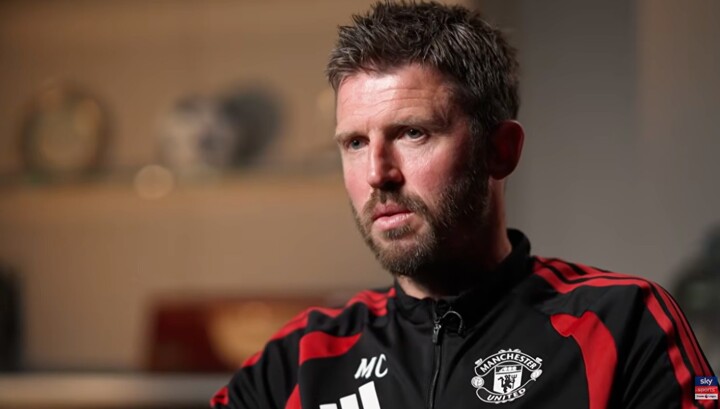
How much time do you actually have to speak with the team during halftime?
Carrick: Honestly, it depends on how long you want to talk during halftime. At Old Trafford at least, I find it's quite a long walk for everyone to get off the pitch and back to the dressing room. You have to go around the corner and then walk down the tunnel. Some stadiums have dressing rooms closer to the pitch, so compared to those, we don't have much time.
But I usually start talking very quickly. When I say "quickly," I mean really quickly. As soon as the players sit down, I'll speak for a few minutes, then give them a bit of time to digest it. So sometimes it could be 2 minutes, sometimes 5 minutes, depending on how the match is going and what the players need at that moment.
On match day, what do you do after the players leave the dressing room and head down the tunnel?
Carrick: Actually, when the players go out, I'm right behind them. Honestly, the hardest part is when they go out for the warm-up. At that point, they're warming up outside, and you're left alone in the dressing room or your office, and it suddenly becomes quiet, and there's not much you can do at that time.
After they go out for the warm-up, do you ever overthink things? Like start going over tactics repeatedly and then doubt certain decisions? Is it easy to get lost in your own head at that point?
Carrick: Yeah, I think there are two sides to it. Sometimes it's good to have a bit of time to think things through on your own; sometimes it's also good to take a moment to clear your head and prepare for what's about to happen. But there are also times when I completely disconnect from the match, spend 5 or 10 minutes watching TV, just to take a breath, clear my mind a bit, and then get ready for the match. So it really depends on the specific situation.
Are there areas of the pitch that a head coach cannot access?
Carrick: On the pitch.
Does that sometimes feel difficult? Do you ever wish you could get directly involved on the pitch?
Carrick: Those days are behind me. I can't do what these players can do now.
Are you in the players' WhatsApp group?
Carrick: No. I have a group with the coaching staff and support staff, mainly for organizational and coordination matters. But the players have their own group.
Can you describe what a typical training day is like for you? From waking up in the morning to going to bed at night.
Carrick: First of all, it's a very long day. I usually wake up around 6:15 or 6:30 and arrive at the training ground around 7:30, usually before 7:30.
Training is basically planned the day before. Most of the time, we might even have a rough idea of what we'll do a week in advance. I don't like arriving at the training ground in the morning and then deciding what to do that day or how to structure meetings. I prefer to plan everything beforehand so that both I and the rest of the staff know what's coming.
The players then arrive gradually, some between 8:45 and 9:45. Then we might have a meeting, or we might not. At 10:30, they'll do gym work; at 11:00, they'll train on the grass outside. After that, depending on the day, we decide what type of training session to organize.
Most of the time, after training, they'll also go to the gym for some additional work and recovery. After that, I generally give the players their own space, unless there are other things to address. Sometimes there are individual conversations, and sometimes there are group meetings.
However, most of the time, I spend the afternoon planning the next match or the next training session, or perhaps watching the young players train, or speaking with the academy coaches, which I think is very important. After that, it's about handling everything that needs to be dealt with, one by one. Sometimes we can leave at 4 p.m., sometimes it's 6:30 or even 7 p.m., depending on what's next.
When I get home, I spend time with my family. I don't really go out again; I enjoy being at home. I have some horses at home, so I'll go check on them, then spend time with my family, switch off from work, and start again the next day.
What's it like managing staff and players who used to be your teammates?
Carrick: I think you gradually get used to managing different people. Ultimately, it's about mutual respect and understanding each other's positions and circumstances. The biggest challenge was probably when I first moved into coaching with Jose. Because I had literally just come out of the dressing room, so it was a bit like being half player, half coach.
During that time, there was an identity transition, though not for very long, which was probably the hardest part to adapt to. Because one moment they're your teammates, and the next you have to start coaching them. But I think as you continue doing it, it becomes easier and easier.
What's the main difference between being an assistant coach and a head coach?
Carrick: Ultimately, as a head coach, everything ultimately falls on you. So if you really want to do something, you can do it. I think that's the clearest difference.
As an assistant coach, you try to understand what the head coach wants, then help him move in that direction as much as possible, rather than suddenly proposing something completely different that changes the whole direction and might even cause confusion.
I think as an assistant coach, you need to have new ideas and different perspectives, but those ideas need to be within a range that's actually executable and shouldn't make things worse. But ultimately, as a head coach or team manager, the decisions are yours to make. Sometimes those are important decisions, sometimes just small ones. But either way, once you make a decision, you can implement it according to your own judgment, and you don't have to guess what others might think.
Related reading:
Diterjemahkan oleh AI.
Situs web AF kini hadir! Lihat berita lengkap, komentar, detail pertandingan, dan statistik di komputer Anda. Kunjungi: www.allfootballapp.com
 맨체스터 유나이티드
 마이클 캐릭
모든 댓글