Brazil's national team coach Carlo Ancelotti granted an exclusive interview to CNN Brasil, where he reflected on the team's World Cup performance and discussed squad renewal for the new cycle, Neymar's future with the national team, the development of young players, and Brazil's midfield needs. This is the second part of the interview.
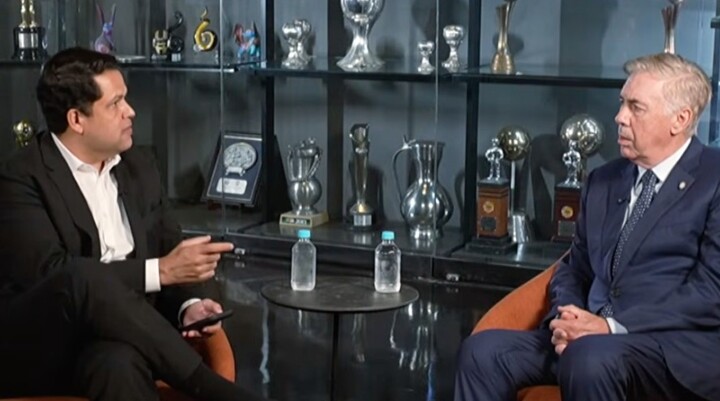
Coach, we can also see that several important players from the World Cup squad have been retained. You've kept the left-back, the centre-back pairing, some midfielders, and several forwards. A total of 10 players from the last World Cup are in this national team call-up. Do you believe Brazil already has a relatively mature fundamental structure for the 2026 World Cup?
I believe the foundation is well built and the overall structure is solid. Of course, we still need to keep watching. Some players who are not currently selected may still return in the future, appear on the next squad list, or even participate in the next World Cup.
The only players truly ruled out are those who have declared their national team career is over, like Neymar and Casemiro. All other players have the possibility of returning to the national team. We will pay attention to all Brazilian players.
Thiago Silva said in an interview this week that Brazil cannot abandon its most experienced players. In your view, should the national team continue reserving spots for players over 30 years old? This is a delicate balance. A player who is 32 now will be 36 at the next World Cup. How do you balance not abandoning experienced players still in good form while also looking toward the future four years from now?
I think we have to take it step by step. Right now, this is the first match after the World Cup, and it's a friendly, so we should focus on young players who could join the national team in the future, such as those born in 2004, 2005, or 2006.
We also have some very talented young players born in 2008. They haven't started playing regularly yet, but they could in the future. So we should focus our attention on these players now, while also considering and respecting the age factor.
In fact, a player can still perform very well at 36 or 37 years old. I once had a captain, Paolo Maldini, who won the Champions League at 39. So it's not a matter of age, but of different stages. For this current stage, we should prioritize young players.
Coach, after the World Cup ended, a discussion began in Brazil. Every time a World Cup ends, Brazilians analyze Brazilian football more deeply, as if they were on a psychiatrist's couch. Now people are discussing the issue of identity among Brazilian players and the national team. Our players leave Brazil at a very young age, and some believe they lose this sense of identity to some extent. You have experience coaching around the world, have worked at many top clubs, have coached many Brazilian players who play abroad, and have now been working in the Brazilian football environment for about a year and a half. How do you see this problem? And how can we strengthen the sense of identity among Brazilian players and Brazil, and the national team, so they feel the power that Brazilian football has in the world?
I believe Brazilian players love their national team more than players from any other country. It's a very strong love. Sometimes this love can also bring them greater pressure and more anxiety. But Brazilian players truly love the Brazilian national team jersey.
I'd like to ask you to elaborate a bit more. You're Italian, you've worked in Spain, and you've coached in many top leagues around the world. Why do you think Brazilian players love the national team more than players from other countries?
Because during my time as a club coach, no Brazilian player ever asked me not to let him go to the national team. But players from other countries have done so, including Spanish, Uruguayan, and French players. However, not a single Brazilian player, during my time as a club coach, has ever asked me not to let him go to the national team.
Let's continue discussing Brazilian football from a broader perspective. This week, Silas—I believe you remember him, he was an excellent player for São Paulo and the Brazilian national team—said he lacks confidence in the future of Brazilian football because he believes Brazilian football is "killing generations of players." He gave the example of Grêmio. This team has more than a dozen foreign players. In Silas's view, this makes it difficult for young players to break into the first team, which in turn affects their chances of making the national team. This may or may not be a coincidence, but since Brazil relaxed its restrictions on the number of foreign players, Brazil hasn't won a World Cup. Many believe that the growing number of South American players entering the Brazilian market is preventing young players from getting opportunities and affecting the development of a new generation. I'd like to hear your analysis on this.
Indeed, this is a very interesting topic, and Silas raises a very important question. The Brazilian Football Confederation (CBF) is also discussing this issue, hoping to help young Brazilian players get playing opportunities at their clubs.
Now, I can say that we certainly lack midfielders; in fact, there is a shortage of midfielders.I hope that over the next four years, Brazilian football can produce more midfielders. I can see that the performance of the under-17 and under-20 national teams is improving, and there are many talented players at the youth development level.
Brazil has many talented players, that's obvious. As I said, the needs of clubs don't always align with the CBF's needs. Therefore, we must pay close attention to these young players.
If we believe certain players are important for the national team but don't have playing opportunities at their clubs, then we must call them up and give them chances to play.
The number 10 shirt of the Brazilian national team has always had a legendary aura. The number 10 is the one who can control the ball, make passes, and organize the game. But for some time now, Brazil seems to have stopped producing this type of player. You just mentioned that the national team lacks midfielders. How should we solve this problem? What do you think about developing traditional number 10 players? I'm thinking of Pelé, Zico, Rivelino, Raí, Raí de Souza, Ronaldinho—the type of player who can control the midfield and organize the game.
Yes, that's true. However, I believe that modern football requires collective effort, not relying on one individual's personal skill. Of course, if you have players with very strong individual abilities, your chances of winning are greater.
But modern football doesn't allow you to not have a strong collective. So our work is to build a strong collective for the future, not just rely on one player with exceptional individual ability.
What type of midfielders do you want to develop and find for the Brazilian national team over the next four years?
I think right now we have many box-to-box midfielders, but fewer positional midfielders. We're watching some young players who fit this profile. For example, Zé Lucas—I can use his name to explain this type. He has characteristics that could be very interesting in the future.
The pace of football today is very fast, isn't it? The rhythm of the game has increased significantly over recent decades. Is there still room for traditional number 10 players in modern football? Brazil used to be one of the most important places in world football for developing this type of player.
I believe in recent years, the number 10 has increasingly become an attacking player, someone who operates behind the striker. This was also the case at this World Cup.
Spain, which won the World Cup, had a very atypical number 10, because it was a number 10 with very high intensity. We also have this type of player in our national team.
Related reading:
Traducido por IA.
¡El sitio web de AF ya está disponible! Consulta noticias, comentarios, detalles de partidos y estadísticas en tu ordenador. Visita: www.allfootballapp.com
 플루미넨세
플루미넨세
 브라질
브라질
 치아구 시우바
 카를로 안첼로티
모든 댓글