Why Manchester United missed out on a left-back in the transfer window. Rob Dawson explains the recruitment philosophy of Omar Berrada and Jason Wilcox.
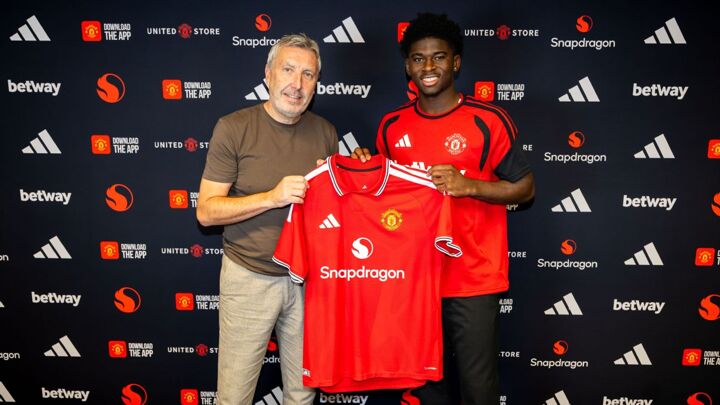
Manchester United spent the summer trying to avoid repeating past mistakes while building for the future.
Previous missteps in the transfer market have largely shaped the club's strategy this window. The priority is moving the team forward without making the same errors that have held the club back before.
Some fans may view Manchester United's reluctance to spend big as a lack of ambition, especially this summer when Manchester City, Chelsea, Liverpool and Tottenham Hotspur all spent £100 million or more on individual players. CEO Omar Berrada and football director Jason Wilcox, however, would argue that caution is necessary given what has happened before.
Why? Because Manchester United finds it harder than most clubs to overcome the consequences of transfer mistakes.
Ugarte is a stark example. The Uruguayan midfielder joined Old Trafford in 2024 for a transfer fee exceeding £50 million. After two underwhelming seasons, he became available to leave this window. The club knew it would need an offer around £20 million to balance the books, but that was unrealistic given his recent form and wage demands.
The best they could hope for was finding a club willing to cover Ugarte's wages and take him on loan. Ultimately, a serious knee injury at the Copa America derailed any potential move. Manchester United will receive wage compensation for Ugarte through FIFA's Player Protection Programme, which applies when players suffer injuries during international duty.
However, this injury merely delayed the problem. Ugarte's contract doesn't expire until June 2029, meaning Manchester United will still need to find a solution for him next summer or beyond. This problem could linger for another three years—precisely the scenario Berrada and Wilcox are trying to avoid.
Midfield Overhaul
After overhauling the attack last year, Manchester United's priority this summer was strengthening midfield.
Ultimately Manchester United opted for three players with Premier League experience—Santos, Tielemans and Baleba—for a combined £155 million. Sources at ESPN indicated that given consistently high prices for midfielders, these three signings were viewed as shrewd value and lower risk. By contrast, the combined fees for Elliott-Anderson to Manchester City, Tonali to Tottenham Hotspur and Enzo Fernández to Manchester City totalled £341 million.
Manchester United was interested in Anderson, but only accepted Nottingham Forest's initial £70 million valuation. They also considered Tonali, but deemed it too risky to invest heavily in a player who had just received a lengthy ban for breaching betting rules.
Budget was also a factor, particularly given that few players needed to leave. Manchester City generated nearly £350 million in sales this summer, while Manchester United's sales brought in less than £50 million.
It was initially expected that Barcelona would activate Rashford's buyout clause, and those funds would have been used for Zirkzee. As it turned out, Barcelona preferred to sign Anthony Gordon for that winger position, and although Manchester United contacted Fiorentina and Juventus about the Dutch forward, nothing materialised. By the time Everton called late on deadline day, it was too late.
The financial reality for the club is that they cannot spend £300 or £400 million in a single window. Manchester United had the means to match Tottenham Hotspur's £85 million offer for Matheus Fernandes, who was on Manchester United's shortlist of midfield targets. However, the club ultimately decided not to pursue it, partly because Fernandes never indicated during talks that he preferred Old Trafford. Manchester United viewed this as a red flag they couldn't ignore.
Berrada and Wilcox have consistently emphasised that they want to sign players who clearly express a desire to play for Manchester United, such as Cunha and Mbeumo. If they got their preferred targets last summer, this time they had to be more flexible.
After a deal for Atalanta midfielder Ederson collapsed due to medical issues, Manchester United accelerated negotiations with Chelsea for Santos. After deciding against Fernandes, they quickly activated Tielemans' £35 million release clause.
In the days after Tielemans arrived, Manchester United also pursued Skelley aggressively. But after Arsenal decided to keep him at the Emirates, Manchester United turned their attention to Baleba. Brighton's initial £120 million valuation was eventually reduced to £70 million.
Manchester United faced other obstacles as well.
Mamadou Sangare was a player the club had closely monitored, and data analysis showed his statistics at Lens last season were comparable to Matheus Fernandes' numbers at West Ham United. However, Manchester United recently noticed a trend: agents are increasingly willing to send players to mid-table Premier League clubs first. This allows players to gain more playing time, and then when they move to a higher-level club in the top six in the future, both the transfer fee and wages will be higher.
Caicedo followed this path, joining Chelsea for £115 million after a full season at Brighton and Hove Albion. Sangare and his team joined Brentford this summer for around £40 million. If he has a good season at Brentford, his value—both in transfer fee and wage expectations—will increase significantly by 2027.
No Need to "Win the Transfer Window"
Sources at ESPN report that Manchester United's priority next summer is defence.
Berrada and Wilcox are satisfied with the signings of Cunha, Mbeumo, Sesco and Lamento. Avoiding mistakes in that transfer window allowed the club to continue its plan to strengthen midfield. Avoiding mistakes this time will also free up funds to bring in centre-backs and left-backs ahead of the 2027-28 season.
A common phrase at the club is "building blocks"—gradual squad improvement over time while avoiding the need to go back and fix problems that should have already been solved.
Sources at ESPN report that Manchester United acknowledges the team failed to address its left-back shortage when the transfer window closed on Tuesday at 11 p.m. BST. They could have signed Raum from RB Leipzig, as the club had been told all summer that he was available. But Manchester United believed that signing the 28-year-old for around £30 million on a four or five-year contract could disrupt the next phase of their transfer plans.
Lewis Hall was Manchester United's primary target for that position, but Newcastle United refused to negotiate, making any deal impossible until next year. If Hall had been the priority this summer, the Baleba deal likely would not have been funded.
Manchester United also considered short-term solutions to fill the gap. In the final week of the transfer window, Ait-Nouri's agent offered him to Manchester United. On deadline day, Manchester City also told Manchester United that any deal would need to include a mandatory buyout clause. Manchester United withdrew its interest after learning a long-term obligation was required to complete the deal.
The club knows it's not ideal, but their plan is about more than winning one transfer window. The goal is to position the team to sign their desired players next summer.
Manchester United hopes this long-term approach will ultimately pay off.
Переведено ИИ.
Сайт AF теперь доступен! Читайте полные новости, комментарии, детали матчей и статистику на компьютере. Посетите: www.allfootballapp.com
 မန်ယူ
မန်ယူ
 အာဘီ လိုက်ပ်ဇစ်
 ရောမ်
ရောမ်
မှတ်ချက် အားလုံး