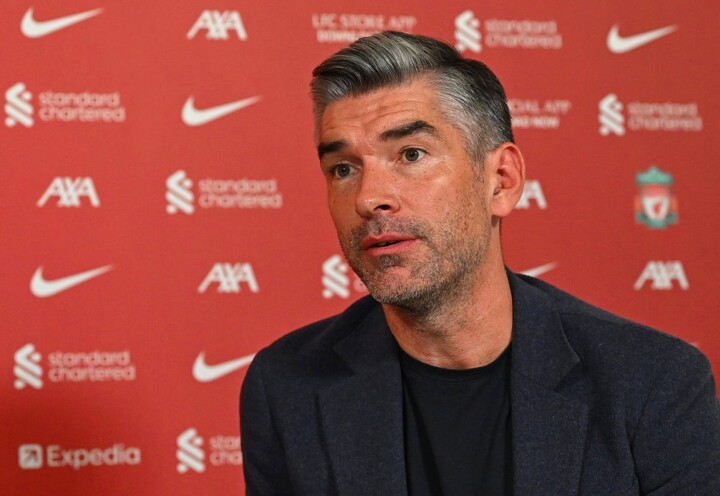
According to The Athletic, Liverpool sporting director Richard Hughes has stepped down from his position. During his tenure, he spent £670 million on squad overhaul, but leaves with the sense that he has compounded Liverpool's problems rather than resolved them.
Ten years ago this week, Sadio Mané scored on his Liverpool debut at Anfield, helping the team to a 4-1 victory over Premier League champions Leicester City. It was the second of his 120 goals for the club, and across 269 appearances he won nearly every major trophy, departing as a legend while Liverpool essentially recouped its initial investment in him.
The numbers behind Mané should serve as a lesson for whoever succeeds Richard Hughes in charge of Liverpool's transfer strategy. Even accounting for inflation, a good deal is signing a 24-year-old for £30 million and selling him at 30 with a haul of medals for potentially £35 million.
Mané ultimately failed to deliver a profit for Liverpool, as he could not establish himself at Bayern Munich and moved to Al-Nassr in Saudi Arabia after just one season, where he remains. This has led some to argue that Liverpool should have kept Mané longer. When he left, his 23 goals in 2021-22 were his second-best return in six seasons. However, in his final season at Liverpool, he spent considerable time playing as a centre-forward rather than on the left wing, where he had been so dangerous.
This decision was partly due to Roberto Firmino's diminishing influence. Meanwhile, Liverpool found a replacement for Mané in Luis Díaz, who joined from Porto. Like Mané, Díaz eventually departed for Munich, but this time Liverpool received a significant profit on the transfer. Such a transaction is difficult to repeat, yet Liverpool should have learned from it.
Díaz's departure now appears to have been a mistake, as he has performed exceptionally well at Bayern Munich, and no one at Anfield has adequately replaced him. The team has faced difficulties for various reasons since summer 2024. It is easy to conclude that what matters is not how much you spend on players or how much you recoup from their sales, but whether the replacement is suitable and successful. However, increased ambitions clearly depend on sensible spending, thereby expanding the club's capacity.
Liverpool officially confirmed that Richard Hughes has resigned as sporting director. Hughes informed the club's leadership of his desire to pursue new challenges and departs with the best wishes of everyone at Liverpool.
This brings us back to Hughes, who announced his departure earlier today. After Díaz's exit, Hughes and then-manager Arne Slot chose not to replace him with Bradley Barclay, instead prioritizing reinforcements in other positions, believing Cody Gakpo could step up. The option of giving Ngoumohé a chance was also considered. Since then, Hughes has approved £670 million in investment to rebuild Liverpool, including the major deal that finally brought Bradley Barclay to Anfield last week. In their away match against Ipswich on Friday evening, Liverpool's performance and victory provided encouragement; it was their most cohesive and organized display since winning the title in 2024.
However, Hughes is blamed for leaving the team with insufficient squad depth. Had he struck smarter deals after Liverpool won the title, many subsequent problems might have been easier to resolve.
Given that Fenway Sports Group has always operated within realistic financial parameters, it is shocking that so many players were allowed to leave Liverpool as free agents since 2021. Of the 14 players who featured in the 2019 Champions League final victory over Tottenham, eight ultimately departed as free agents or for negligible fees — and if you include Trent Alexander-Arnold, his market value would certainly be ten times the nominal fee Real Madrid would have paid to secure him for the Club World Cup. At some point, even before Hughes arrived, the ruthlessness that made Liverpool competitive disappeared, as they received little compensation for their heroes, with the exception of Mané, Fabinho, and Jordan Henderson.
Hughes's record deserves serious scrutiny, because as it stands, the overspending in 2024 means he departs with the sense that he has compounded Liverpool's problems rather than solved them. Even at the end of his three-year tenure, he was still dealing with the consequences of poor decisions made by previous staff — some of which were too easily overlooked.
The enormous praise Liverpool received for building a team under Jürgen Klopp is now a distant memory. Over six transfer windows from summer 2016 to summer 2018, Liverpool acquired Sadio Mané, Joël Matip, Georginio Wijnaldum, Mohamed Salah, Andy Robertson, Virgil van Dijk, Fabinho, and Alisson Becker. Only Naby Keïta could be considered a mistake from that period, while player sales, Champions League performances, and commercial growth helped balance the books.
Liverpool made few acquisitions in 2019, but a year later won their first league title in 30 years, so the ends justified the means. However, since 2020, after four changes in sporting directors, Liverpool's transfer policy and player retention have been, at best, inconsistent. Tellingly, when Slot wins the title again in 2025, the most influential players will still be Alisson, Van Dijk, Alexander-Arnold, and Salah — who began playing together in 2018.
When transfer decisions are consistently rated only six out of ten, the team will eventually require significant corrections in subsequent windows, as Klopp did after 2016 when forced to seek short-term solutions for problems that are currently affecting the right flank. On the day Mané thrashed Leicester City at Anfield, Klopp fielded James Milner as left-back, with midfielder Lucas Leiva alongside him in central defence.
Переведено ИИ.
Сайт AF теперь доступен! Читайте полные новости, комментарии, детали матчей и статистику на компьютере. Посетите: www.allfootballapp.com
 လီဗာပူး
 Mark Hughes
 ကိုဒီ ဂက်ပို
 ဘာကိုလာ
မှတ်ချက် အားလုံး