AC Milan defeated Venezia 2-0 at home in the second round of Serie A, and manager Amorim was interviewed by DAZN after the match.
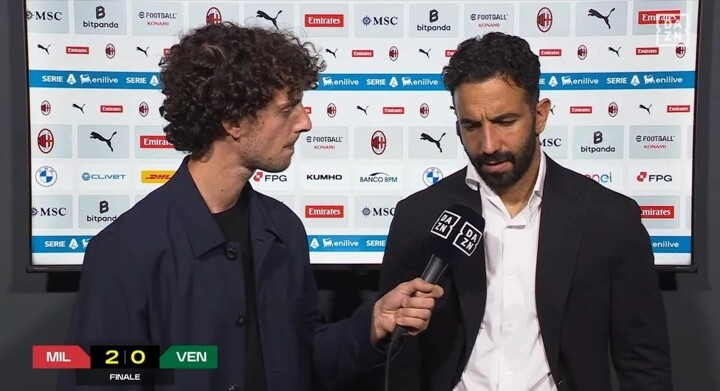
It seems you've understood our Italian conversation perfectly, and you've also grasped Massimo Ambrosini's tactical analysis completely. Since you understood his points, let me ask you directly: do you agree with Ambrosini's assessment that Milan still has significant room for improvement in controlling the tempo and dictating play on the pitch? From an objective perspective, this was a highly competitive and tightly contested match where both teams gave their all. Throughout the game, both sides had periods of possession and exchanged blows. However, we could clearly see that when you demonstrated your team's technical quality and your star players' individual skills at critical moments, you managed to win the game naturally and take home the victory. What are your thoughts on this?
I think for anyone watching the match, this game was actually quite straightforward to understand. Before today's kickoff, I had already stated clearly in the pre-match press conference that this would be an extremely difficult and complicated confrontation for us, largely due to the opponent's unique playing style and resilient tactical approach.
At the same time, we all know that for a top club like Milan, playing at a great stadium like San Siro, the pressure is always there. Especially after our last match against Torino, this was our first official home game in front of our fans, and everyone in the stands had high expectations. They all wanted us to press hard and regain possession as quickly as possible.
However, this also led to a negative tactical chain reaction—because we were eager to press, our defense exposed large spaces, allowing the opponent's strong attackers to frequently create dangerous one-on-one situations with our defenders during counterattacks. As a result, we went through very passive and difficult moments during several transitions between attack and defense.
However, I think one thing is equally clear: we did create more threatening goal-scoring opportunities in this match. But the downside is that we never controlled long passes well today, nor could we effectively stabilize the game's rhythm. Instead, we were dragged unwillingly into the opponent's chaotic rhythm, which prevented us from playing our own style of football completely.
Coach, I'd like to ask a follow-up question because I was just a few meters from you on the sideline observing the match. I noticed a specific moment when a sudden realization appeared on your face, as if a light bulb switched on. At that moment, you were preparing to make a substitution with midfielder Adrien Rabiot, but suddenly you changed your mind and decided to also bring on Alexis Saelemaekers as an attacking midfielder. I want to ask: do you really see Saelemaekers as a potential option in that crucial attacking midfield position in your tactical system? What exactly were you thinking at that decisive moment when you made that double substitution?
The main reason for that substitution was my strong sense at that moment that we needed to make some tactical adjustments to completely change the situation on the pitch. We needed a different tactical approach; we desperately needed to inject more creativity and dangerous passes in behind the opponent's defense and near their goal. That was my genuine tactical thinking at the time. As the head coach on the sideline, closely observing the game, you must constantly read the situation in real time and do your best to position the most suitable players in the most suitable positions.
Hello, coach. For any team in their building phase, there are many tactical details that need to be corrected and refined. This is completely normal in football. However, starting this journey with a win is of paramount importance because in professional football, when you secure victories and three points, the entire team can analyze problems and identify areas for improvement in a more peaceful and confident psychological environment. As you mentioned honestly, you have many tactical details you want to address. So, after these two official matches, looking ahead to next Sunday's league match, what do you believe are the central priorities you need to address immediately?
Our players clearly need more time and deeper technical and tactical preparation. In our current defensive approach, it seems our players are passively waiting for defensive situations to develop, rather than proactively cutting out potential threats in open spaces through active pressing and positional anticipation.
We must all acknowledge that at a club with such deep historical roots as Milan, it's not easy or simple to have every player execute individual marking perfectly. We're well aware that external expectations for a top club like Milan are immensely high, and our historical glory also brings an invisible mental burden for the players. But despite that, the players have worked very hard in training and in matches, as has our coaching staff.
Sometimes, we really can't win matches in the most spectacular or beautiful way, but this victory itself is still extremely crucial and important. One issue we need to focus on next is having more players in the box and attacking when we cross from the wings. Additionally, especially our defenders must remain extremely focused throughout the match; they cannot be mere spectators when the team is attacking. They must be mentally prepared at all times for possible transitions or opponent counterattacks.
Coach, I'd like to ask a specific question about your newly acquired Portuguese forward Gonçalo Ramos. We all noticed he spent some time on the San Siro pitch today trying to find and adapt to the game's rhythm. Clearly, in his debut wearing Milan's legendary red-and-black shirt at San Siro, he inevitably felt immense psychological pressure and nerves. In the early stages of the match, he even wasted two simple chances that we thought he should have scored easily. Fortunately, however, the brilliance of a top-class striker eventually emerged, and he proved his worth with a spectacular finish in front of goal. In fact, in the previous match against Torino, his overall tactical weight and support for our team's tactics were already very evident. I want to ask you: in terms of specific goal targets, have you set any rigid goal objective for him this season? How many goals do you expect him to score for Milan this season? Are you satisfied with his overall competitive state and his attitude today?
To be honest, I really don't like defining a specific number of goals a striker should score, and I don't like measuring a player with cold, rigid numbers. Of course, we paid a huge transfer fee to acquire him, but his aggressive work rate and competitive spirit, his professional attitude and his rich experience that he demonstrates on the pitch fully justify the price.
Today, Ramos' value cannot be measured simply by goal numbers, especially his work rate in high pressing in the attacking third was extremely valuable. Sometimes, his relentless runs and pressure created the impression that there were two of him coordinating defensively on the front line. At the same time, his contribution to tactical link-up play and teamwork was equally significant.
And the most important point, which you just highlighted specifically: although he unfortunately wasted two excellent goal-scoring opportunities in the first half, when the third chance came, he remained absolutely calm, composed and relaxed, completely unaffected by the psychological pressure and negative emotions from the first half, and finally calmly finished past the goalkeeper. This is the mental quality possessed by top strikers and champion players.
Traduzido por IA.
O site do AF já está online! Acesse notícias completas, comentários, detalhes de partidas e estatísticas no seu computador. Acesse: www.allfootballapp.com
 Milan
Milan
 Venezia
 Rúben Amorim
 Adrien Rabiot
 Alexis Saelemaekers
 Gonçalo Ramos
Todos os comentários