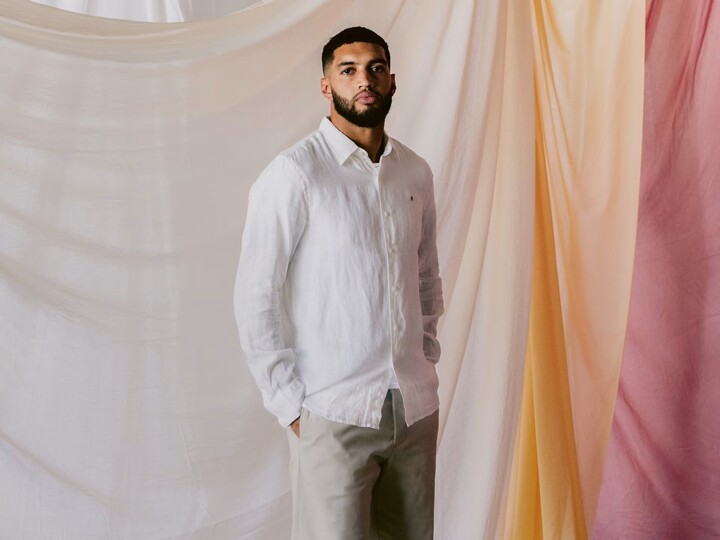
Siyer was interviewed by Borussia's "51" magazine, where he discussed the difficulties he has faced in life and how these experiences have shaped him both on and off the pitch. This article is the first part of an exclusive interview.
Related reading:
Siyer - I speak several languages and will always help my teammates whenever they need me.
What does the celebration mean - rubbing your head and making a gesture to the fans after scoring?
This celebration is dedicated to my younger brother. Before my first match with PSV, he asked me how I would celebrate if I scored. When I asked him to suggest a gesture, he recommended this one.
This celebration reminds me of our childhood. We used to go to the beach together all the time, and after swimming, we'd always do it. This gesture is a reference to that. Later, I felt that a simple wave just wasn't enough to fully express the celebration, so I decided to add the head rub.
Borussia fans will certainly want to see this celebration as much as possible. In your first week at Münster, what are your impressions of the club and the fans?
I felt welcomed warmly. After training sessions, many fans would wait around hoping to get autographs or take photos with us. I think that's great. You can really feel how much Borussia means to so many people. It's a big club, everyone knows it. But you only truly understand how big this club is when you become a part of it.
What exactly impresses you about this place?
Everything here is well-organized and perfectly arranged. The player facilities, the catering, the medical support - everything is like this.
During training, you can feel the intensity and the quality of the players. They think very quickly and react very quickly, which is truly impressive. These are things you only discover once you arrive here.
Why did you choose Borussia? What attracted you most about this club?
It has a lot to do with my experience playing against Borussia with PSV in the Champions League last season. When Borussia players stepped onto the pitch, I felt their pride and their style of play. All of that greatly captivated me, and I really liked it.
You also spoke with Vincent Kompany before the transfer. What did he tell you? Why was he so keen to bring you in?
It's because of my characteristics that I fit very well with Borussia. I'm a player who enjoys pressing, and I can create threats in front of goal. At the same time, I work very hard both when attacking and when defending from a deeper position. PSV's style of play is similar to Borussia's style, and this style suits me very well. Kompany told me that making mistakes doesn't matter - what's most important is to keep trying. If you keep trying, everything else will follow naturally.
Bentaleb is the first Moroccan player to play for Borussia in the Bundesliga. He told us that you have such good momentum and intensity from the first moment that it's impossible to stop you. What special qualities will Borussia fans notice about you when they see you for the first time? And after watching 10 matches, what else might they discover?
First of all, I'm very happy to hear Bentaleb say that about me. Although I didn't know him personally, all Moroccan players know him. From the start, fans can expect intensity from me. I always give 100%, and I feel I can't even manage 90%. After 10 matches, I hope they'll see goals I score and chances I create.
Let's go back to the beginning. As a child, you went to the park almost every night with your father to play football. Tell us about those nights.
I was about 10 or 11 years old at the time. My father noticed that I never used my left foot. He told me, "If you really want to be a good player, you have to use both feet." So every night in the park, he made me kick with my left foot 70 to 80 times. It was really frustrating. Most of my shots went wide, or my father easily blocked them.
Who got tired first - you or your father?
I think if my father hadn't been there, I would have given up after two or three kicks. At that time, I was just a little child who wanted to play happily. But now I understand how much those difficult nights in the park have helped me. I'm very grateful to my father and my parents.
Your father trained your left foot. What did your mother provide?
My communication style comes from my mother. She always asks, "What happened? How are things? What can we do better, or what can we change?" This personality trait comes from her.
When did you first truly realize how much your current life is connected to your parents' strength and faith in you?
Actually, quite early. When I was about 16 or 17, my mother told me about my childhood. At that time, they were very worried that I wouldn't be able to walk normally in the future. It was then that I really understood how hard they worked to give me a normal life.
Now it's my turn. Compared to what they did, what I have to do is simpler - work, keep going, keep trying.
As a child, your feet were curved inward.
Yes, the media later downplayed it a bit, but it was true. If they hadn't done anything back then, I would have had difficulty walking, and at some point I might not have been able to walk at all.
As a child, I wore metal braces to straighten my feet. Those metal pieces were large, and it was difficult even to move around with them. But my mother insisted on keeping them on. She held me in her arms all night while I slept. Because of that, she lost a lot of sleep. She did all of this so that I could walk.
Your parents made many sacrifices for you and the whole family. They left your homeland Morocco, went to Spain first, then relocated to Belgium. What did they tell you about the resilience needed to start over repeatedly in unfamiliar places?
My parents are my greatest role models. When we went to Spain, they had nothing. When we went to Belgium, it was the same - they didn't know anyone. Now they have a very good life, they've raised four children, and they've built a loving family. Whatever happens, our family will stay united. Their journey has shown me that anything is possible.
Looking back at the experience of moving repeatedly, what was the most difficult thing for you? Was it learning a new language? Making new friends? Or adapting to a new football culture?
When we moved from Spain to Belgium, the language was the most difficult. Fortunately, I was young enough to learn it very quickly. Later, when we moved from Belgium to the Netherlands, I really felt the difference in football culture. In Belgium, the style of play is more physical and intense, while in the Netherlands, there's more ball possession and technical play. But because this style of play suits my characteristics very well, I was able to adapt fairly easily.
You're not only a talented footballer but also very skilled with languages. How many languages do you speak?
Five - English, Spanish, French, Arabic, and Dutch. I'll soon add German to that list. I'm interested in different languages and cultures.
AI ဘာသာပြန်ဆိုသည်။
AF ၏ PC ဝဘ်ဆိုက် စတင်ထွက်ရှိပြီ! သင့်ကွန်ပျူတာမှ သတင်းများ၊ မှတ်ချက်များ၊ ပွဲစဉ်အသေးစိတ်နှင့် စာရင်းဇယားများကြည့်ရှုနိုင်သည်။ ဝင်ရောက်ရန်: www.allfootballapp.com
 Bayern München
 Medhi Benatia
 Ismael Saibari
Todos os comentários