In Matchday 4 of La Liga, Real Betis defeated Real Madrid 1-0. After Mbappé missed a penalty in added time, Bartra's premature entry into the penalty area sparked controversy. Spain's Technical Refereeing Committee (CTA) determined that the VAR's decision not to order a retake was correct, and Bartra's actions did not constitute an illegal premature entry into the penalty area.
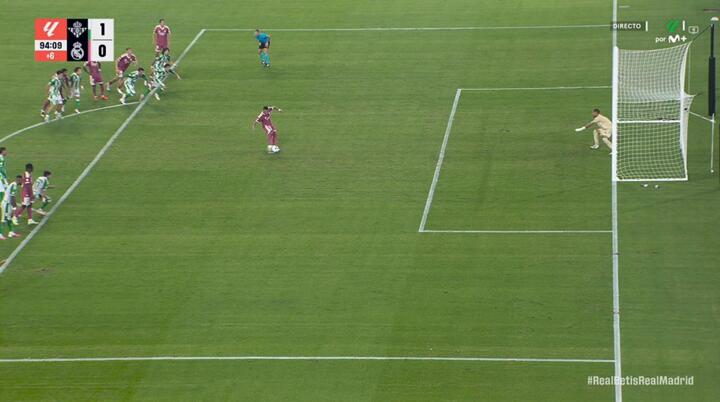
La Liga's 2024-25 season has had its first major controversial decision, which occurred in the final stages of the match between Betis and Real Madrid. To understand why Bartra's action—when goalkeeper Álvaro Fernández saved Mbappé's penalty—was not ruled a premature entry into the penalty area, one must carefully examine the relevant rules. The controversy occurred in the 93rd minute of the match. Romain Peña committed a foul on Vinicius, awarding a penalty, a decision that was not controversial in itself.

Subsequently, Fernández saved Mbappé's penalty, and Bartra prevented Mbappé from challenging for the rebound. Slow-motion footage showed that the Betis defender was moving toward the penalty area at the moment, but at the instant Mbappé struck the ball, he was airborne in full sprint with neither foot on the ground inside the area.

The question then arises: does this situation constitute premature entry into the penalty area?
The VAR determined it was not an infraction, and the guidelines on controversial decisions issued by the refereeing committee provided the same explanation. These guidelines were first introduced by Fran Soto and his team.
The relevant clause on "premature entry into the penalty area" states: "If, at the moment the penalty is taken, a player has one or both feet inside the penalty area, or on the penalty area line, including the penalty arc, then that player has entered prematurely. When judging whether a player has entered prematurely, the projection of other parts of a player's body onto the ground is not considered."
However, an additional clarification is provided in a note below: "If a defending player jumps before the penalty is taken and enters the area while airborne, their body position will be projected onto the ground. If the projection is inside the area, they are considered to have entered prematurely; if they then actively interfere with play, they will be penalized."
According to the CTA's interpretation, if a player enters the area by running and at the moment of the penalty both feet are not on the ground inside the area, then this is not considered premature entry. However, if a player deliberately jumps with both feet to circumvent the rules and thus enters the area, such action will be penalized.
Therefore, in the CTA's view, Bartra did not commit an infraction by entering prematurely, and the VAR's judgment on the situation was correct.
Bartra himself was also aware of this rule.
After the match, the Betis defender said: "In previous matchdays, Gaya also made a small jump like that. I asked a referee friend if that was allowed, and he explained the rule to me, saying that if your foot is still in the air, the penalty doesn't need to be retaken. It worked for me this time, but if Mbappé had taken the penalty a bit later, I might have already landed inside the area. It's just a detail. I'm very happy because these three points are very important for us."
Traduzido por IA.
O site do AF já está online! Acesse notícias completas, comentários, detalhes de partidas e estatísticas no seu computador. Acesse: www.allfootballapp.com
 Real Madrid
 Real Betis
 Marc Bartra
 Kylian Mbappé
Todos os comentários