On August 4th, the Spanish Referees Technical Committee (CTA) announced the rule changes for the new La Liga season. The core new rules cover multiple dimensions, including goalkeeper injury stoppages, substitution time limits, goal kicks, and Video Assistant Referees (VAR).

I. Time Limit Rule for Substitutions Leaving the Field
This clause has been implemented in the 2026 World Cup and will be simultaneously adopted in all professional leagues in Spain for the new season, to prevent time-wasting: after the substitution board is shown, the substituted player must leave the field within 10 seconds; if there is no substitution board, the referee's gesture will be the starting point for timing.
If a player fails to leave the field within 10 seconds (except for special circumstances such as injury or safety protection), the player must still leave the field, and the substitute player must wait until one minute after the match resumes before entering the field. When multiple players are substituted simultaneously, all players to be substituted must leave the field within a unified 10-second limit, based on the last substitution signal.
II. New Rule for Goalkeeper "Tactical Falling" (La Liga Pilot Authorized by IFAB)
Restrictive clauses have been introduced to address goalkeepers intentionally falling, disrupting opponents' rhythm, and taking advantage of opportunities to set up tactics, based on IFAB Circular No. 34:
When the game is interrupted due to a goalkeeper injury, the team's head coach must immediately designate an on-field player to leave the field; if the coach does not designate anyone within 10 seconds after the referee allows the team doctor to enter, the on-field captain will automatically leave the field. The player who leaves the field must wait one minute outside the field after the game resumes before being allowed to re-enter.
Three types of exemption scenarios, where the penalty of leaving the field is not enforced:
1. The goalkeeper's injury is due to a foul that requires an immediate free kick ruling;
2. The goalkeeper collides with an on-field player, and both require medical treatment;
3. The goalkeeper has a bleeding injury.
·General clause: Any on-field player receiving treatment on the field must also leave the field and wait for 1 minute, and can only return with the referee's permission.
III. Updated Ruling Standards for Set Pieces "Advantageous Attack"
When a team takes a throw-in, free kick, or corner kick, if there is a violation in the serving location or action, but the opponent immediately and cleanly gains possession of the ball, the referee may apply the advantage principle to continue the game; if the opponent fails to control the ball, the serving team will re-serve or a penalty will be issued.
IV. Unified Penalty Standard for Second Touch in Penalty Kicks
Regarding the controversial penalty kick involving Alvarez against Real Madrid in the Champions League, the Spanish Football Federation will simultaneously implement the unified IFAB guideline:
1. If a penalty kick shot unintentionally touches the ball a second time and scores, the goal is valid: the penalty kick is retaken;
2. If a penalty kick unintentionally touches the ball a second time and the shot is ultimately off target: the penalty kick is deemed missed.
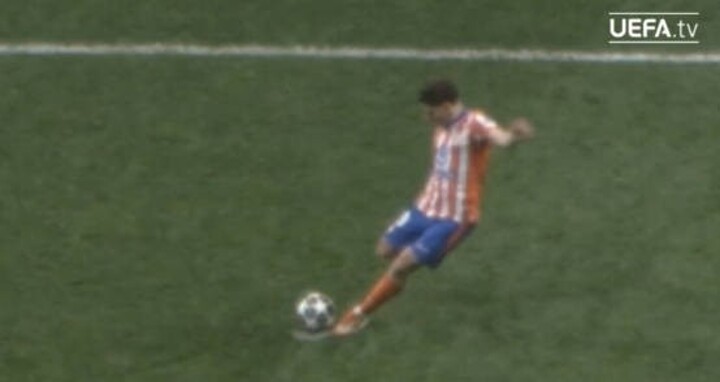
The controversial penalty kick involving Alvarez against Real Madrid
V. Penalties for Time-Wasting in Throw-ins and Goal Kicks
When the referee observes a team deliberately delaying a restart, a 5-second countdown will begin:
1. If a throw-in exceeds the time limit: direct possession awarded to the opponent;
2. If a goal kick exceeds the time limit: a corner kick awarded to the opponent.
VI. Unified Penalty for Defender Handballs in the Penalty Area After a Goal Kick (
Last season, a controversy arose in Atletico Madrid's match against Barcelona: Musso placed the ball to take a goal kick, and Pauwels stopped the ball with his hand in the penalty area. At that time, the referee ruled that the ball had not entered play and did not award a penalty kick.
The new rule clarifies a unified standard: if a defender deliberately touches the ball with their hand/arm in the penalty area after the goalkeeper has touched the ball to take a goal kick, a penalty kick will always be awarded; if a defender is to be involved in playing out a goal kick, they cannot handball the ball to stop it after the goalkeeper has touched it.

Pauwels' goal kick controversy
VII. New Reviewable Scenarios for VAR
In addition to the original categories of goals, penalty kicks, direct red cards, and fouls before a goal, four new review permissions have been added:
1. Red cards issued due to an obvious mistaken second yellow card can be corrected by VAR intervention.
2. Wrong player cautioned/sent off (mistaken identity): when the referee shows a yellow or red card, an obviously unrelated player from either team was penalized for the foul. In this case, the foul itself is not subject to review; only the identity of the penalized player can be corrected.
3. The "identity confusion clause," widely recognized for addressing simulation in the 2026 World Cup, will be incorporated into the detailed VAR procedure revision plan issued in Circular No. 32. However, this clause cannot be activated this season until this revision plan is officially implemented.
4. VAR can only review mistaken identity issues when the referee determines a foul but gives disciplinary action to the wrong player. Examples:
·A player receives a yellow card for another player's handball foul;
·A player receives a yellow card for another player's reckless tackle;
·All similar scenarios: the referee determines a foul occurred, but mistakenly issues disciplinary action to another player. This review can only correct the identity of the offender and cannot overturn the referee's original decision on "whether a foul existed," with the sole exception being: the foul itself falls within VAR's original reviewable scope—goals, fouls before a goal, penalty decisions, direct red card incidents.
5. Obvious mistaken corner kick: Even if the ball actually flew out of bounds from the touchline, as long as the review can be completed immediately and does not delay the resumption of play, VAR can intervene to correct it; if the corner kick has already been taken quickly, the decision will not be changed. When overturning a decision based on VAR information, the referee must make the official television signal gesture. Important note: VAR intervention for mistaken corner kicks is only allowed in extreme cases where the facts are clear and the review can be completed immediately without delaying the match.
6. When the attacking team is preparing to take a free kick/corner kick and the ball has not yet been kicked, if an attacking player commits a foul that the on-field referee does not detect, VAR can recommend the referee to review it on the sideline, provided the following conditions are met simultaneously:
(1) The foul is an act that warrants a direct red card expulsion: violent conduct, spitting, biting, or highly offensive, insulting, or abusive words or actions;
(2) The foul action continues until the moment of touching the ball, or after touching the ball;
(3) The foul occurs after the referee has signaled the restart (gesture, whistle), and has a direct and immediate impact, and simultaneously meets any of the following conditions: helps the attacking team score a goal, or creates a good scoring opportunity;
(4) Significantly weakens the defending team's ability to prevent a goal;
(5) Forces the defending team to commit a penalty foul, or receive a direct red card or a second yellow card for denying a clear goal-scoring opportunity, or obstructs or interferes with a highly threatening attack.
AF's PC site is now live! Browse full news, comments, match details and stats on your computer. Visit: www.allfootballapp.com
 Валенсия
 Реал Мадрид
 Барселона
 Депортиво Ла-Корунья
 Атлетик Бильбао
 Атлетико Мадрид
 Севилья
 Осасуна
 Вильярреал
 Малага
 Реал Бетис
 Реал Сосьедад
 Расинг Сантандер
 Эспаньол
 Сельта Виго
 Леванте
 Депортиво Алавес
 Хетафе
 Эльче
Эльче
 Райо Вальекано
Все комментарии (6)