Regarding this summer's transfer market, The Telegraph has reported that the Premier League transfer market has become "nearly completely out of control." Deviation from economic rationality has reached irrational levels, and it is only a matter of time before the bubble bursts.
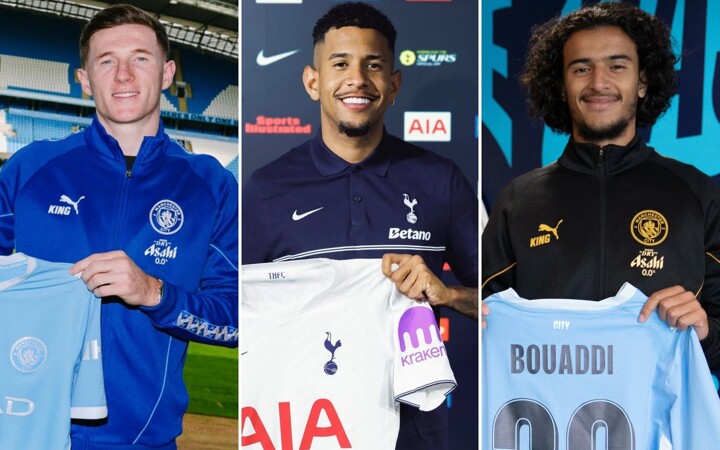
Transfer fees in the Premier League have reached astronomical levels that would astonish even the wealthiest of magnates, and the standards for evaluating transfer value continue to collapse. Take Savinho, for example. He changed his name back to Savio, hoping to bring himself good fortune. Yet this winger hardly needed financial luck. Despite scoring only 2 goals in two seasons as a substitute for Manchester City, his transfer fee to Tottenham reached a maximum of £85 million.
Such deals that defy common sense are rare outside England. Paris Saint-Germain, currently back-to-back European champions, acquired Ferran Torres—who scored 21 goals in his final season at Barcelona and netted the decisive goal in the World Cup final—for nearly half of Savio's transfer fee.
The English transfer market is not merely overheated; it is almost completely out of control, with the line between shrewd acquisition and pure extravagance entirely blurred. If you can stomach it, look at Chelsea's outgoing transfers this summer. Chelsea somehow convinced Nottingham Forest that Delap is a striker worth £50 million. After spending just one year at Stamford Bridge, this striker contributed only 3 goals across 1,907 minutes of play. Remarkably, this fee is £20 million higher than when Chelsea acquired him just 14 months ago. At that time, he was hailed as a prime example of Clearlake Capital's success, not because his talent had flourished significantly, but simply because they could flip him for a profit to the first desperate buyer facing relegation. This phenomenon completely distorts logic and induces not anger but rather a strange numbness.
This numbness intensifies when you see Delap's former Chelsea teammate Nicolas Jackson move to Aston Villa for £65 million. What justifies such an enormous investment in this Senegal international? Admittedly, he was a typical example of Clearlake Capital's early strategy: sign promising young stars to ultra-long contracts, spread transfer fees over many years, thereby weakening constraints on old profit-and-sustainability rules. Yet shortly after extending his contract through 2033, he was deemed surplus to requirements and loaned to Bayern Munich. Even the German giants seem unimpressed, treating him merely as rotation cover when resting Harry Kane. Still, his market value has more than doubled compared to when he transferred from Villarreal to Chelsea in 2023.
With just four days until the transfer window closes, players are valued as commodities at unprecedented prices, with transaction costs starkly divorced from reality. The most common defense is "it's the market, stupid"—a twist on President Clinton's 1992 American economic campaign slogan. This argument is difficult to refute. The 20 Premier League clubs have spent a staggering £2.7 billion this summer, attempting to break last year's transfer spending record. For comparison, this sum exceeds the combined transfer spending of all top-flight clubs in Spain, Italy, and Germany.
However, many deals now emerging involve inflation comparable to currency devaluation in some nations. The chaos began when Manchester City offered Nottingham Forest £116 million for Elliot Anderson. This single deal alone inflated prices across the entire market. Football is now caught in a self-consuming cycle. Sandro Tonali, who recorded 0 goals and 2 assists for Newcastle United last season, is valued at £100 million. Even Tonali's own family would struggle to view him as a £100 million player. His most memorable moment in three years at St. James' Park was a 10-month suspension for gambling rule violations. Yet Tottenham, historically frugal under chairman Levy, is now desperate to display ambition, obsessing over his acquisition and ranking him among the 15 most expensive players in football history. Combined with Savio's irrational fee and their acquisition of Matheus Fernandes—who was relegated with West Ham just six weeks ago—for £85 million, Tottenham's actions reek of sheer desperation.
All established industry norms have collapsed, yet nobody seems to notice. Tottenham sold Luka Vuskovic to Brighton & Hove Albion for £46 million. This Croatian prospect had never appeared in an official match for Tottenham. His market value skyrocketed following an impressive loan spell at Hamburg while just 19 years old. Then there is the goalkeeper anomaly. The more they play, the higher their transfer fee. Last July, Trafford was Burnley's Premier League starting goalkeeper when Manchester City triggered his £31 million buy-back clause. However, Guardiola subsequently acquired Donnarumma from Paris Saint-Germain, leaving England's most promising young goalkeeper to play just one league match over the next eight-and-a-half months. Yet this bench warmer's value in other clubs' eyes has risen, and Leeds United signed him to a club-record £40 million contract.
In this chaotic transfer market, such bizarre events are far from isolated. Liverpool was once regarded as a transfer market master, skillfully combining quality international players, domestic talent, and academy prospects. Yet look at their current predicament. Their combined £241 million investment in Isak and Wirtz weighs heavily on the team, while academy graduate Curtis Jones, who joined Kirkby's academy at age nine, transferred to Inter Milan for merely £30 million. Combined with Trent Alexander-Arnold's departure from his boyhood club to Real Madrid, the situation is deeply concerning. Liverpool's celebrated "This Means More" philosophy—centered on homegrown stars—now flickers only as dying embers.
Reality has completely inverted. Manchester City shows no hesitation lavishing £86 million on an 18-year-old to reclaim domestic dominance. Manchester City fans would seriously argue that Brahim Diaz's dominant performance in Ligue 1 completely justifies this price. But truthfully, just three months ago, few in Britain had heard of this Moroccan prodigy. Who can say where he will ultimately reach? After all, splurging vast sums on teenage players demonstrates no greater business acumen than 17th-century Dutch tulip traders desperately hoarding bulbs of rare varieties that hadn't even sprouted. That "Tulip Mania" collapsed in less than three years, yet this transfer fee inflation in the Premier League continues escalating. Its deviation from economic rationality has reached irrational levels, and the question is no longer whether the bubble will burst, but when.
AI翻訳。
AFのPCサイトが新登場!パソコンでニュース、コメント、試合詳細、詳細データをご覧いただけます。アクセス:www.allfootballapp.com
 Ливерпуль
 Астон Вилла
 Тоттенхэм Хотспур
 Манчестер Сити
 Лидс Юнайтед
 Ноттингем Форест
 Брайтон & Хоув Альбион
 Интернационале
 Эллиот Андерсон
 Сандро Тонали
 Кертис Джонс
 Лиам Делап
 Джеймс Траффорд
 Николас Джексон
 Савиньо
 Матеуш Фернандеш
 Лука Вушкович
 Айюб Буадди
Все комментарии