Ahead of the second round of Premier League fixtures, TA published an article discussing Florian Wirtz's situation, arguing that while Wirtz needs a specific environment to perform well, Liverpool has been struggling over the past year.
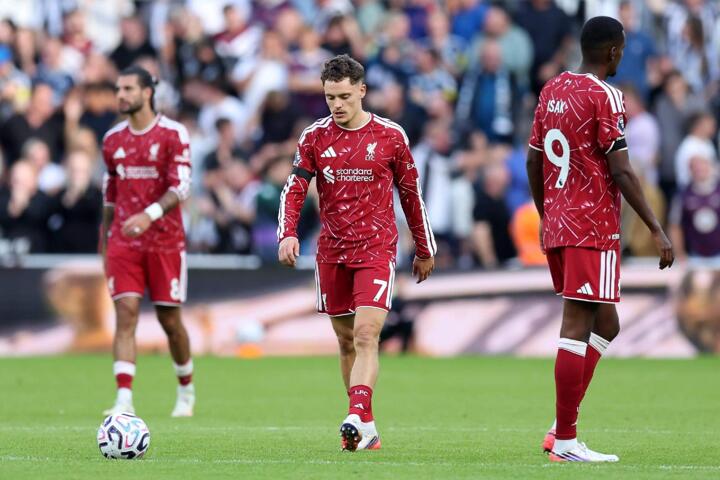
Old problems persist into the new season, and Florian Wirtz's performance at Liverpool has come under scrutiny.
There is no doubt that since his £116 million transfer from Bayer Leverkusen to Liverpool last summer, Wirtz's performances have fallen short of expectations. He must bear some responsibility for his underwhelming debut season. The transition from the Bundesliga to the Premier League is challenging, and he knew what it would entail when he joined the club.
However, this narrative is somewhat unfair. Florian Wirtz is often portrayed as the sole underperformer in an otherwise healthy team, but this is clearly not the case. Compared to Klopp's excellent team and Slot's squad that won the Premier League title in their first season, Liverpool has played awkwardly and fragile over the past 13 months, lacking identity, fluidity, and confidence.
How many players in world football could maintain consistent performances in such conditions? Strikers sometimes can, because their role—converting chances and missing them—is relatively straightforward and binary, though under immense pressure. But few players can be placed at the center of a team and be expected to perform regardless of the team's form or chemistry.
Rhythm is equally important.
People's memories of Florian Wirtz in Germany are remarkably consistent. The player was constantly moving forward with the ball, with the ability to accelerate at any moment. His game relied heavily on instinct, quick decision-making, and understanding with his teammates. Back then, his touch was light and natural; now he plays slower, more cautiously, and less confident in what he's doing.
In Liverpool's 2-2 draw with Newcastle last weekend, a particularly telling attack unfolded in the second half. Wirtz received the ball near the halfway line, drove forward, and attempted to pass to Gakpo in the center as he pushed toward the penalty area. Gakpo didn't anticipate the pass, didn't start his run in time to meet it, and reacted a fraction of a second too slowly. The ball was intercepted, and the attack broke down.
It doesn't matter who was at fault for this failed attack. Should Gakpo have kept pace with his teammate, or should Wirtz have passed it to his feet, adapting to the Dutchman's preference? These are not the most important details. What matters more is that Liverpool's attacks, especially those involving Wirtz, are too often disjointed. Someone is trying, but something is always missing.
This is not solely Wirtz's responsibility, nor is it Gakpo's fault—it's an incompatible combination where neither player is getting what they need. This context must be considered when evaluating the situation.
Before his expensive move to Anfield, Florian Wirtz had the perfect environment at Bayer Leverkusen. In front of him was a double pivot led by Xeka, who could consistently deliver penetrating passes. On the wings were fullbacks Grimaldo and Frimpong, who were individually dangerous and created space for Wirtz through their movement and positioning, or provided passing lanes he could exploit.
Moreover, Leverkusen under Alonso often used the center-forward not just as a focal point but as a deep playmaker. Whether Boniface or Schick, the player in that role frequently dropped deep, vacated the penalty area during build-up, distracted defenders with movement, or created opportunities for Wirtz to interact with them.
It's not that Liverpool should play like Leverkusen. And it's not that Slot should rebuild his new team around one player. Does that even work in modern football? The real insight is that Florian Wirtz was molded by his environment at Bayer Leverkusen, and the same is true at Liverpool—just with completely different results.
Furthermore, it is premature to make final judgments about Slot's future in England after his first competitive match. The Premier League is full of examples of players whose performances improved or declined after a change of scenery.
Even at Liverpool, consider the careers of Robertson and Henderson, who succeeded precisely because they were well-suited to the team and that specific era. Then look at the transfers of Núñez or Naby Keïta, who ultimately underperformed expectations.
Premier League teams have always relied equally on combinations rather than individual players. Torres and Gerrard. The trio of Firmino, Salah, and Mané—that combination was incredibly balanced and perfectly suited to Klopp's style of play.
Looking further afield, consider Dembélé's career trajectory over recent years. Once on the verge of leaving Barcelona, three years later he won the Ballon d'Or at PSG. Or look at Kane's significant improvement at Bayern Munich. Similarly, Luis Díaz thrived in the Bundesliga last summer.
One player's talent is never enough; what matters is placing him in the right environment.
Barko will likely join Liverpool in the coming days, which will further shift the team's internal chemistry. He will benefit some new teammates and impact others. But until Slot assembles all these pieces—both existing players and future acquisitions—into a cohesive unit, no one knows what role each player will assume and what effect they will have.
This, of course, includes Florian Wirtz, regardless of how much he cost.
Переведено ИИ.
Сайт AF теперь доступен! Читайте полные новости, комментарии, детали матчей и статистику на компьютере. Посетите: www.allfootballapp.com
 Ливерпуль
 Флориан Вирц
Все комментарии