On September 9, Beijing time (CEST), in the first leg of their Champions League group stage match, Real Madrid defeated visiting Inter Milan 2-1 at home. Shortly after, The Athletic published a tactical analysis examining Real Madrid's setup and playing style in that match.
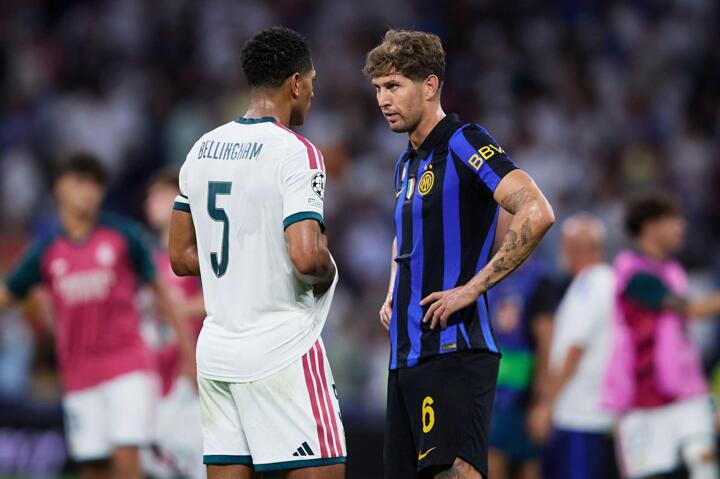
It's often tempting to draw sweeping conclusions after major Champions League encounters.
However, in football—a low-scoring sport—the reality on the pitch is frequently more complex and nuanced. Real Madrid's high press in their 2-1 win over Inter Milan is a prime example.
In this meeting between Mourinho and his former club, Real Madrid scored two goals from their high press, yet Inter Milan also breached their defense repeatedly.
Real Madrid employed a mixed pressing approach: when Inter Milan built attacks down the right, Alexander-Arnold and Brahim maintained zonal coverage to shield the center; when the Italian side shifted play left, Real Madrid quickly switched to man-to-man pressing.

In this scenario, Valverde, Vinicius, and Bellingham each marked Barella, Pavard, and Calhanoglu respectively, Alexander-Arnold pressed Curtis Jones, while Konate maintained a narrow defensive line.
Mbappé initiated the press by approaching Bisseck, who played it back to the keeper, who then shifted focus to the left.

Moments later, as Inter Milan looked to attack from the left, Brahim stepped forward; simultaneously, Konate advanced to tightly mark Lautaro Martinez, and Real Madrid activated full man-to-man pressing.
When Jones played the ball back to Josep Martinez and the keeper distributed to Bastoni on the wing, Real Madrid's man-to-man press was fully engaged.
Brahim pressed the left center-back, Dumfries stepped up to press Carlos Augusto, Mbappé marked Bisseck ready to intercept any back pass, and other Real Madrid players stayed tight to their assignments.
Under intense pressure, Bastoni played the ball to Augusto, whose long pass was headed clear by Huijsen.

Both Real Madrid goals that evening stemmed from this high-pressing tactic, though Inter Milan's errors were largely avoidable.
In the build-up to the first goal, as Jones carried the ball down the right wing, Alexander-Arnold and Brahim maintained their zonal coverage of Curtis Jones and Bastoni, while Cucurella, Bellingham, Valverde, and Huijsen marked Diouf, Calhanoglu, Thuram, and Barella respectively—the latter two Real Madrid players adjusting their assignments due to Inter's midfield shifts.
This limited Jones's passing options, and Alexander-Arnold subsequently pressed his English teammate, whose error forced Bisseck into another mistake.
Brahim, positioned narrowly, capitalized on the opportunity by threading a pass that allowed Mbappé a one-on-one to make it 1-0.

Real Madrid's second goal also came from their high press.
Here, Vinicius Jr., Valverde, and Bellingham marked Bisseck, Barella, and Calhanoglu, while Mbappé pressed Inter's keeper directly.
Martinez distributed to Pavard on the wing, who found Bastoni, triggering Real Madrid's man-to-man press once more. Brahim rushed to the left center-back, Dumfries advanced on Augusto, and Valverde gambled that his speed would cut out the pass to Barella.
Inter played the ball back to Martinez, but Valverde immediately pressed the keeper, blocking any pass to Barella.
Faced with Real Madrid's blanket man-to-man marking across the pitch, Martinez had no options (as shown below); he panicked and made an error, allowing Valverde to intercept and score.

"Valverde's goal was no accident; it was a perfect illustration of our tactical system and approach at that moment," Mourinho said after the match.
Real Madrid's high press and intense pressing created two additional excellent chances for Bellingham and Mbappé in the 47th and 67th minutes. However, their system was repeatedly undone by Inter Milan's fluid build-up play from the back.
In the example below, with the ball on Inter's right, Alexander-Arnold and Brahim covered Curtis Jones and Bastoni zonally.
Yet when Inter shifted play left, Dumfries was still far from Augusto, and Alexander-Arnold chose to block the passing lane to Martinez, leaving Jones completely unmarked.
This was a defensive miscalculation by Alexander-Arnold, as the defensive structure should have maintained man-to-man assignments in this situation, as Konate correctly did by staying tight to Inter's center-forward.
As a result, Bastoni easily found the unmarked Jones, and Inter progressed smoothly upfield.

In another example below, Bellingham marked Calhanoglu, Mbappé pressed Inter's keeper while blocking Bisseck's passing lane, and Real Madrid's left-sided players pressed their opponents.
When the ball shifted to Diouf, Mbappé no longer had the angle to block Bisseck's pass; at this point, Mbappé should have rotated his marking assignment with Bellingham.
But the French captain stood still, and Bellingham hesitated when covering Calhanoglu, finding himself in a two-vs-one situation.
Mbappé's positional error left Bellingham unable to mark Bisseck, and Diouf subsequently found an unmarked Bisseck behind the center-backs.
Even when Mourinho's team committed to their man-to-man press, their movements occasionally lacked urgency.
Bastoni distributed to Augusto on the wing, and Dumfries advanced to press the left-back, but Alexander-Arnold was still some distance from his assignment, Curtis Jones.
Next, Konate failed to tightly mark Martinez, allowing Inter to penetrate Real Madrid's defensive block, forcing Valverde to drop and cover.
The problem was that Sučić, originally marked by Valverde, pushed forward, forcing Cucurella to shift over and leaving Diouf unmarked near the touchline.

Jones recognized the shift in play and quickly switched to Diouf, allowing Inter to easily penetrate Real Madrid's penalty area.
Real Madrid's inability to disrupt Inter's build-up from the back allowed Chivu's side to create numerous chances in Bernabéu's second half.
So, was Real Madrid's high press successful or not? Regardless, it did help the team create four quality chances and convert two of them.
Mourinho's fifth match in charge was a stern test of Real Madrid's longstanding defensive vulnerabilities.
The aggressive high press demonstrated progress, but weak structural organization without the ball revealed persistent problems.
Yet the truth often lies somewhere between these two extremes.
Diterjemahkan oleh AI.
Situs web AF kini hadir! Lihat berita lengkap, komentar, detail pertandingan, dan statistik di komputer Anda. Kunjungi: www.allfootballapp.com
 Интернационале
 Реал Мадрид
 Кристиан Киву
 Жозе Моуринью
 ه. كالهانوغلو
 إن. باريلا
 B. Pavard
 Трент Александер-Арнольд
 K. Mbappé
 Вальверде, Федерико
 Ибраима Конате
 A. Bastoni
 Браим Диас
 Хосеп Мартинес
 Винисиус Жуниор
 Биссек, Ян-Аурель
 Джуд Беллингем
Все комментарии