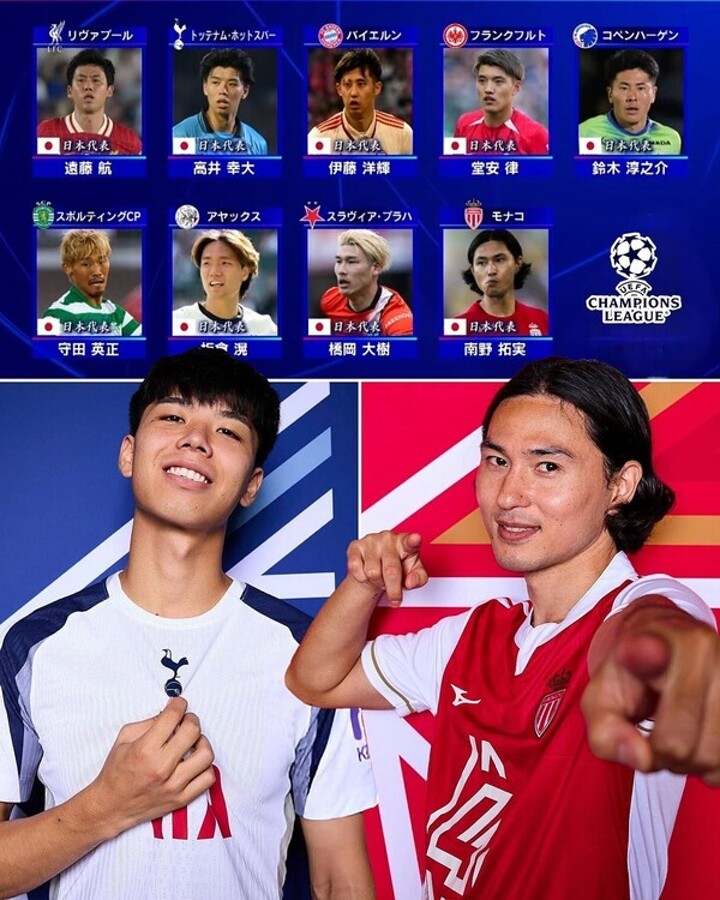
Foreign media outlet football-asian has compiled statistics on the number of Asian players active in Europe's top leagues. According to the data, there are 263 Asian (AFC) players across 46 top European leagues, with Japan leading by a significant margin with 97 players.
The outlet notes that the breakdown of Asian players in Europe's top leagues by country for the 2024-25 season shows Japan's reach far surpassing South Korea by nearly fourfold. However, a closer examination of the numbers reveals a more nuanced picture.
With Europe's summer transfer window closed, a complete map of AFC player distribution across top European leagues can now be drawn. The total stands at 263 players spread across 46 leagues, ranging from the Premier League to semi-professional leagues in San Marino. Of these, 97 are Japanese players and 26 are South Korean – at first glance, the nearly fourfold disparity seems stark.
But the reality is more complex.
The Numbers and Their Hidden Meaning
The distribution of Japanese players is striking: 97 players spread across 27 different leagues, reaching far beyond mainstream European football into countries like Latvia, Lithuania, Armenia, Georgia, Azerbaijan, and Kazakhstan – leagues barely known to European fans, let alone attracting regular streams of Asian talent. South Korean players, by contrast, are spread across just 13 leagues.
Narrowing the focus to the traditional "Big Five" leagues – Premier League, La Liga, Bundesliga, Serie A, and Ligue 1 – the gap narrows significantly. Japan has 32 players (representing 33.0% of their total 97 players in Europe's top leagues), while South Korea has 8 players (representing 30.8%). On this metric, South Korea's penetration rate into the elite leagues is essentially on par with Japan, despite having only a quarter of the total player count.
There is a significant difference in how players from both nations are distributed. The 26 South Korean players are spread across 23 different clubs – averaging just over one player per club, indicating a model built on individual talent identification and proven ability rather than sheer numbers. The 97 Japanese players are spread across 67 clubs, but clustering is more pronounced: Sint-Truiden in the Belgian Pro League alone has 8 Japanese players.
This is no coincidence. Sint-Truiden has been controlled by Japanese capital since 2017, when DMM.com acquired majority shares from former owner Roland Duchâtelet; this was followed by investment from companies including Japanet and Septeni Holdings.
The club effectively functions as an outpost for Japanese football in Western Europe – beyond Sint-Truiden, Borussia Mönchengladbach has 4 Japanese players, while Freiburg, Le Havre, Antwerp, and Westerlo each have 3. South Korea's clustering effect is far simpler: Arouca in Portugal, Midtjylland in Denmark, and Austria Wien in Austria each have 2 South Korean players.
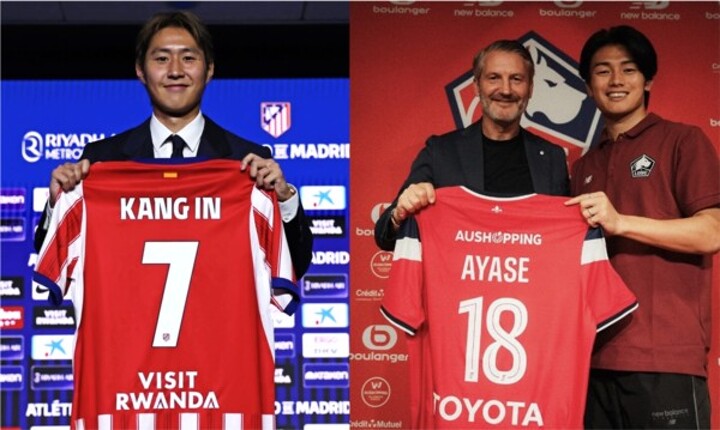
At this point, the overall numbers no longer tell the whole story. This summer, Lee Kang-in transferred from Paris Saint-Germain to Atlético Madrid for a reported fee of €40 million (approximately 70 billion KRW) – the second-highest transfer fee in history for an Asian player.
That record belongs to another South Korean player: Kim Min-jae, whose €50 million transfer from Napoli to Bayern Munich in 2023 still tops the list. Third and fourth are Shoya Nakajima's 2018 transfer (€35 million) and Son Heung-min's move to Tottenham in 2015 (€30 million) – meaning South Korea currently holds the top two spots on the all-time Asian football transfer fees list, with both clubs rejecting Champions League interest throughout August rather than entertaining offers.
Kim Min-jae at one point appeared set to leave Bayern this summer but had a last-minute change of heart and stayed in Munich. Meanwhile, Lee Kang-in donned the No. 7 shirt for Atlético after signing a five-year contract.
Compared with Japan's broader reach, transfer fees highlight a structural difference: South Korea's export model is built around select players reaching the top of the market, while Japan's model is based on volume, development pathways, and systematic distribution – a strategy that trades peak individual value for comprehensive coverage.
Two Systems, Two Philosophies
After speaking with a number of talent scouts and club officials in Belgium, Germany, and the Baltic states, a consistent picture emerges of how Japanese players arrive in Europe: increasingly formal pathways, through agents, satellite club relationships, and in Sint-Truiden's case, direct ownership, sending talent abroad early with competition determining who survives. This mirrors the model pioneered by Brazil decades ago, simply adapted to Japan's own football economy.
This trade-off is evident in the data – 32.0% of Japanese players in Europe play in so-called peripheral leagues, more than double South Korea's 11.5%.
South Korea's approach, by contrast, appears more artisanal – fewer players sent, but a higher proportion arriving as finished or near-finished products. Portugal has quietly become the preferred stepping stone for the next generation of players – Lee Hyun-ju and Park Si-hoo are both at Arouca – while Kim Ji-soo (still on the fringes of the senior national team) as South Korea's sole Premier League representative also reflects the displacement effect felt by Korean players in top leagues, which is less severe for Japan with nine Premier League players.
The European footprint of other AFC members is also worth noting. Abdulkodir Khusanov's transfer to Manchester City remains a standout example of an Asian player reaching a truly elite club outside South Korea, Japan, and China.
Indonesia has quietly built its own version of a "Japanese-Dutch pipeline," with five naturalized or dual-national players in the Eredivisie alone – Paes at Ajax, Hilgers at Heerenveen, Hübner and Rommeny both at Fortuna Sittard – while Jay Idzes captains Sassuolo as a centre-back.
Saudi players remain rare in Europe's top five leagues, exemplified by Saud Abdulhamid's stint at Lens, while Mousa Tamari of Jordan continues to hold his place at Rennes.
None of this changes the overall arithmetic – Japan's reach across European leagues is undeniable. But football, as always, values more than just one kind of number. In a numbers game where it cannot win on quantity, South Korea has chosen to respond by winning on value.
Diterjemahkan oleh AI.
Situs web AF kini hadir! Lihat berita lengkap, komentar, detail pertandingan, dan statistik di komputer Anda. Kunjungi: www.allfootballapp.com
 ญี่ปุ่น
 โคเรีย รีพับลิค
ความคิดเห็นทั้งหมด