According to ESPN, Haaland's goal in the Manchester derby sparked VAR controversy, and the subsequent decision exposed the limitations of video referees in their pursuit of absolute perfection.
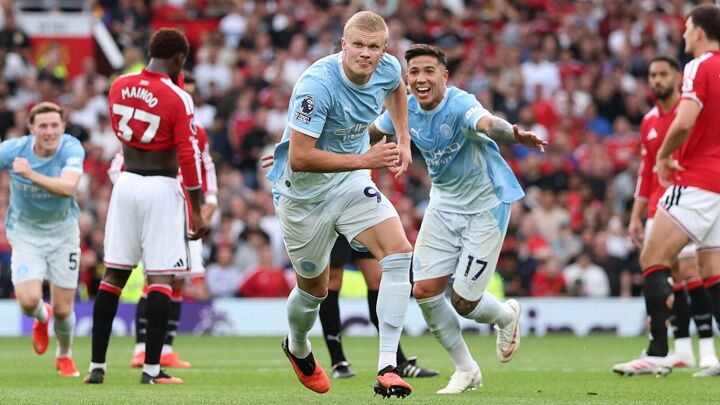
Haaland may be the most clinical striker, but his goal in Man City's 1-0 victory over Manchester United on Sunday proved that even when the purpose of VAR is to deliver such perfection, perfection remains elusive.
Following a successful trial at the 2018 World Cup, VAR was introduced to the Premier League in 2019. The technology was adopted by the world's most-watched competition to make the most critical decisions clearer and more certain, and to end matches decided by on-field referee mistakes.
No more incorrect offside calls, no more wrong red cards, no more players escaping serious fouls unseen by the referee—coaches would no longer have to complain about official errors after a defeat. Controversy would be consigned to history, and everything would be perfect.
This has always been the outside world's view of VAR: a final safety net delivering instant justice through video review. But video technology rests in human hands, perfection itself is subjective, and subjective judgment affects every decision-making process.
In the Manchester derby, Haaland's goal was initially ruled offside by linesman Stewart Burt, and VAR's task was to verify whether this decision was correct. The VAR team had to answer three questions: was Haaland in an offside position, was there a foul in the build-up, and was any other player in an offside position?
All three questions must be answered before the linesman's decision can be overturned. But after semi-automated technology showed Haaland was not in an offside position, the VAR team still had to make subjective judgments on the second and third questions. Matthew Donohue was the VAR official in charge, with assistant referee Blake Antrobus providing support.
There was no foul in the build-up, so the second question was quickly resolved. But the third question drew the VAR team into trouble. The officiating team ruled that Enzo, despite moving toward Gvardiol's cross and attempting to head the ball, was neither playing the ball nor blocking the run of Manchester United defender Lisandro Martínez.
This decision exposed a long-standing flaw in VAR. When faced with subjective decisions, different referees will interpret them differently. It can never be a perfect system unless AI replaces all referees and makes every correct decision in milliseconds.
But ironically, within a system that can never be perfect because of human involvement, referees try to make it perfect by overthinking and over-analyzing decisions that should be straightforward and simple.
Had Donohue and Antrobus applied the Laws of the Game correctly, they would have determined that Enzo was attempting to play the ball and also blocking Lisandro Martínez's run. According to the rules, he was in an offside position on both counts. It is bewildering that they sat in front of video screens pursuing the perfect decision, only to turn a 100% correct decision into a 100% incorrect one.
Perfection was actually right before the VAR team's eyes, clearly stated in the Laws of the Game. But they added their own interpretation, resulting in what may be the worst VAR error in Premier League history.
Howard Webb, the 2010 World Cup final referee and current head of Professional Game Match Officials, said last month that he wanted VAR officials to maintain high standards when intervening in on-field decisions and only to intervene when there is a clear error by the referee or assistant referee. But his instruction failed to account for VAR officials second-guessing themselves and being influenced by concerns like "what if I make a wrong decision." They wanted to get it right, but in the end, they overlooked the most obvious thing, and that is what happened at Old Trafford.
Three hours after the final whistle on Sunday, Professional Game Match Officials released a statement acknowledging that Haaland's goal was an "incorrect" decision, but it was too late to change the result. The authorities finally admitted the mistake, but by the time United manager Ruben Amorim and his players headed home, so-called perfection had arrived—a deeply unjust perfection.
Haaland's goal could have significant ramifications. United have collected only 4 points from 4 matches, equaling the club's worst start in Premier League history. If this trend continues, Amorim will face increasing pressure to keep his job. Man City were reduced to ten men in the 25th minute when Foden received a red card, and the match appeared headed toward a draw; if City's fortunate victory ultimately helps them win the title by one or two points, those two points could prove decisive.
If Haaland's current tally of 115 goals eventually reaches 261 Premier League goals by the end of his Man City career, surpassing Alan Shearer's record of 260, will there be an asterisk next to that Old Trafford goal that should never have counted?
All these scenarios could play out, and none of them would be perfect. But all of them will stem directly from that VAR decision in the 199th Manchester derby.
Perfect? Far from it.
Website AF đã ra mắt! Xem tin tức đầy đủ, bình luận, chi tiết trận đấu và thống kê trên máy tính. Truy cập: www.allfootballapp.com
 แมนเชสเตอร์ ยูไนเต็ด เอฟซี
 แมนเชสเตอร์ ซิตี้ เอฟซี
 ไมเคิล แคร์ริก
 เออร์ลิ่ง ฮาแลนด์
 ลิซานโดร มาร์ติเนซ
 เอ็นโซ่ เฟร์นานเดซ
ความคิดเห็นทั้งหมด