In Round 4 of La Liga, Real Betis defeated Real Madrid 1-0. After Mbappe missed a penalty kick during stoppage time, controversy arose over whether Bartra entered the penalty area too early. Spain's Technical Refereeing Committee (CTA) determined that VAR's decision not to order a retake was correct, and Bartra's positioning at that moment did not constitute an illegal early entry into the penalty area.
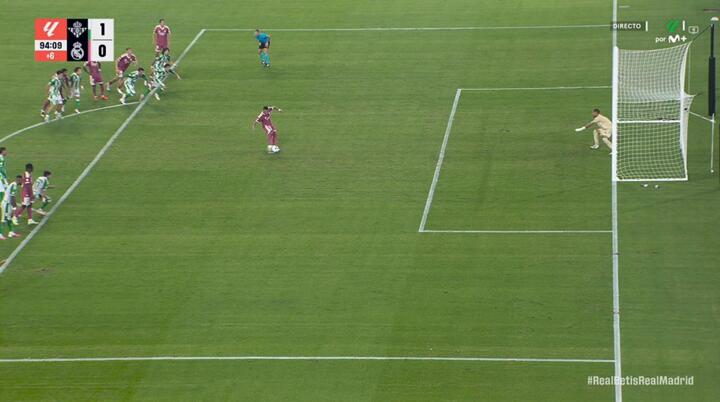
The 2024-25 La Liga season witnessed its first major refereeing controversy in the closing minutes of the Real Betis vs. Real Madrid match. To understand why Bartra's movement when goalkeeper Álvaro Valles saved Mbappe's penalty was not deemed an early entry into the penalty area, it is necessary to examine the relevant rules carefully. The controversy occurred in the 93rd minute of the match. Abde committed a foul against Vinicius, resulting in a penalty kick—a decision that was not controversial in itself.

Valles then saved Mbappe's penalty, and Bartra prevented Mbappe from reaching the rebound. Replays showed that the Real Betis defender was moving toward the penalty area at that moment, but at the moment Mbappe struck the ball, he was airborne with neither foot inside the penalty area.

So the question becomes: does this situation constitute an early entry into the penalty area?
VAR determined it was not an infraction, and the controversial refereeing handbook released by the refereeing committee provided a similar explanation. This handbook was first introduced by Fran Soto and his team.
The relevant provision on "early entry into the penalty area" states: "If, at the moment the penalty kick is taken, a player has one or both feet in the penalty area or on the penalty area line, including the penalty arc, that player has entered the penalty area early. When determining whether early entry has occurred, the projection of other body parts onto the ground is not considered."
However, an additional clarification in the accompanying illustration adds: "If a defending player jumps before the penalty kick is taken and enters the penalty area while airborne, their body position will be projected onto the ground. If the projection falls within the penalty area, this is deemed early entry into the penalty area; if they subsequently actively participate in the attack, they will be penalized."
According to the CTA's interpretation, if a player enters the penalty area while running and has neither foot in the penalty area at the moment the penalty kick is taken, this situation is not considered early entry into the penalty area. However, if a player deliberately jumps with both feet off the ground to circumvent the rule and thereby enter the penalty area, such an action would be considered potentially punishable.
Therefore, according to the CTA's view, Bartra did not commit an early entry violation, and VAR's judgment on this situation was correct.
Bartra himself is also aware of this rule.
After the match, the Real Betis defender said: "In previous rounds, Gaya made a similar small jump. I asked a referee friend whether this was allowed, and he explained the rule to me, saying that if the feet are still in the air, the penalty does not need to be retaken. It worked in my favor this time, but if Mbappe had taken his shot a moment later, I might have already had my feet on the ground inside the penalty area. It's just a small detail. I'm very pleased because these three points are very important for us."
Website AF đã ra mắt! Xem tin tức đầy đủ, bình luận, chi tiết trận đấu và thống kê trên máy tính. Truy cập: www.allfootballapp.com
 Real Madrid
 Real Betis
 Marc Bartra
 Kylian Mbappé
Tất cả bình luận