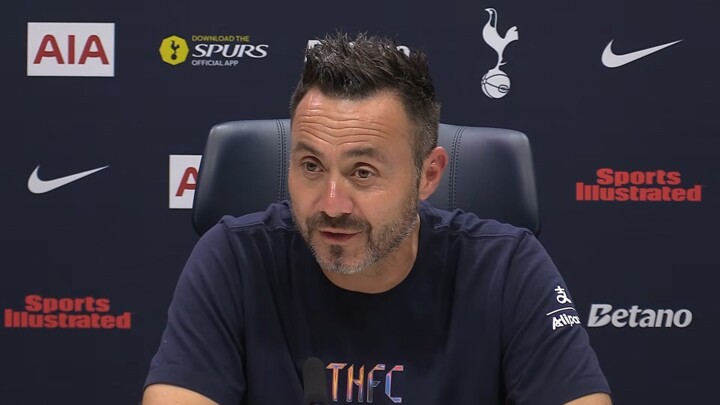
At 00:30 on 16 September (CEST), Tottenham will face Liverpool away in the third round of the EFL Cup. After a media embargo lifted, comments from Tottenham head coach De Zerbi during his pre-match press conference have been released. This article contains the second half of that content.
Read More
【De Zerbi: I Have Great Faith in Solanke, He Can Score 10 to 15 Goals in a Season】
I recall last season when the team struggled with confidence, you seemed to enjoy relaxing the players through activities like organizing dinners and having a few drinks. Are you using a similar approach now? Do you want them to not carry too much burden and worry?
We just had a team dinner with all the players last week.
Was there food on the table?
Yes. There was water and beer. Yes.
Was it still that restaurant in Mayfair (an affluent area in London)?
That's right.
What's the core purpose of this? Is it to help them completely relax and feel more comfortable?
Not entirely. Perhaps I'm not objective enough in evaluating my players, but my assessment of them may be completely different from what the media thinks. I believe all of them are excellent players. We're currently in the process of building a new project and creating an entirely new team. If the team doesn't score, if we don't win, I'm willing to take responsibility.
But I will never change my belief and assessment of these players because of that. Whether they win and score, or fail to score, I won't change my attitude toward them and the respect they deserve. If we want to change the difficult situation from the past two or three seasons, we must demonstrate stronger inner strength at this moment, steadfastly believe in our daily training, trust in the quality and strength of our players, and trust in the various decisions we made a month ago. Otherwise, we'll only fall into a vicious cycle of constant changes — you can keep changing players, keep changing coaches, switching back and forth, but ultimately nothing significant will change.
Instead, we can keep a cool head, maintain humility, and work with proper professionalism. Each of us must be brave enough to take responsibility, face difficulties and move forward firmly, maintain focus, continue training, continue fighting, and believe in ourselves steadfastly. Because I have complete faith in my players, and I hope they can believe in themselves as steadfastly as I believe in them.
We've discussed how to help players reduce psychological burden and create a good environment conducive to scoring and improving performance. I'd like to know specifically what you can do on the training ground to help them improve their finishing quality and execution in the final attacking phase?
I've emphasized the role of video analysis before, as it's extremely important in modern football. How a match looks from a pitch perspective and from watching video footage is completely different, and video can help us improve overall tactical coordination. But beyond team tactics, targeted individual training is also essential, such as through specialized individual drills to improve passing quality, improve the accuracy of crosses, and improve attacking ability from the near post.
For example, Robertson's positioning in that area was actually part of our tactical plan before the match. If you carefully watched that match or still remember the details: Johnson on the right, Robertson pushed higher up, Tonali spread wider, and Marmoush moving freely in the half-space. Johnson was perhaps a bit confused by the movement at that moment, wasn't he?
However, when Robertson crosses, the method and attacking positioning before our goal wasn't actually correct. The striker's movement, the far-side winger's follow-up, and the two midfielders' penetration into the half-space didn't meet the requirements. They must decisively penetrate into the penalty area. Perhaps the first cross couldn't directly create a goal, but getting into a good position could allow them to compete for a second ball, or react quickly to win the ball back immediately when we lose it in that area — whether near the penalty area or in the attacking third.
We must demonstrate stronger offensive intensity, because sometimes you can score through direct combination play, but more often you must create chances through constant pressure — you lose the ball while attacking, you react positively immediately to win it back, and then score at that moment.
Roberto, finally, I'd like to ask you about the international break. What do you think about the timing of this international break?
I already have enough pressing issues to deal with right now; where would I find the energy to worry about international break matters? I really don't know, we'll have to see how things develop. Perhaps it's a good thing, because if there's a monthly break disrupting the rhythm of the season, that would be worse, but let's wait and see how things actually unfold.
Do you have any specific training plans for the players who will stay at the club?
I want to wait until the final squad lists of the national teams are confirmed. Yes, and then we'll arrange... We've prepared two different training plans and will organize things appropriately.
I'm just curious, at a club like Tottenham where there's not only focus on results but also very high expectations and attention to tactical style of play, is building a new project more difficult? Because there's always immense pressure to both play attractive football and score many goals, which seems like an additional heavy burden...
No, no, listen to me. I'm very happy to work at Tottenham, and I'm extremely proud to coach here. I'm experiencing and living all of this with great passion, giving my best effort. This is a completely normal phenomenon and an inevitable part of building any new project. If you blindly compare the present to the past, that's unfair and incorrect.
If I list the names of the major Premier League clubs over the past 10 years, they've invested enormous sums and changed large numbers of players, but such a transformation is absolutely not an overnight or immediate success. Change requires sufficient time. Sometimes you might think everything will go smoothly initially, sometimes momentum will be stronger later, but all of this is a very normal plan, a regular project, and a regular development process.
Sorry, who pays for these fancy dinners each time?
Of course I do, because I'm the head coach of this team! I'm older than these players, and it's my honor and pleasure to dine with my players.
It seems like if you keep treating everyone to meals, you'll spend all your bonus money...
Haha, yes, but I just need to save enough money for cigarettes, everything else is fine.
Let's talk about something a bit more serious. You just mentioned the extensive work done in video analysis, practical training on the pitch and tactical analysis, which I completely understand. So do forwards typically do extra shooting practice? Are there any traditional additional training sessions?
Of course there are. Do you really think we don't do that? We always do it, there are always specialized sessions.
So after daily training, do they specifically do an extra hour of shooting practice on the pitch?
We've done that before, and also before Saturday's match against Everton. I don't need to say much about this, because the players themselves genuinely want to train more and work harder. This is certainly not something the head coach forces; it's not the coach coming in and ordering them, "Everyone, stay for an extra 30 minutes." No, the players themselves are eager to stay and train more. The players are very keen to improve themselves; they've personally felt the pain of recent losses and lack of goals, so they're more eager than anyone to change the situation through additional training.
Website AF đã ra mắt! Xem tin tức đầy đủ, bình luận, chi tiết trận đấu và thống kê trên máy tính. Truy cập: www.allfootballapp.com
 托特纳姆热刺
 德泽尔比
德泽尔比
 罗伯逊
罗伯逊
 马尔穆什
马尔穆什
 托纳利
托纳利
全部评论