According to Spanish media outlet OK Diario, Sandro Cariso has become an important member of José Mourinho's coaching staff since he took over Real Madrid. Although his name rarely appears in public, this sports science expert is responsible for analyzing players' physical exertion, monitoring training load, and identifying risk signals before injuries actually occur.
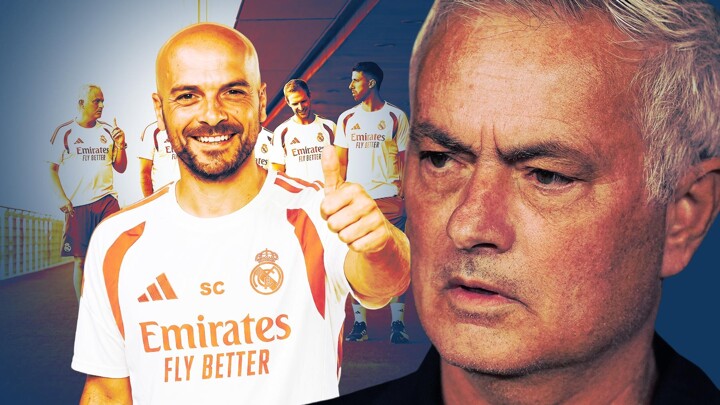
The report states that Cariso joined Real Madrid in July 2026, a move personally requested by Mourinho. After several previous seasons plagued by frequent muscle injuries, Mourinho believed that the team needed to bring in a professional he fully trusted to change the approach to physical conditioning and further strengthen injury prevention.
Cariso is not a physical therapist or doctor; his expertise lies in physiology and sports science. His main job is to study how each player's body responds to training and matches, monitor exercise load, and provide relevant information to the coaching staff. Simply put, he uses data to concretely present the players' fatigue levels.
Cariso, 40, has spent most of his career in Portugal. He initially worked for smaller teams such as Linda-a-Velha, and then joined Benfica in the 2013-14 season, primarily involved in youth development and academy work.
In the 2015-16 season, Cariso moved up to the Benfica first team and became one of the main experts in the Benfica LAB sports science department. This department is primarily responsible for applying science, technology, and data analysis to player performance.
Cariso remained at Benfica for a long time thereafter, gradually becoming a highly recognized professional in Portuguese football. Benfica originally hoped to keep him, but Mourinho's invitation and the opportunity offered by Real Madrid eventually swayed Cariso, who had worked for Benfica for 13 years.
One of Cariso's important roles in the Real Madrid coaching staff is to connect the physical, medical, and athletic departments. He works with fitness coaches and maintains close communication with the medical team, collecting players' self-perceptions and analyzing training data to help Mourinho determine which players can play normally, which players need reduced loads, and which players are at a higher risk of injury.
This working model avoids the medical and athletic departments operating independently. Cariso acts as a bridge between the two, so that when Mourinho makes personnel decisions, he no longer relies solely on the coach's intuition or the players' own physical sensations.
Mourinho has also previously explained that every decision the team makes needs to consider player feedback, training data, and medical department opinions. This continuous exchange of information is part of Real Madrid's overall plan to reduce injury risk.
Real Madrid insiders describe this mechanism as a "traffic light" system. They believe that compared to last season, the biggest change is that the team has more of these "traffic lights." The club has brought in more professionals and consultants, and has increased preventive examinations for players.
Real Madrid explained: "The real difference compared to last year is the number of 'traffic lights.' That is to say, starting this season, the club has more professionals, consultants, and preventive examinations. Our goal is for the red lights to come on earlier and earlier, leaving more reaction time. Of course, there are also disadvantages to doing this, so nothing is absolute."
Early detection of risks means the team can promptly reduce players' training loads, modify training content, or directly stop players from training and playing, preventing minor discomfort from eventually developing into actual injuries. However, this system cannot provide absolutely accurate answers. Increased monitoring may also lead the team to take more cautious measures, such as resting players who feel they can play, or even temporarily changing the starting lineup. Therefore, the coaching staff still needs to make final decisions based on data, player feelings, and match circumstances.
Real Madrid's recent handling of Federico Valverde against Rayo Vallecano is a typical example of this philosophy. Valverde felt a slight issue in the first half and was subsequently substituted at halftime. Real Madrid was already leading 3-0 at the time, so Mourinho decided not to let this important player take on additional risks.
Mourinho explained after the match: "If it had been 0-0, he would have continued playing. We would have pushed the risk to the limit, but the score was already 3-0, so we chose to protect the player."
Valverde did not suffer a serious injury at the time, but his body had shown warning signs. Real Madrid's current approach is to take measures as much as possible before an injury actually occurs, rather than dealing with problems after they appear.
This is also Cariso's core value in Mourinho's coaching staff. He does not decide the starting lineup, nor is he responsible for medical diagnoses, but he provides Mourinho with the data and information needed to assess players' physical condition. From before training begins to after the match ends, monitoring of players' physical load is consistently maintained.
Mourinho hopes that Real Madrid's new physical conditioning management system will place greater emphasis on science, prevention, and load control, and Cariso is the important member he personally selected for this purpose.
AF's PC site is now live! Browse full news, comments, match details and stats on your computer. Visit: www.allfootballapp.com
 皇家马德里
皇家马德里
 穆里尼奥
穆里尼奥
 巴尔韦德
巴尔韦德
全部评论(3)