Mbappe developed a series of pustules on his chin. On Wednesday, in several posts on the social platform X, the captain of the French national team appeared in screenshots from France's match against Sweden (3-0) with this visible condition. One post asking, "What is the condition on Mbappe's chin called?" quickly surpassed 5 million views, while another reached 19 million. Several similar tweets also garnered extremely high view counts.
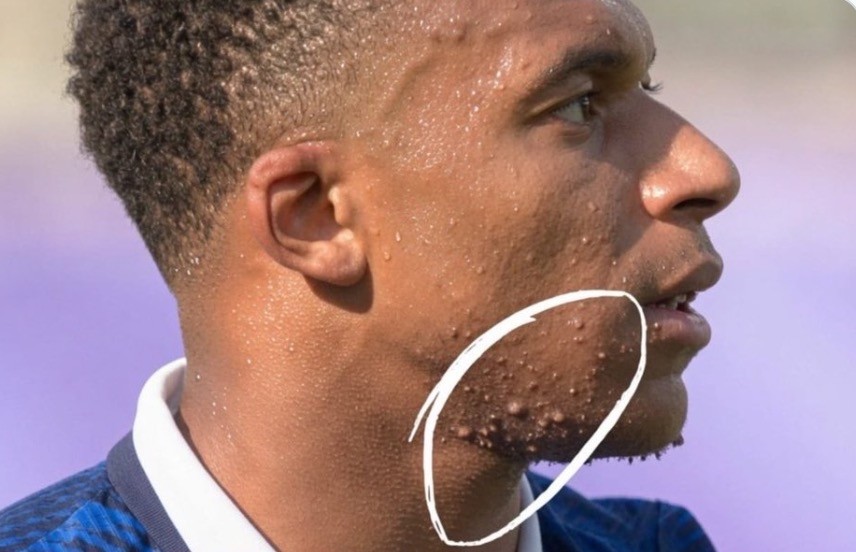
Among these fake images, only a very small number were labeled by social media platforms as "AI-generated." On June 4, a few days before the start of the 2026 FIFA World Cup, Mbappe had already been targeted by AI-fabricated fake news. An article, falsely claiming to have been published by Eurosport and circulating on social platforms, stated that the player revealed his transfer from PSG to Real Madrid was due to harassment by French President Emmanuel Macron.
Eurosport was furious.
Videos pointing to this fake news link also featured AI-generated fake voices of the French national team forward, with related video views ranging from 1 million to nearly 3 million. The article in question almost perfectly replicated the layout of the Eurosport website and even used the byline and avatar of the outlet’s reporter, Martin Mosnier. This forced Eurosport to issue a statement and seek legal intervention.
"Formally, its credibility is convincing enough to deceive people, which is terrible — those unfamiliar with our editorial style are very likely to fall for it," Martin Mosnier said with concern. "But luckily, I felt at the time: this is too outrageous... People who know Eurosport would certainly not be fooled. For now, we can still distinguish between true and false, but the future is worrying. If, in a few months or years, dozens of such AI-generated fake news pieces appear daily, we simply won't have time to debunk each one and issue statements. This is what truly frightens me."
As the first FIFA World Cup in the age of AI approaches, fake news, fabricated videos, and manipulated images are rampant on the internet, especially on social media platforms. FIFA is closely monitoring this phenomenon but has not yet taken a clear stance, stating only that a social media protection mechanism has been established. However, merely reporting AI-generated images or videos does not necessarily lead to their removal — it must also be proven that this content is defamatory or discriminatory.
The French Football Federation (FFF), when interviewed, stated that it has also established monitoring mechanisms: "Once content that is factually incorrect or harms the image of players or staff is discovered, we submit it to the platforms for handling. Unfortunately, we have to rely on the platforms' willingness to cooperate. For example, platforms like X are completely uncooperative, and we deeply regret this."
As of now, the fake images of Mbappe with pustules on his chin, along with the conspiracy theories derived from them, are still circulating on the X platform. The Real Madrid forward is far from the only victim of this phenomenon. Early in the tournament, an AI-generated image went viral, claiming that an Iranian player had held a pink satchel to commemorate students who died in a US military bombing in February 2026. The fabrication was actually easy to identify: the jersey in the image was not an Iranian team uniform, and the player was not a member of the Iranian national team.
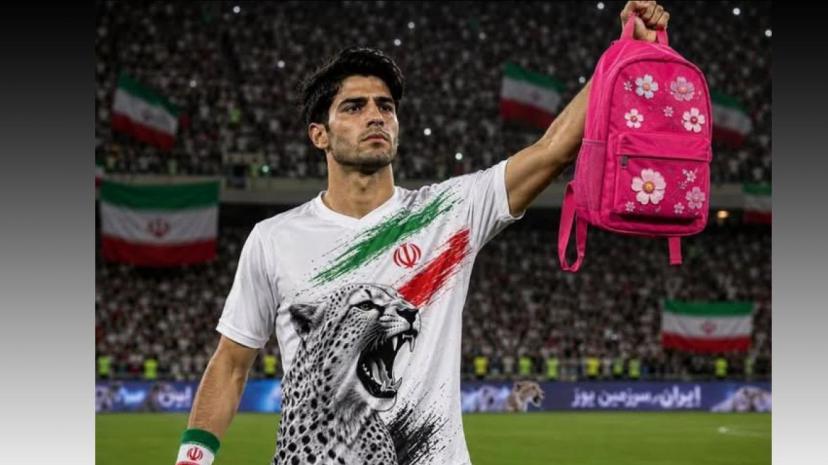
Also targeting Iran, an AI-generated fake video claimed that a magnificent decoration honoring Iran appeared at the opening ceremony of the Mexico FIFA World Cup. On June 14, another image, which received over 3 million views, showed a spectator resembling Adolf Hitler at the Germany vs. Curaçao (7-1) match. It was a Hitler impersonator inserted into a real screenshot of German fans. Similar examples are countless.
Gabriel Turinici, a professor specializing in digital technology and generative AI at Paris Dauphine University (Paris FC Dauphine University), is not surprised by the scale of this phenomenon during the FIFA World Cup: "This happens with all major events, as we saw during the last US presidential election. Any event that attracts significant public attention will generate this type of false content, which is regrettable but not surprising. 90% of manipulated images and videos have only one goal: commercial monetization—profiting from public attention, ultimately leading to advertising revenue and making money through clicks. In this 'game,' any content that causes anxiety, involves violence, or is pornographic is most likely to attract attention and traffic."
At the end of the faking chain is paid pornographic content.
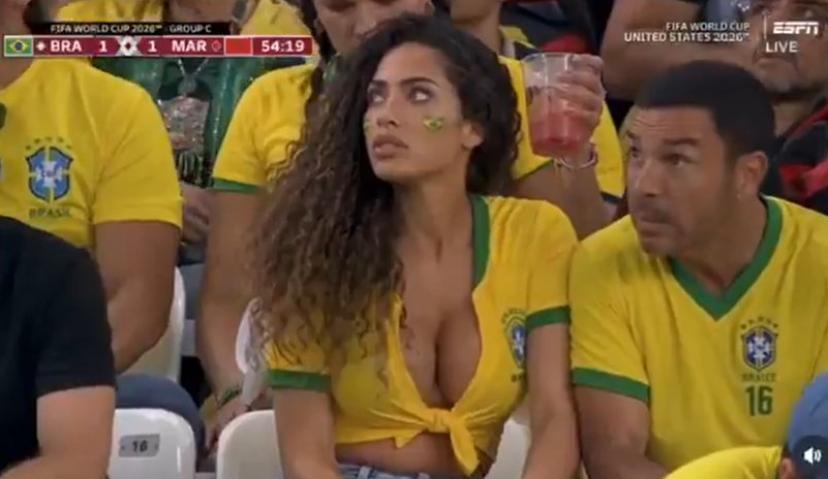
To entice netizens to click, many fabricated videos created false scenarios of players fighting on the field or in the stands. However, the most prominent phenomenon early in the tournament was a series of overly sexualized fake videos of female fans generated around the major participating countries. The end of the fakery chain is not only paid pornographic content, but also fake AI paid training courses claiming to teach users how to earn over $18,000 per month using deepfake technology.
Like Eurosport, other media outlets have not been spared from being faked. A manipulated clip of France vs. Senegal (3-1) went viral (nearly 2 million views in half a day), claiming that Nicolás Haas, the Argentine commentator for DirecTV, referred to Senegal and France as "two African countries" at halftime. The original recording of the clip proved otherwise, but doubts surrounding the incident persisted throughout the day.
Companies such as NewsGuard in the US specialize in detecting false content, while organizations like OpenAI have also launched tools capable of identifying whether content is AI-generated. However, Gabriel Turinici found that most fraudsters do not even bother to make fake content difficult to detect. "This shows that for them, the click-through rate is already satisfactory enough," the scholar believes.
"I ran a test: I found two AI-manipulated images from this FIFA World Cup, made a few adjustments in just two minutes, and rendered them 'undetectable.' I then tested them with seven detection tools, and only one questioned their authenticity; the other six judged them to be real images with a confidence level of 97%. In theory, there will always be undetectable AI-generated content. The best way to address this is for all AI tools to add a watermark to every image they generate for identification. However, not all tools do this yet..."
AF's PC site is now live! Browse full news coverage, comments, match details and stats on your computer. Visit: www.allfootballapp.com
 France
 Germany
 Iran
Iran
 Senegal
 Real Madrid
 Mbappe
 FIFA World Cup
All Comments (5)
Today 05:11
Today 05:03
Today 04:23
Today 04:07
Today 03:01