Gabriel Martinelli struck late and a fresh wave of faith broke in Brazil. Those who had called for Casemiro to be hooked at half time and those who wanted to see Neymar not Martinelli appear from the bench threw up their hands in we-are-not-worthy praise of Carlo Ancelotti.
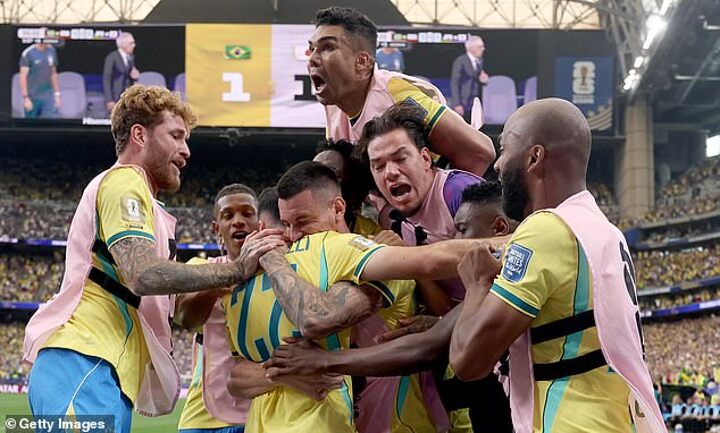
In Don Carlo they are learning to trust. At least that was the theme of hundreds of new memes born in a nation increasingly obsessed with the infinite scroll of social media. All conveying a message that there is no reason to doubt the wisdom of their great Italian coach.
An hour or so earlier, most Brazil fans would have sided with Roy Keane and Lee Dixon on ITV, neither of whom expected Casemiro to return for the second half against Japan on Monday. 'A shadow of his former self, wandering around in midfield,' said Dixon.
Not only did 34-year-old Casemiro return but he headed in the equaliser and turned the game before Martinelli came on and settled it in stoppage time, Brazil's first win when conceding first in a World Cup knockout tie since England in 2002.
Ancelotti reflected with familiar understatement on signs of progress, talking about the 'suffering' and 'evolution' and of what he considered a 'more complete' performance. 'We were not lost like in the first half against Morocco,' said the 67-year-old Italian.
In Brazil, there are plenty who do not care how they win the World Cup just as long as they do. Think of Arsenal's pursuit of the Premier League last season. The wait is growing long and if they fail to win this World Cup, they will be staring squarely at the longest stretch without the golden trophy since Pele arrived on the scene in Sweden 1958.
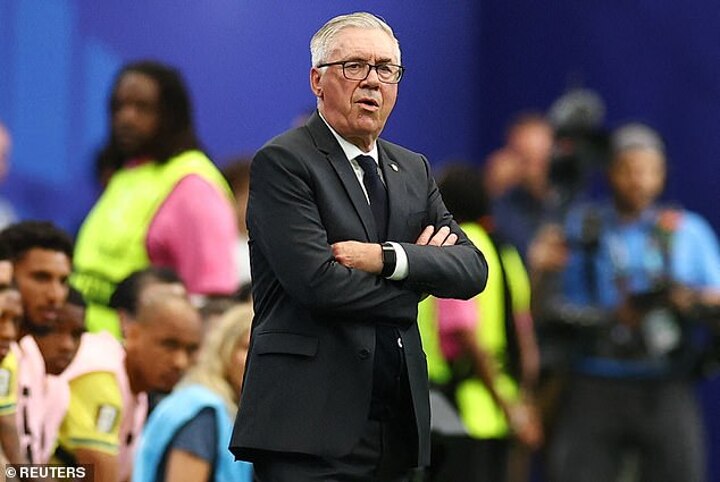
Those impatient for success are loving the Ancelotti touch. They point out how his style is actually more expansive than that of his predecessor Tite, eking more from the best players, and that his strategy and in-game tactical tweaks are unlocking ways to win.
His decision to replace Matheus Cunha with match-winner Martinelli only reinforced the theory that his experience at the sharp end of European football is the key to making the step up from talented also-rans to winners.
For others, there is something fundamentally not quite right about this Brazil. They do not come with the freedom of expression that makes them Brazil. They are a functional and hard-working team with some exceptional players, but they lack individual flair.
Brazil craves heroes from its football. And the absence of them in the years since Neymar slipped from his peak has been part of a wider disconnection between the team and those fans who expect a sense of adventure more in keeping with the culture and spirit of Jogo Bonito, the beautiful game as represented by Brazil of the Pele era or the Zico era or the 2002 champions with Ronaldo, Rivaldo and Ronaldinho and flying full-backs Cafu and Roberto Carlos.
These are though different times. The game has changed. Traditions have been abandoned in what passes for a pursuit of sporting excellence.
For decades, Brazil has exported its best footballers, although the trend has never been so extreme. Of Ancelotti's 10 outfield starters against Japan on Monday only Bruno Guimaraes was not playing in Europe by the age of 21. Guimaraes joined Lyon at 22. And, as a rule of thumb, the more prodigious the talent and the further forward they play, the earlier they are snapped up by European clubs.
Ancelotti's front three, Vinicius Junior, Cunha and Rayan all moved to Europe as teenagers. As did his attacking subs Endrick and Martinelli. As did Rodrygo and Estevao, two brilliant forwards who would have been at this tournament but for injury. Some of them have not kicked a ball in senior football in Brazil.
Back in 1994, Ronaldo was a rarity when he left Cruzeiro for PSV at 17. Years later, when Ronaldinho and Neymar moved to Europe, they were 21. The trend has been accelerated beyond belief. And that must have some sort of impact.
In the same way we wonder where all our maverick players have gone and whether those like Jack Grealish have their natural flamboyance suffocated by the micro-coaching necessary to hold down a place in a top Premier League team, Brazilians must fear the same when they bid farewell to teenage stars crossing the Atlantic to make their millions.
Trading Brazilian footballers is big business – and not often for the benefit of Brazilian football. The bulk of it driven by foreign interest and it makes for a complicated relationship between the Brazilian FA – too weak and unstable to do anything about it - and its clubs.
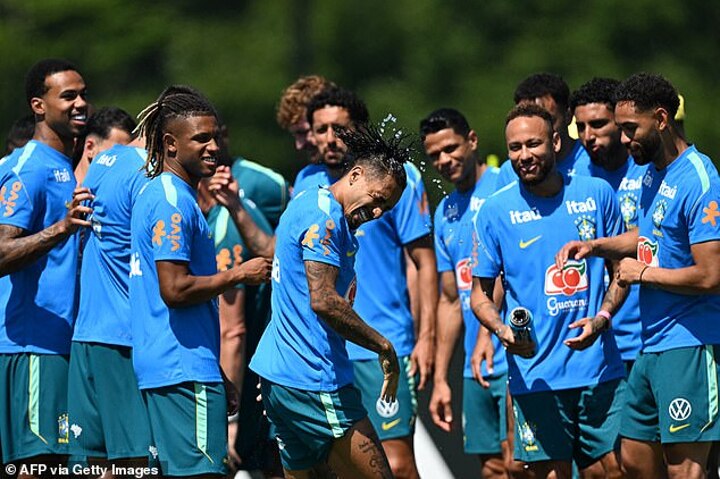
There will always be cycles of talent, but creative quality still pours out of Brazil. Palmeiras have a thriving academy, responsible Endrick and Estevao. Few clubs invest heavily in youth development, however, while more have come to rely on the old stars rebounding from Europe in their 30s and an influx of Portuguese coaches.
Now with an Italian coach in charge of a national team packed with players who have played most of their senior careers in Europe, Brazil has never been more European so how should they reflect the traditions of Brazil?
Besides, who can blame them if it can make them more competitive? Certainly not the English with a German in charge of their team. It is not our place to demand Brazil produce a carefree brand of football to satisfy our romantic notion of the way they should play the game.
Just like England, Brazil are locked into its own desperate quest to win again. Their last five World Cup campaigns have been ended by European opponents. It was France in 2006, the Netherlands in 2010, Germany in 2014, Belgium in 2018 and Croatia in 2022.
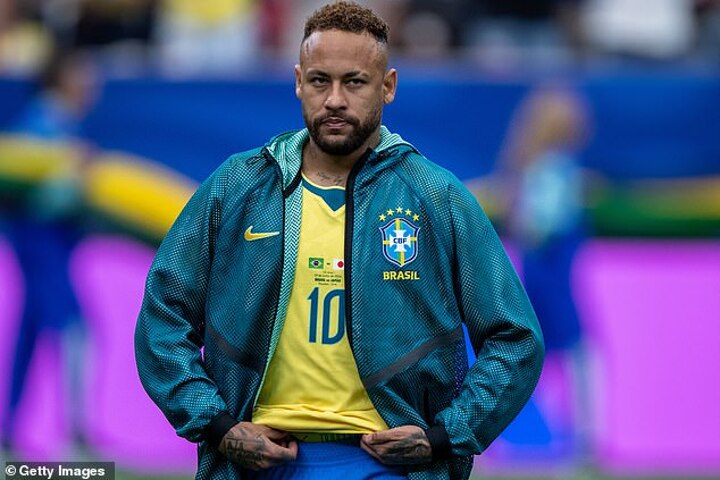
Nobody has emerged as Neymar's heir apparent, which fuelled the pre-tournament sideshow and his surprise selection by Ancelotti. Vini has not quite risen to the same status. There is no figurehead to compare with Lionel Messi in Argentina.
The Europeans meanwhile are turning out players with superstar flair. Brazilians look enviously at France, harnessing the raw talent emerging from poor immigrant communities around Paris as they did the favelas to produce such an exciting range of attackers led by Kylian Mbappe.
Similar could be said of Spain, with Lamine Yamal the latest to follow Messi out of Barcelona. Even London, if you consider Hammersmith-born and raised France international Michael Olise, who has the hallmarks of a classic Brazil No.10.
Perhaps it is significant that none of the above are currently operating in the Premier League, arguably the most stifling and over-coached of the top European leagues. Perhaps not. But for now, all trust has been handed to Ancelotti as Brazil take on Norway, the only country they have played and not beaten in World Cup football.
'Our team is evolving and that's what matters most in a World Cup,' said Romario, hero of 94, in his newspaper column for O Globo. 'From the second round onwards, there's no easy way. In a single-elimination match, determination and fighting spirit are fundamental to achieving the objective. From now on, it's about putting your heart into it, gaining confidence and going after them.'
 Santos
 Arsenal
 Manchester United
 Real Madrid
 Messi
Messi
 Casemiro
 Neymar
 Ancelotti
 Rodrygo
 Martinelli
 Inter Miami CF
 Matheus Cunha
 Endrick
All Comments (8)
Today 20:31
Today 20:19
Today 19:45
Today 19:39
Today 19:37
Today 19:27
Today 19:21
Today 19:17