Take a deep breath, England. A very deep breath. Then as many more deep breaths as humanly possible in a short span of time.

Plus another for survival’s own sake as you climb into the sky-high Estadio Azteca. You will need every last gasp up there.
Harry Kane’s team take on Mexico’s mountaineers under an altitude disadvantage — for a place in the quarter-finals — made even more extreme by their travel plans.
They flew in two days before kick-off, losing the one modicum of release from the thin-air pressure available to them.
The best option would have been to arrive as close as possible to 24 hours before the game at 1am tomorrow (BST).
The human body does not begin the production of additional red corpuscles necessary to absorb vital extra oxygen into the blood-stream until at least a full day after arrival at anything like Mexico’s 7,400ft above sea level.
That process of acclimatisation is exhausting of itself, especially at the start, which is why Liga MX teams from the coast or lowlands travel to away matches at this elevated home of Club America on match-day mornings. In and out before the oxygen deficit kicks in.

What a difference a day makes. England can expect to be feeling the effects as this match begins. So, was as much due diligence applied to altitude syndrome in 2026 as it was when England took part in Mexico 70 and Mexico 86?
A tad curmudgeonly, our one and only World Cup-winning manager, Sir Alf Ramsey, paid heed to the then-modern medical science. He insisted on a three-week training camp in Mexico City and followed that with warm-up matches at even higher altitudes against Ecuador in Quito (9,500ft) and Colombia in Bogota (8,500ft).
Ramsey, by the way, monitored the time his players spent sun-bathing at poolside on his pocket stop-watch. Looking at England’s tans this weekend, no such restriction appears to have been applied.
Those preparations enabled Bobby Moore’s team to play a magnificent part in the 1-0 defeat by probably the best team of all time — Brazil’s 1970 world champions — on the steaming foothills of Guadalajara.
A more genial manager Sir Bobby Robson may have been in 1986, but he, too, listened to the specialists. A 32-day acclimatisation to heights in Colorado’s Rockies was interspersed by sea-level games in the heat of Los Angeles. As England moved on to Mexico, they made camp at a semi-desert town called Saltillo 5,250ft up the mountains above the hot-spot city of Monterrey.
When they went a little higher, to their quarter-final in the Estadio Azteca, it was not a lack of air which wrought their defeat by Argentina. Rather the genius of Diego Maradona receiving a helping Hand Of God followed by the greatest individual goal in World Cup history.
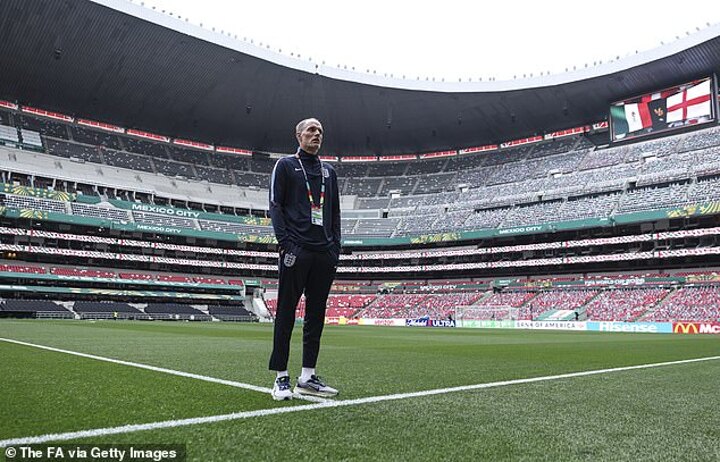
England were never going to be favourites in this Azteca attempt. Even less so having missed the opportunity to give themselves a small helping hand.
They face a Mexico team yet to concede a goal in this World Cup. The hosts have lost only two tournament matches in this granite fortress in 18 years.
You do not have to be a footballer to suffer from the reduced air supply England will endure. At the opening match here, my colleague Oliver Holt and I were confronted by three long climbs up steep ramps of crumbling stone to reach the press box.
At my grand age the rasping lung-strain was inevitable but my much younger colleague also reported severe chest pains and chronic loss of breath.
Come kick-off, Mexico will be roared into action by a manic crowd generating an atmosphere which sucks the very breath out of opponents. Oxygen of which England cannot afford to be deprived.
 England
 Mexico
 Tuchel
All Comments (7)
Today 22:09
Today 22:05
Today 21:17
Today 21:15
Today 21:13
Today 20:23
Today 20:17