According to The Athletic's report, Casemiro is a double-edged sword for the current Brazil national team. Defensively, he tends to press high and lose his position, but offensively, his heading ability is a crucial scoring method. Currently, no one in the squad can perfectly replace him.
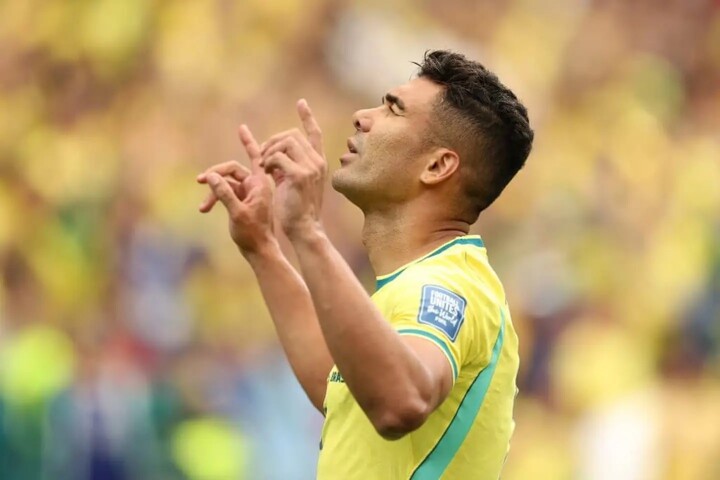
His entire performance against Japan encapsulated Casemiro's last three seasons at the club level.
He played poorly in the first half, revealing the 34-year-old midfielder's declining mobility in top-tier competitions. Japan repeatedly attacked the midfield with abundant stamina, easily advancing past him multiple times. By halftime, many fans called for his substitution, but Lucas Paquetá's unexpected injury forced Ancelotti to adjust his substitution plans.
The Brazil coach chose to keep the number five midfielder on, while subtly adjusting tactics: Endrick came on, and Matheus Cunha shifted significantly to the left wing, a change that completely unleashed Vinicius Jr.'s attacking firepower.
However, at NRG Stadium in Houston, it wasn't the team's array of talented attackers who sounded the charge for Brazil and scored the equalizer. It was Casemiro.
In just one afternoon, he went from being heavily criticized to becoming the hero of the match, once again shattering external doubts that he was "no longer capable of competing at the highest level."
With a career full of honors, he no longer needed to prove himself, but knockout international competitions do not allow for sentimental considerations, and the on-field competition is fiercely uncompromising.
While being good at scoring goals is a bonus, his core responsibility is to guard the midfield. To draw an analogy: it's like a mechanic who messes up your car but then turns around and makes a fantastic carbonara — no matter how good the skill, it's ultimately straying from the main job.
Brazil will face Norway next, and the intense physical confrontation will continue in the scorching New Jersey heat. Is Casemiro currently an asset to the team, or a liability?
Casemiro's form plummeted during his time at Manchester United, and in 2024, when Dorival Júnior coached Brazil, he was even left out of the Copa América squad. After a year of silence, the midfielder only returned to the squad when Ancelotti took over the national team in 2025.
All of this is understandable. Given enough space on the ball, Casemiro can command the midfield, orchestrating both attack and defense, just as he did when he helped Real Madrid win five Champions League titles, two of which were under Ancelotti.
Positioned in front of the two center-backs, Gabriel and Marquinhos, he remains a crucial part of the team's build-up play from the back. From the player data panel against Japan, it's clear that he frequently distributed the ball to both wings and constantly made defensive actions in his own half, protecting Brazil's penalty area.
Casemiro's biggest point of contention now revolves around his off-ball defensive efficiency.
The Brazil international is fond of pressing high and intercepting. Last season in the Premier League, he attempted 13 effective contests (including successful tackles, fouls, and failed contests) per thousand opponent touches, leading all Premier League midfielders.
This shows his willingness to challenge for the ball, but his habit of frequently going to ground in challenges also often prevents him from cleanly winning the ball. Against Japan, the hidden danger emerged early: in the 14th minute, he committed a reckless foul at the edge of the box and received a yellow card.
Looking back at this attacking and defending sequence, Brazil had sufficient numbers in defense, and there was no need to rush forward to pressure, yet a lazy tackle from behind gave the opponent a dangerous free-kick.
Perhaps this yellow card made him more cautious, and then Kaishu Sano broke the deadlock for Japan: the opponent's midfielder intercepted a pass, easily bypassed Casemiro through the middle, and scored from long range.
A post-match review makes it clear: Casemiro should have prioritized covering the space behind him, rather than rushing directly at the ball carrier. At that time, three Japanese players were around, and rushing to press during a transition was a complete mistake.
These two critical errors in the first half almost defined his entire performance in the first half, but after halftime, Casemiro turned the tide of the match in just ten minutes.
In the second half, he pushed further up the pitch, first making a run into the box and attempting a diving header, which was cleared off the line by Takehiro Tomiyasu, narrowly missing an early goal; not long after, unmarked, he snuck to the back post, precisely meeting Gabriel's cross with a powerful header to beat Aya Suzuki in goal.
This goal was no accident. His precise timing for aerial challenges and judgment of landing spots have been his trademark at Manchester United this season – in the 2025-26 Premier League season, he scored 8 headers, leading all players in Europe's top five leagues.
Most of these headers came from set pieces, thanks to multiple high-quality crosses from Bruno Fernandes. Set pieces are crucial in international knockout tournaments, and Casemiro's excellent aerial ability alone merits him a starting spot.
After the match, Ancelotti publicly supported the midfielder: "Casemiro is a natural leader. He knows his role on the field perfectly, and no one needs to teach him how to play that position well. That's crucial."
In the group stage matches against weaker teams like Haiti and Scotland, Casemiro could easily control the game's tempo, but against Morocco's tough defense, many shortcomings in Brazil's midfield were exposed.
When Morocco shifted the ball horizontally, they always found an unmarked receiving player. The match footage showed Casemiro's slow footwork in one-on-one defending, and he was completely out of position when trying to cover the areas he had left open.
Morocco repeatedly exploited this space to create threats easily in the first half.
There was another sequence in the first half: Brazil's midfielders collectively condensed to the near side, attempting to restrict Morocco's attacking space, but Mazraoui easily evaded Casemiro's interception, and then El Khannouss' through ball gave Hakimi ample space to sprint on the far side.
Brazil's midfield could only frantically retreat to withstand Morocco's relentless attacks.
Objectively, his teammates' performances also failed to relieve pressure on Casemiro. Ancelotti simultaneously deployed Bruno Guimarães and Paquetá in midfield, a combination that lacked defensive awareness, physicality, and running coverage.
This often left Casemiro alone in the central midfield, leading to an imbalance in the defensive line, forcing multiple players to cover, and widening the gaps.
Morocco's first goal was a prime example: Casemiro had to deal with two attacking players alone, yet his teammates failed to cut off the passing lane beforehand. Neither side dared to press, leaving him in a dilemma, and Díaz seized the opportunity to deliver a through ball, allowing Saibari to score.
Looking at Ancelotti's full squad, if Casemiro were rotated on Sunday, there would be no one in the team who could perfectly replace him.
The fact that 32-year-old Fabinho can only wait on the bench speaks volumes about the current situation; while young players Danilo Santos and Ederson have rotation potential and deserve more playing time in matches.
Ancelotti has always been skilled at on-the-spot tactical management, and he himself admitted that Casemiro's self-redemption against Japan was a stroke of luck.
In this FIFA World Cup, Casemiro is both a solution and a thorny problem for Brazil.
AF's PC site is now live! Browse full news, comments, match details and stats on your computer. Visit: www.allfootballapp.com
 Brazil
 Casemiro
 FIFA World Cup
All Comments (17)
Yesterday 23:55
Today 00:29
Today 00:05
Today 00:03
Today 00:01
Today 00:00
Yesterday 23:57
Yesterday 23:57
Yesterday 23:56
Yesterday 23:56
Yesterday 23:56
Yesterday 23:55
Yesterday 23:55
Yesterday 23:13
Yesterday 23:05