According to TA's analysis and report, Barcola's weakness is inefficient finishing in front of goal, but in terms of other abilities, he is absolutely worth £100 million.
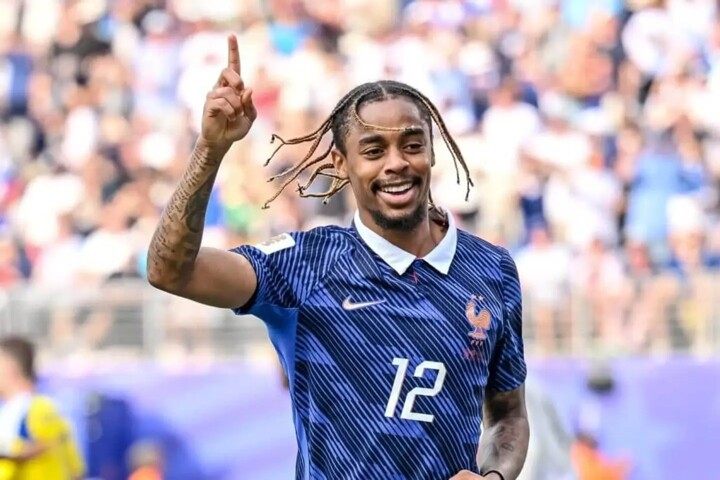
Reports indicate that every summer transfer window, the ever-increasing transfer fees in football constantly refresh public perception. Elliott-Anderson's £116 million transfer from Nottingham Forest to Manchester City became the benchmark for pricing in this summer's transfer market. TA reported this week that Paris Saint-Germain believes their winger Bradley Barcola's actual value should be far higher than this figure.
Milan previously signed forward Gonçalo Ramos from Paris Saint-Germain for a club-record transfer fee, as Paris had no urgent need to sell the forward. However, Barcola has two years left on his contract and is unwilling to renew – as a two-time Champions League winner, he has never been able to consistently secure a starting position in the team. But if he insists on leaving, this French international winger will certainly not lack suitors. Arsenal has long openly expressed interest, and Liverpool was also rumored to be interested in signing him in mid-June.
So the question is: Is Barcola really more valuable than Anderson, whom Manchester City signed for £116 million?
Player Valuation: Pure Financial Data Analysis
To evaluate player value from a purely financial perspective, TA collaborated with the global sports intelligence agency Twenty First Group (TFG), whose clients include several top clubs and major professional leagues.
Important Note
1. "Value" ≠ Transfer Price
The player valuation provided by TFG may differ significantly from the final transfer offer for a deal.
2. Value: Determined solely by the player's intrinsic qualities, unaffected by market conditions. Key reference dimensions include age, position, and competition history.
3. Transfer Price: Takes into account all external transaction factors to determine the final transfer fee a parent club can receive, such as remaining contract duration, buying club's financial strength, selling club's financial situation, etc.
This article uses data valuation, not market transaction price, as the evaluation standard.
For Barcola, TFG estimated that if he moved to the Premier League, his baseline value would be £100 million. This is based on his exceptional talent, more than two years remaining on his contract, and his ability to play as both a left and right winger and a forward.
This figure does not include market variables that affect the final transfer price – such as the current recruitment needs and negotiation stances of both buyers and sellers. Paris Saint-Germain could certainly demand a higher offer, but this valuation provides a reasonable price range.
Compared to the list of historically high-priced wingers in the Premier League (Grealish £100 million, Antony £82 million, Sancho £73 million, Pepe £72 million, Mbemba £71 million last year), TFG's valuation of £100 million is not inflated.
Looking back at last summer's transfer market, Liverpool splashed out €136.3 million (equivalent to £116.8 million, $156.1 million) for Florian Wirtz, and also secured Alexander Isaac, with the total transfer fee potentially reaching £130 million (equivalent to $173.6 million).
Whether a player is worth the transfer fee can only be definitively judged after they play for their new club; however, pre-transfer evaluations are based entirely on the player's past on-field performance, and Barcola's record is highly debatable.
Before the World Cup last month, many believed Barcola was merely a backup option for both Paris Saint-Germain and the French national team. But this view is too one-sided – he is a core member of both the club and national team's top attacking systems.
The 2024-25 season marked his career peak, delivering an impressive 21 goals and 20 assists in a single season. However, public discussion about him increasingly focuses on his inconsistent finishing efficiency. In many crucial matches, he missed excellent scoring opportunities.
But looking at the full season, Barcola's goal output is largely in line with expectations: 11 goals in the 2025-26 league season, with an expected goals (xG) value of 10.9; 14 goals in the previous league season, with an expected goals of 13.6.
Compared to cold hard data, the game logic behind the data is more worth delving into.
In terms of deadliness in front of goal, Barcola is not as good as his teammates Dembélé, Kvaratskhelia, and Doué, but his game is full of impact. In today's football environment where many wingers are accustomed to tracking back to defend, his ball-carrying attacking characteristics are particularly eye-catching.
His scoring has two distinct features: first, precise positioning, appearing perfectly in the scoring zone; second, relying on speed to break through behind defenders for one-on-one chances. In the first group stage match of the World Cup against Senegal, he scored with a high-speed run to extend France's lead. His off-the-ball movement is full of tactical thought: in the footage, it's visible that as soon as Rabiot gets the ball, he immediately anticipates the space and starts his sprint; in another instance, he cleverly feigns with a shoulder drop, pulling the defender out of position before accelerating and breaking through.
There is a question from the outside: Premier League defenses will not give him such ample space for ball-carrying sprints, but his speed can also create a large number of counter-attacking opportunities for the team.
In this year's Champions League final, Barcola came on as a substitute and twice broke behind the defense late in the game, continuously challenging Saliba's defensive line. Liverpool is already adept at counter-attacking tactics, scoring 7 counter-attacking goals in the league last season, compared to Arsenal's 4. If Barcola is signed, it will significantly strengthen the counter-attacking threat of both teams.
Barcola doesn't just rely on dribbling to impress audiences; his long-range shooting is also excellent. At the beginning of last season, in a 2-0 victory against Lens, he scored two goals from outside the box; two other goals were even more impressive.
Although his overall goal count for a single season is roughly in line with expectations, he often misses simple chances yet can score difficult shots. However, his attacking output also has another noteworthy pattern.
Combining the ten-game rolling average data from his last season at Lyon and his first season at Paris: this winger's actual goals often exceed his expected goals (xG overperformance). In the past two seasons, Paris has won both the Ligue 1 and the Champions League consecutively. Barcola has shown a pattern of "xG overperformance in the first half of the season, and goals underperforming expectations in the second half."
This also explains why he missed opportunities multiple times in the Champions League knockout stages, but his overall quality cannot be defined solely by these missed chances.
Most forwards' statistics fluctuate, and Barcola's assist data in the past two seasons has also shown significant fluctuations.
In both seasons, he created an average of 2 scoring opportunities per Ligue 1 game, but there was a huge difference between actual assists and expected assists (xA): in the 2024-25 season, expected assists were 5.9, while he delivered 10 actual assists in the league; in the previous season, expected assists were 4.5, but he only had 1 assist in Ligue 1.
When interpreting this data, it's crucial to consider Paris's tactical system, which is distinctly different from most teams. His assists in the past two seasons have relied primarily on two points: extreme explosiveness and fearlessness in one-on-one duels with defenders.
The day after the summer transfer window closes on September 1st, Barcola will turn 24. All major clubs expect him to improve his consistency in converting chances in front of goal next season.
His talent is undeniable, but to consistently deliver on his potential, he is better suited to being a dedicated wide attacking core rather than part of a rotational system of multiple wingers. His starting as a substitute in this World Cup and ultimately securing a stable starting position is ample proof of this.
Many fans will scoff at Paris's valuation being higher than Anderson's £116 million transfer fee, but in the current transfer market, this offer is reasonable. The real core question is: how much higher will Paris's psychological asking price be compared to the £116 million Manchester City paid Nottingham Forest?
Regardless of which club decides to pursue Barcola, a huge transfer fee will be required to complete the deal. But all the data and on-field performances mentioned above prove that he is absolutely worth the high price tag.
AF's PC site is now live! Browse full news, comments, match details and stats on your computer. Visit: www.allfootballapp.com
 Arsenal
 Liverpool
 Paris Saint-Germain
 France
 Barcola
All Comments (17)
Today 00:03
Today 00:02
Today 00:01
Today 00:01
Today 00:01
Today 00:01
Today 00:00
Today 00:00
Today 00:00
Today 00:00
Today 00:00
Yesterday 23:47
Yesterday 23:47
Yesterday 23:37
Yesterday 23:29