
England defender Gary Stevens was interviewed by FIFA.com, recalling England's encounter with Argentina in the 1986 FIFA World Cup.
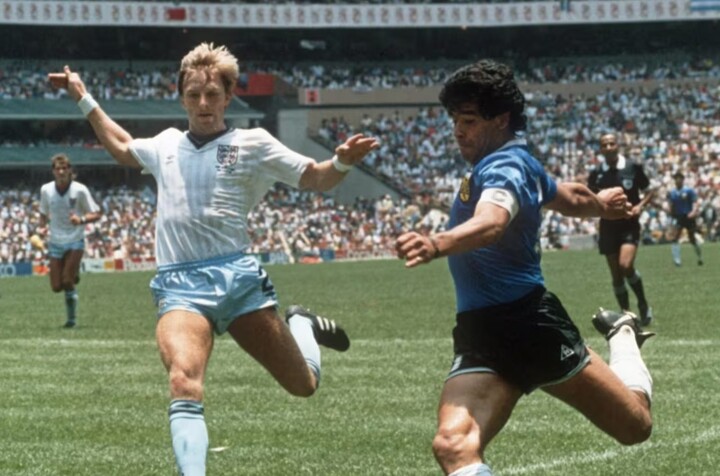
Gary Stevens was one of the top full-backs in English football in the 1980s, winning the English League Championship with Everton and various cup competitions with Glasgow Rangers. At the international level, he represented England in two FIFA World Cups and one European Championship. But today he often jokes that the "one thing he's most known for" has nothing to do with football. He said with a smile: "My head is on a stamp."
And it was a stamp issued by Argentina, all thanks to Diego Maradona. At the 1986 Mexico FIFA World Cup, Maradona led Argentina to victory, and Argentina then released a set of commemorative stamps. One of them captured the final moments of his legendary second goal when Argentina beat England 2-1 in the quarter-finals.
Stevens was part of Bobby Robson's England team in that match; in the stamp image, he stands helpless in the six-yard box, watching the Argentine captain complete a series of dribbles and then shoot low into the near post.
Stevens now lives near Perth, Western Australia, and works as a physiotherapist. He enjoyed stamp collecting as a child, and he told FIFA about this strange story that was told to him by a client.
"A few years ago, I was treating a patient and he asked me: 'You're a stamp collector, right?' — the professional term for a stamp collector is a philatelist, and I replied yes. He then said: 'Do you know you're on a stamp?'"
Later, this customer specially came to his physiotherapy clinic, bringing a set of four commemorative stamps, which completely recreated the classic scene of June 22, 1986.
Stevens sighed: "Imagine, not many people in the world get to be on another country's commemorative stamp." This set of stamps is now framed and hanging on his wall at home.
At the moment Maradona scored his second goal, with goalkeeper Peter Shilton and center-back Terry Butcher both faked to the ground, Stevens was the last defender still standing in the six-yard box.
He recalled that he was intently watching Argentina's No. 10, waiting for him to swing his leg and exert force, so he could anticipate the direction of the shot and react defensively.
"When defending, you focus on the player's leg movements. As soon as he lifts his leg, you can tell if it's a push shot or another type of shot, getting a bit of a prediction clue beforehand. I was waiting for him to open his leg for a push shot, but at the last moment, he poked the ball into the net with his toe. Even so, it was a brilliant finish – he didn't give me any predictive movement signals throughout."
Maradona's two goals that day are among the most replayed classic moments in football history. Stevens also witnessed the first "Hand of God" goal up close.
He was the closest defender to Maradona and goalkeeper Shilton who were contesting the ball, and at first, he even thought Maradona had headed the ball into the net.
"He completely fooled me. I saw him make the heading motion, and my perspective at the time was almost identical to the referee's. Only from the side could you clearly see him raising his hand to hit the ball, but he simultaneously flicked his head, and all I saw with my eyes was a heading motion."
Revisiting this classic England-Argentina match, Stevens also talked about many details on the field. He first mentioned the pitch: "The pitch conditions were terrible, completely different from the flat, high-quality turf of the same stadium when Tuchel's England played Mexico in the round of 16 today."
"The Estadio Azteca is located at high altitude, and the high midday temperature was the biggest challenge." Stevens said he suffered severe dehydration during that match, losing a full 5 kilograms of weight.
At that time, there were no fixed water stations or bottled water supplies on the field, and the tools for quenching thirst were rudimentary: "It was like the plastic bags used to hold goldfish at a market, filled with clear water. Staff would throw them onto the field, and we'd pick one up when we had a chance, bite through the bag, and drink as much as we could."
After the match, he and center-back Terry Butcher were taken to the changing room for post-match doping control. Two Argentine players were sitting at the other end of the changing room.
"Guess who? Maradona, and number five Jose Luis Brown – who later scored in the final. They were still in the tournament and could only drink water; we were already out, so the staff brought in a case of beer. We waited a full 90 minutes to complete the sample collection, and during that time, we both chugged beer and got quite drunk."
After many years, reviewing the game with a peaceful mind, he sincerely admired Maradona's talent, first and foremost his astonishing instantaneous explosiveness.
"I always considered myself to be quite fast, and in that game, I marked him many times. His sprint speed over 10 yards was incredible; he was full of explosive power."
In addition, he possessed an extraordinary sense of balance and a very low center of gravity, and the English defenders simply couldn't keep up with his pace.
"Top players all have this magical talent for balance. I once played against George Best, and it's really hard to understand how they do it. Maradona's second goal wasn't a crazy long dribble; he didn't touch the ball many times, maybe ten times, but each touch allowed him to get past a defender. Messi is the same type; he can easily leave defenders behind."
The conversation naturally turned to this Wednesday's semi-final: now England needs to contain Messi, making up for the regret their team couldn't achieve 40 years ago.
Stevens' answer was very cautious, as the football environment and tactical systems are vastly different now.
"Maradona was at the absolute peak of his career then, perfect timing; but Messi now has immense experience in major tournaments. To deal with such a superstar, you can't just stick to him one-on-one throughout the match – there are ten other players on the field in international competitions, and simply marking him closely is not worth it."
Stevens was a substitute and experienced England's semi-final loss to West Germany in the 1990 FIFA World Cup. He also offered two expectations for Tuchel's England team, who will be playing in Atlanta:
"I think the team should start with high intensity. Most games in this tournament have had a slow pace in the first half, and England should proactively attack and suppress Argentina. This game is either an all-out effort to win or elimination, so go for it... just don't let it go to a penalty shootout."
AF's PC site is now live! Browse full news, comments, match details and stats on your computer. Visit: www.allfootballapp.com
 Argentina
 England
 Gary Stevens
 Diego Maradona
 Rest In Peace
 FIFA World Cup
All Comments (20)
7-17 17:53
7-15 22:55
7-15 17:26
7-15 17:24
7-15 17:22
7-15 15:08
7-15 15:05
7-15 15:05
7-15 15:04
7-15 15:04
7-15 15:03
7-15 13:34
7-15 12:15
7-15 12:08
7-15 12:08
7-15 12:05
7-15 11:59
7-15 11:56
7-15 10:56