On July 15, Croatian media outlet "Jutarnji List" republished a letter from the Croatian Football Federation (HNS) to FIFA. In the letter, the Croatian Football Federation requested clarification on VAR and referee decisions, and increased transparency following the chaotic final moments of the match against Portugal.
Croatian Football Federation's letter to FIFA:
This FIFA World Cup has once again demonstrated the global power and popularity of football. Therefore, it is even more imperative that we uphold the fundamental values of the sport – fairness, fair play, and the equal application of football rules to all national teams.
It is precisely because certain controversial situations have elicited strong reactions worldwide – among referees, media representatives, football experts, and the public – that we deemed it necessary to contact you to clarify the application of the Laws of the Game and FIFA protocols by the referees in the Round of 16 FIFA World Cup match between Croatia and Portugal, held in Toronto on July 2, 2026.
In the second half of that match, three Croatian goals were disallowed, all due to delayed offside calls. Furthermore, after VAR intervention, Portugal was awarded a penalty, which ultimately led to them leveling the score. Despite the referee being close to the players at the time and witnessing the foul firsthand, he did not consider it sufficient for a penalty. Therefore, this situation did not constitute a "clear and obvious error." Considering that such fouls occur in the penalty area in almost every match, we also believe that the referee could not reasonably deem it a "clear and obvious error." In other words, neither of the two fundamental criteria for VAR intervention were met. According to VAR rules, VAR has neither the right nor the obligation to ask the referee to review the pitchside monitor.
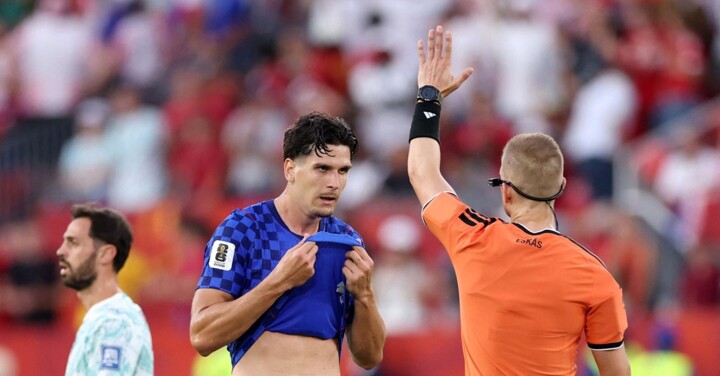
Particularly controversial was referee Espen Eskås's decision in the 103rd minute to disallow Gvardiol's goal due to an offside by Mario Pašalić. FIFA's official statement claimed: "The connected ball technology embedded in the match ball detected a touch by Igor Matanović, which enabled the referee to correctly award offside and disallow Gvardiol's goal."
Meanwhile, FIFA's official explanation of the offside rule on its website states: "Hair is considered part of the body only if it affects the movement or trajectory of the ball. This may only occur with significant contact with a large amount of hair, such as a top knot."
Therefore, it remains unclear whether the referee disallowed Croatia's goal simply because Matanović might have touched the ball with a single strand of hair, or because he believed this contact affected the ball's movement or trajectory – a conclusion that cannot be drawn from publicly available video footage.
Furthermore, all existing footage clearly shows that after the ball passed over Matanović's head, its direction, trajectory, speed, and spin remained unchanged. In other words, he did not touch the ball, and thus there was no offside. We believe that it is fundamentally wrong for a barely perceptible vibration recorded by sensors alone to decide the outcome of such an important match.
We believe that football, fans, players, referees, the spirit of the game, and FIFA itself will not benefit from excessive reliance on technology, let alone facts seen by the human eye. As reactions from people around the world (not just Croatian fans) show, almost no one believes Matanović touched the ball. When technology tries to convince the public that this is not the case, many understandably call such a decision "blatant robbery" or claim that "technology is destroying football." This widespread negative reaction does not help to enhance FIFA's reputation or public trust in technological innovation. This is particularly concerning because we firmly believe that technology plays an important and desirable role in football – but certainly not in this manner.
The entire situation is further complicated by the following question: if sensor data unequivocally confirmed a touch, and the VAR team undeniably ruled offside, then why was the referee initially called to review the pitchside monitor replay? In such a scenario, this would entirely be a factual judgment that VAR is empowered to make independently. Conversely, if the referee was indeed called to review the replay, then what exactly did he review? What specific footage led him to conclude that Matanović touched the ball or affected its trajectory?
Furthermore, existing television footage clearly shows – through the data displayed at the bottom of the screen – that the alleged "peak" of contact occurred long before the ball reached the Croatian forward accused of touching it. Such footage is clearly insufficient as reliable evidence for making such an important decision. Therefore, we request that FIFA provide the Croatian Football Federation with the relevant video assistant referee (VAR) room footage so that we can ascertain why this "peak" occurred before the ball approached Igor Matanović.
We are fully aware that any subsequent explanation of these events cannot change the outcome of the match against Portugal. We respect the Portuguese team and congratulate them on advancing to the Round of 16.
However, given that football matches – especially the FIFA World Cup – are passionately followed by billions of fans worldwide, we believe it is necessary to further strengthen trust in referees, particularly regarding the standards and methods of applying modern technology, to prevent its misuse or use for purposes contrary to its original intent. Everything that happened in this match, especially the final decision regarding offside, caused great dissatisfaction among fans worldwide, which negatively affected this historic FIFA World Cup tournament.
Therefore, we believe that FIFA should conduct a comprehensive analysis of all controversial situations in this match and provide a complete explanation of the referee's decisions that had a decisive impact on the outcome of the Round of 32 match. While such an explanation cannot restore the Croatian national team's chance to compete for a major world championship again in Luka Modrić's extraordinary national team career, we sincerely hope that in the future, clearer rules and improved procedures can prevent similar unfair and anti-football decisions – decisions where sensors override what the human eye sees.
Regrettably, such decisions cause immense disappointment to fans – from Croatian fans in the stadium to fans, media representatives, commentators, and the general public worldwide. We firmly believe that such situations are avoidable, and therefore we decided to communicate with you in this way. We are also well aware that no explanation can alleviate the tears, sadness, and disappointment of the players and fans.
In light of all the above, we earnestly request that you seriously consider the issues and suggestions we have raised.
We await FIFA's response, and more importantly for us, how Croatia will be judged in the future.
(End of Letter)
Nearly two weeks have passed since Croatia's Round of 16 FIFA World Cup match against Portugal. "Jutarnji List" stated that the day after the match, the Croatian Football Federation (HNS) immediately sent a strongly worded letter to FIFA, demanding an explanation for the match outcome witnessed by the world and calling for respect for the principles of fair play and the Laws of the Game. FIFA has not responded. However, the Croatian Football Federation insists that FIFA provide a reasonable explanation and will not give up until a satisfactory answer is received. Croatia has repeatedly felt dissatisfied with referee decisions in major tournaments before. Some decisions were subjective, while others were, unfortunately, objective facts. The Croatian Football Federation is doing everything in its power to prevent such incidents from happening again, to avoid further anger towards Infantino and his team.
AF's PC site is now live! Browse full news, comments, match details and stats on your computer. Visit: www.allfootballapp.com
 Croatia
 Portugal
 FIFA World Cup
All Comments (72)
Today 20:54
Today 20:54
Today 20:54
Today 20:54
Today 20:54
Today 21:49
Today 21:49
Today 21:21
Today 21:17
Today 21:05
Today 21:03
Today 20:57
Today 20:55
Today 20:55
Today 20:55
Today 20:55
Today 20:54
Today 20:54
Today 20:53
Today 20:53