Ahead of the FIFA World Cup third-place play-off between England and France in 2026, England coach Tuchel attended a press conference to answer questions from reporters. The following is the first part of the press conference.
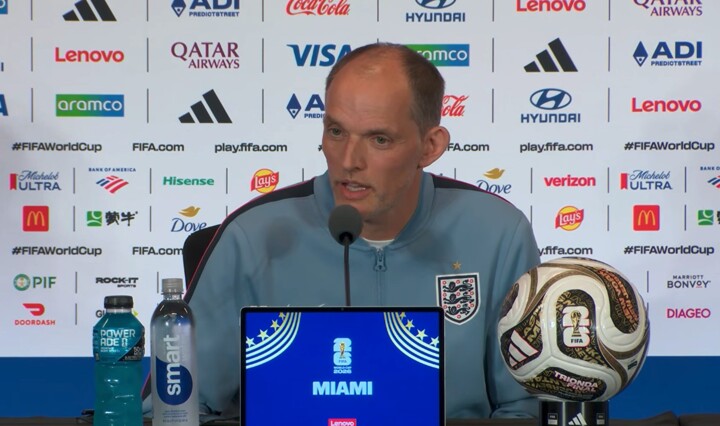
Hello, Thomas. Since the semi-final, there have been a lot of narratives and opinions about how England finished the game on the pitch and the tactical setup. After 48 hours of reflection, even Donald Trump has weighed in today. Looking back now, how do you evaluate the performance in the last 35 minutes of the match?
Are you trying to get Donald Trump to testify in this case? No, I'm just kidding. My opinion remains unchanged: we played too passively, becoming overly passive. If you're asking if I regret my decision, my answer is no, I don't. Because I felt the team was becoming too passive, and the momentum of the game was shifting. I tried to help, tried to support my team. I made several decisions based on my instincts, intuition, experience, and desire to win. I made decisions to help the team achieve a result, and although we didn't get the desired outcome in the end, I rightfully bear responsibility for those decisions. But these decisions were made under immense pressure, in real-time during the game—that's what in-game management is about. I would only regret it if I hadn't tried to help or hadn't reacted. But I don't regret the decisions themselves.
Hello, Thomas, looking back again, when you made these decisions and spoke about wanting the wing-backs to be more active, yet the team became passive, does the responsibility lie with the players, with you, or is it due to the flow of the game? Who is accountable for this?
Listen, I take responsibility. If you find it easier to blame someone, then blame me; that's fine. If you have to find someone to take the blame, I accept it; I am the head coach. As I said, we made in-game decisions based on trust, the desire to win, and experience, and based on how we actually felt during the game. Any other assumptions are just assumptions; no one knows what the outcome would have been with different substitutions or adjustments. It's easy to fall into simplistic thinking, getting caught up in attacking versus defending, but football is much more complex than that. It's about how you execute a certain tactical structure. We had many problems in the 4-4-2 formation, and we couldn't solve them later in other tactical structures either. That's just how it is, and we have to accept it. And by the way, we also have to bear this pain. This is our pain, the pain of me and the players. We bear the deepest hurt, and this scar will stay with us. This was a very painful defeat, and we are the first ones to face it, not the critics, commentators, or those family members who only wish us well and suffer with us. This team is extremely competitive, and every player here has a strong desire to win and good intentions. We will overcome it, we will use this experience, we will respond, and all of this starts tomorrow. We still have ground to make up, and we are well aware of that, and that is the focus now.
Hello, Thomas, regarding Kane's position on the field the other day, he seemed to be playing very deep. What do you think was the reason for this? Also, how did the players respond to your feedback that the team played too passively?
In what situation do you mean Kane played too deep? Was it in the last 30 minutes? Because at that time we were defending deep. That's the choice you make when you defend deep. If you adopt a deep formation, the whole team must participate. We were not proactive enough to break out of the deep defense. But in football, this is a reflection of team spirit, cohesion, and mentality. We must defend as a whole, as 10 or 11 players together. When we are pressed deep, Kane also has to participate in deep defense. He did so at certain moments in the first half as well. The difference was that back then we could push up and find triggers for counter-attacks. But in that game, we became too passive, couldn't keep possession, and couldn't win duels. That's what we need to improve next.
It's a great pity that you and the English people couldn't achieve the goal of reaching the final. Can you explain your tactical considerations after taking a 1-0 lead? Why did you choose to change the game structure at that point? What was your intention?
I have explained it many times, and I can explain it again for you. We were playing a 4-4-2 formation. After our goal, Argentina gained a lot of momentum. They made a series of very aggressive adjustments, committing many players forward. They were constantly pushing for a goal, and the players they brought on were increasingly attack-minded. We were unable to stop their crosses or defend against players making runs into the box. So I decided to switch to a back five, aiming to increase defensive width and get closer to their wide players responsible for crossing. We had done this before against Mexico, and it took a few minutes to adapt from a back four to a back five, which was normal, but we executed it very well afterward. This time, we couldn't turn the momentum, but that was the initial intention. We just played too passively, while Argentina found a new rhythm; they found their form. In the broader context, perhaps it's worth mentioning that it was our 14th match together, and our first competitive loss. As I said, it was a painful defeat. We faced the reigning champions in the semi-finals, and we were leading 1-0 for 85 minutes. We faced the best players in the world and ultimately lost 2-1, which is very painful. We deservedly reached the semi-finals; we are one of the top four teams in the world. We wanted more, and we are very disappointed because we wanted to play in the final. We once believed we could do it. We built a genuine belief, and we dreamed with it. But I still believe that the other three countries almost came with the expectation of winning the championship, and we did not. France, Spain, Argentina, they are already at that level. We are not there yet, and there is still a gap to close. That is what we will start doing tomorrow; we will not stop chasing, we will not stop hunting, and we will not stop challenging. We need to improve the footballing details. This is the big picture. So, I don't think there's much room for drama in this matter. If you want to play the blame game, fine, you can do that, but I have the right not to participate.
Hello, Thomas, do you think you will be a better coach next time after experiencing a major tournament?
Through every day of hard work, through every experience of working with top players, I am getting better. So, today I am better than yesterday.
Hello, Thomas, I would like to ask about Saka. Can he play tomorrow? Also, was there a specific reason why he wasn't fielded against Argentina?
Of course there was a reason, it was a real-time decision regarding Bukayo. Bukayo always has the ability to start for us. But at the time, we decided to adopt a more physically confrontational approach and chose Morgan Rogers. I felt that after the match against Norway, Morgan showed some special qualities, and I also felt it in training. I am glad that he proved our choice was correct with an assist. In the preparation process, we had multiple options in mind, and Bukayo was one of them. But when the game was in trouble and we couldn't get out of it, we made that decision.
Thomas, have you studied the performance data? Because if you compare the match from a few days ago with the match against DR Congo in the same venue and environment, your high-intensity running data significantly decreased. Are you now aware that the players were actually exhausted, and was this a factor in your decision-making?
Yes, I think even if we don't want to admit it, because it always sounds like an excuse, we would never bring it up ourselves. But I do feel that playing with ten men in Mexico, the high altitude, the long travel, and extra time against Norway, cost us more sleep and physical energy than we anticipated. I felt that. This group of players is very special; they give their all in every game. If you see a drop in data, there must be a reason, because the players' motivation is still extremely high, just like every team that reaches the semi-finals. So, yes, we didn't reach that intensity. I think Argentina found a new rhythm, new motivation, and belief. They have built over several years and have the experience of overcoming difficulties and winning together. All these factors played a role. Messi also found new form on the other side of the pitch. There are many reasons.
AF's PC site is now live! Browse full news, comments, match details and stats on your computer. Visit: www.allfootballapp.com
 Argentina
 Arsenal
 Aston Villa
 England
 France
 Bayern Munich
 Spain
Spain
 Tuchel
 Kane
Kane
 Saka
Saka
 Morgan Rogers
 FIFA World Cup
All Comments (223)
Today 14:24
Today 14:24
Today 14:24
Today 14:23
Today 14:24
Today 14:45
Today 14:45
Today 14:43
Today 14:43
Today 14:34
Today 14:34
Today 14:34
Today 14:34
Today 14:34
Today 14:34
Today 14:34
Today 14:34
Today 14:34
Today 14:33
Today 14:33
Today 14:33
Today 14:33
Today 14:33
Today 14:33
Today 14:33