On July 19, the 2026 FIFA World Cup final in the USA, Canada, and Mexico will be held at MetLife Stadium, featuring defending FIFA World Cup champions Argentina against European champions Spain. Ahead of the match, renowned sports media outlet The Athletic used a data model to predict the outcome of the final. The results indicated that Spain would have a slight edge.
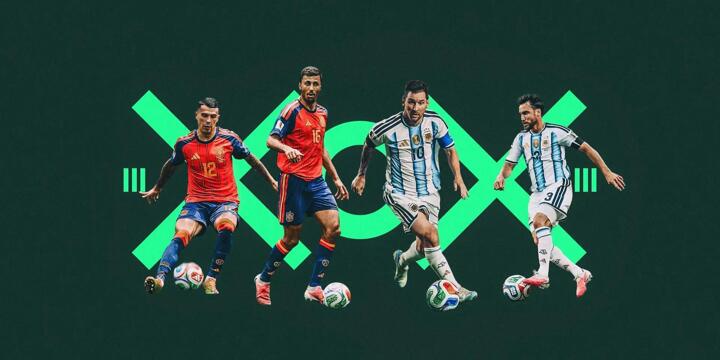
This is the only blemish on Luis de la Fuente's Spain team's almost perfect run in this FIFA World Cup—they have never trailed in a match so far, conceding only 1 goal in 7 games, which was against Belgium in the quarterfinals.
Ball-dominant possession football has long been deeply rooted in Spanish football culture, and captain Rodri is the best embodiment of this style: he has completed 655 successful passes, making him the player with the most successful passes in a FIFA World Cup final stage since statistics began in 1966. His central defensive teammate Cubarsí ranks second with 550 successful passes. Even more impressive, the 19-year-old's ability to drive forward with the ball and deliver incisive passes into midfield is exceptional, averaging over 22 passes that break the opponent's defensive line per game, with a passing accuracy of up to 94%, the best record in this FIFA World Cup for this metric.
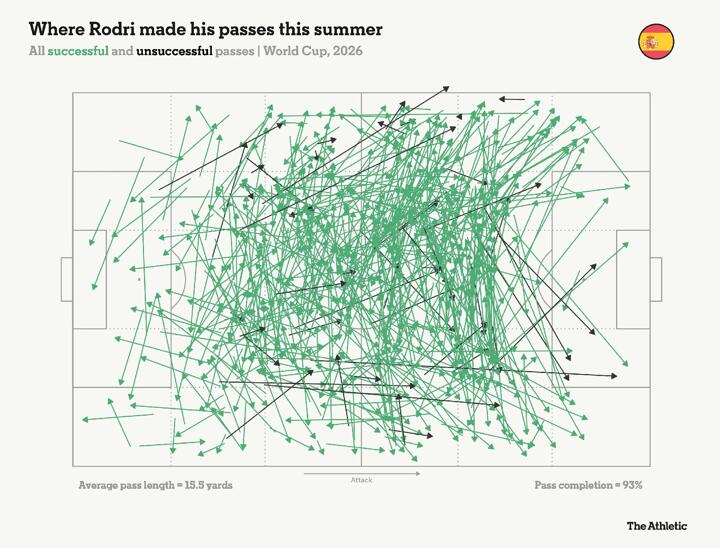
Rodri's FIFA World Cup pass distribution map this summer
No matter how you analyze it, these statistics speak volumes.
Spain averages 28 continuous passes of 9 or more per 90 minutes, ranking first among all participating teams in this FIFA World Cup, and the value brought by such continuous passing is multidimensional.
On the one hand, sustained possession can slowly wear down the opponent's physical strength—opponents who don't get the ball for extended periods are compressed near their own half, their legs become heavier, and their thoughts gradually become muddled. On the other hand, this possession advantage is closely linked to Spain's defensive acumen after rare turnovers. De la Fuente's team excels at counter-pressing, immediately swarming the ball carrier to quickly regain possession and maintain pressure on the opponent.
According to FIFA data, Spain spent 12.2% of their time in this FIFA World Cup in a counter-pressing phase when out of possession, the highest proportion among all teams that reached the quarterfinals. In addition to controlling the tempo with the ball, Rodri also ranks first among all players in this FIFA World Cup for successful counter-presses.
The 30-year-old player's tenacity can be seen in the following example: in the 3-0 victory over Austria in the Round of 32, when Yamal lost possession in the Austrian box, Rodri swiftly pounced on Sabitzer, decisively winning the ball back, then looked up to see four teammates in red shirts in a pass-friendly position. Spain's tactical style also has flexibility, adapting to transitions and accelerating the pace of the game—utilizing the brief chaos of a disorganized opponent to turn it into their own advantage.
This is evidenced by their possession transition frequency (i.e., the number of turnovers) and offensive efficiency: 31% of Spain's attacking sequences result in entries into the opponent's penalty area.
Combining these two, Spain's threat extends beyond prolonged possession; their playing style has multiple dimensions of lethality.
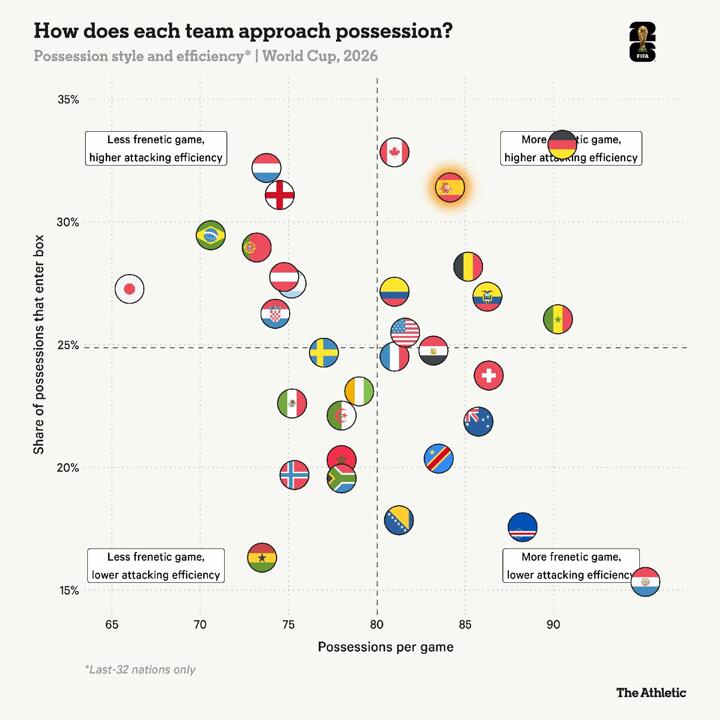
Analysis of each team's possession style | X-axis is average possession, Y-axis is percentage of possession sequences entering the penalty area
Yamal is a gem for Spain, but after recovering from a hamstring injury at the end of last season, the young player's goal threat in this FIFA World Cup has not been as expected.
Although Yamal's dribbling ability and delicate footwork can instantly change the course of a game, the true core of Spain this summer is the team's cohesion—a result of years of working together: in the starting lineup for the semi-final against France, seven players also started in the 2-1 victory over England in the European Championship final two years ago.
Spain's squad stability is sometimes comparable to a club team, and De la Fuente worked with many players in the current squad during his decade coaching in the Spanish youth system.
A key tactical feature of Spain in this tournament is the use of full-backs.
Whether cutting inside, overlapping, creating chances, or scoring crucial goals, Cucurella and Pedro Porro's roles in Spain's attack are highly significant.
The positional rotation and coordination between Cucurella and Baena on the left flank have been perfect, with both consistently occupying different channels on the field to stretch the opponent's defense and create spaces, which was vividly demonstrated in the semi-final victory over France.
Throughout the tournament, the same rotation tactic also appeared in the second group stage match against Saudi Arabia, where the two players pulled opposing players out of defensive positions through inverse movements, creating pressure on the flanks.
The tactical pattern on the right flank is identical, and Porro's winning goal against France is an excellent example of the seamless coordination and full potential of the wide players.
Yamal stayed in the widest channel, attracting French left-back Lucas Digne, which created space for Porro. After a brilliant one-two with Olmo, he cut inside into the central channel.
"Value-added full-backs" is a major tactical trend in this FIFA World Cup, where full-backs or wing-backs act as "extra players" to support the attack, surging into the opponent's penalty area. Porro, who has scored 2 goals in 7 games, is a perfect practitioner of this tactic. He often partners with Yamal and links up exceptionally well with his teammates on the field. Considering the roles of Argentina's full-backs in both attack and defense, the tactical balance on Spain's two flanks will likely be a key highlight of the final.
Let's start with Argentina's defensive weaknesses without the ball—of the 7 goals conceded by the defending champions in this tournament, 5 originated from defensive errors on the flanks. As shown below, 3 of these goals were conceded from Argentina's left flank in similar scenarios: against Jordan, Egypt, and England, crosses to the edge of the six-yard box were not successfully cleared.
Another 2 goals were scored after opponents easily broke through the flank defense: Dedúarte of Cape Verde and Ndoye of Switzerland both skillfully bypassed Argentina's corresponding full-backs with intricate play, then scored from tight angles inside the box.
Given Spain's efficiency in wide play, Argentina coach Scaloni and his coaching staff must be highly vigilant and find ways to curb Spain's wide threats, as this has been their "Achilles' heel" throughout the tournament.
In attack, Argentina's forward line, with the exception of right midfielder Giuliano Simeone (who has started 2 games in this FIFA World Cup), does not have naturally wide players.
This means their full-backs—usually Tagliafico (left) and Molina (right)—need to take on the task of providing width. Pressing Argentina's two full-backs deep into their own half is an effective tactic to reduce their attacking threat, but Scaloni's team is better at using the technical abilities of Messi, Enzo, Julián Álvarez, and Mac Allister to combine through the middle.
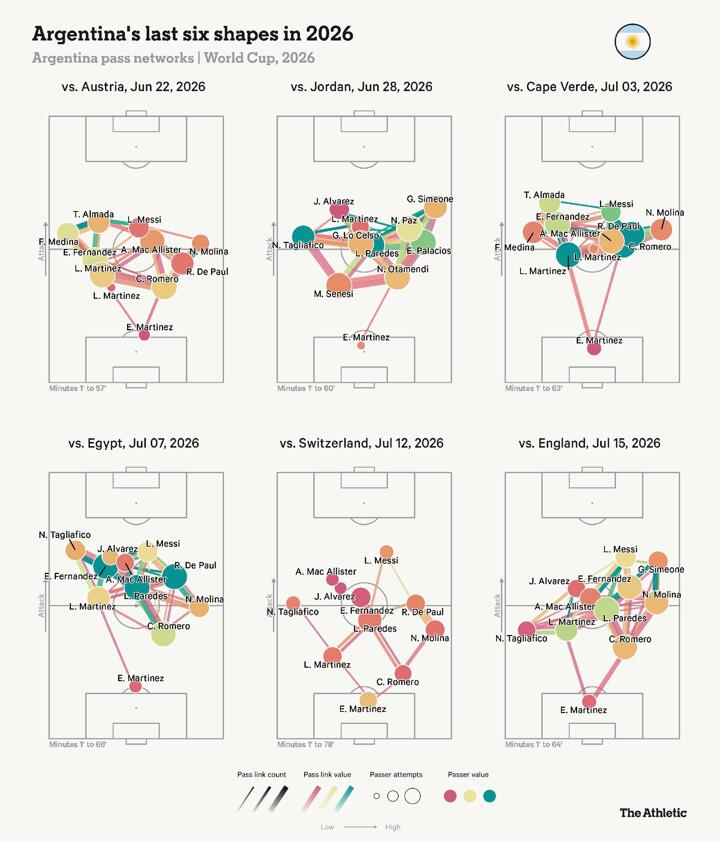
Argentina's formation and passing network in the last six matches of the 2026 FIFA World Cup
In the attacking half, Argentina's touches in the central midfield account for 33%, the highest among all teams in this FIFA World Cup.
Their narrow formation is deliberate, aiming to find breakthroughs through the center of the opponent's defense as much as possible. They have attempted 40 through balls in this tournament, the most of any team. In the widest channels of the attacking third, Argentina's attacking proportion is only 42%, higher only than South Africa's 39%.
This is largely thanks to Messi.
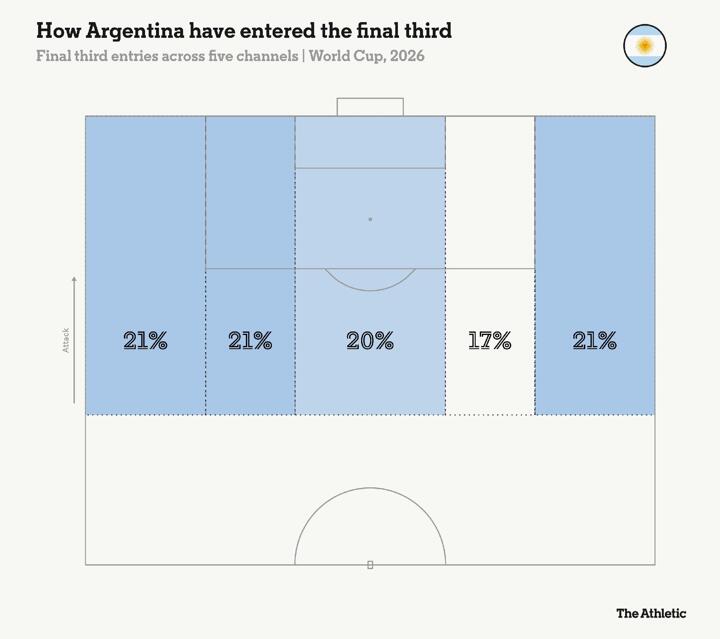
How does Argentina advance into the final third?
The 39-year-old player continues to defy expectations with extraordinary performances: he ambles casually in the opponent's half, then suddenly bursts into action, delivering a fatal blow. Although he spends 64% of his game time walking, no player in the world is better than the Argentina captain at optimizing his timing of runs.
The data highlights his central role.
Among all players who advanced to the Round of 16, Messi created 33% of his team's total chances, unmatched by anyone; in terms of non-penalty shots as a percentage of the team's total shots, only Haaland of Norway (higher than Messi's 29%) had a higher percentage; in terms of touches in the attacking third as a percentage of the team's total touches, only Achraf of Morocco (higher than Messi's 19%) had a higher percentage.
If it wasn't clear before, it's certain now: all of Argentina's tactics still revolve around this agile "magician."
Tactically, Messi has the freedom to roam anywhere on the field to find space and inflict damage on opponents. Sometimes he drops deeper to participate in offensive build-up. Sometimes he drifts to the left side of the pitch, operating in the vacant areas there.
In the semi-final against England, he stood firm in the right half-space, then delivered two assists in the closing stages of the game, helping Argentina complete a comeback.
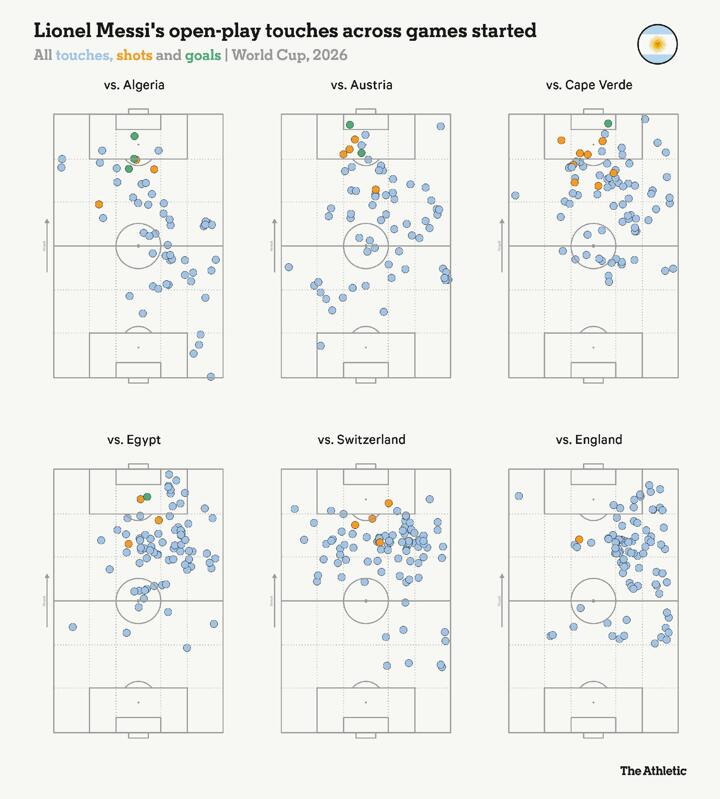
Messi's open-play touches distribution in each starting match
In this tournament, Messi has contributed a total of 12 goals (8 goals and 4 assists), more than any other player, and he is poised to lift the FIFA World Cup trophy for the second consecutive time.
This might sound cliché, but perhaps all Spain can do is hope Messi has an off day tomorrow. Because Messi is Argentina, and Argentina is Messi.
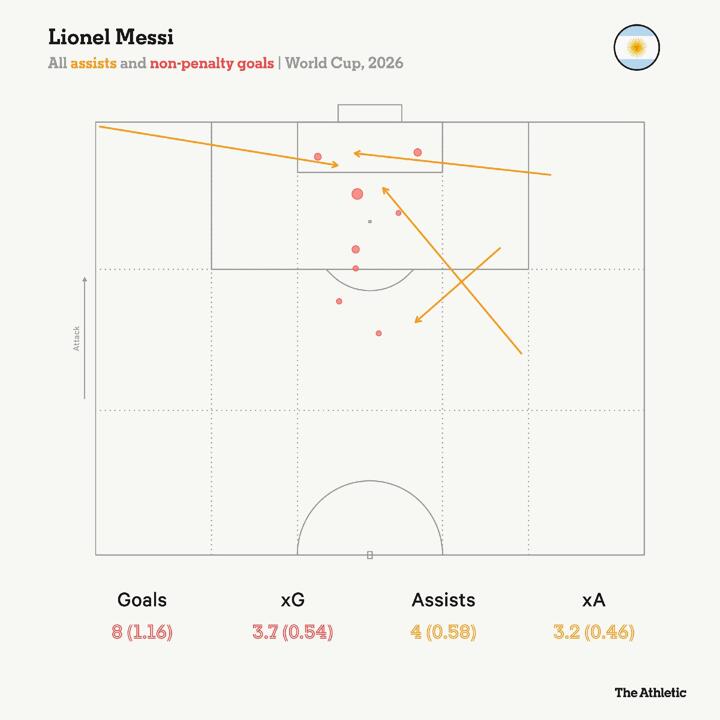
Messi's 2026 FIFA World Cup all assists and non-penalty goal locations
In their journey to three finals in the last four FIFA World Cups, Argentina has often needed Messi to carry them through. Compared to Spain's almost perfect record, the defending champions have been trailing for 14% of the time in this tournament, double the percentage of time they trailed during their Qatar victory (7%).
Many teams understand that Argentina can never be counted out early because they will fight until the very end. Of Argentina's 19 goals in this tournament, 12 were scored after the 75th minute (including extra time goals), with 9 of these goals changing the game's outcome (equalizing or taking the lead).
This is why the outcome of this final is so unpredictable.
Sunday's final will see the FIFA's current world number one and two teams face off, and it will also be the first time in FIFA World Cup history that the reigning European champions and Copa América champions compete for the title.
The Athletic's prediction model suggests Spain has the advantage, with a 59% chance of winning the title, while Argentina has 41%.
Both teams have rarely lost in recent years: Spain's last official match loss was in March 2023 in a European Championship qualifier away to Scotland, a tournament they eventually won; Argentina, on the other hand, has not lost a knockout match since their semi-final defeat to Brazil in the 2019 Copa América, and since then they have won three consecutive major tournament titles.
Tomorrow, one side will fail to maintain their unbeaten record. May the best team in the world win the FIFA World Cup.
AF's PC site is now live! Browse full news, comments, match details and stats on your computer. Visit: www.allfootballapp.com
 Argentina
 Spain
Spain
 FIFA World Cup
All Comments (106)
Today 14:41
Today 14:41
Today 14:40
Today 14:40
Today 14:40
Today 15:54
Today 15:54
Today 15:35
Today 15:31
Today 14:55
Today 14:49
Today 14:49
Today 14:48
Today 14:46
Today 14:45
Today 14:45
Today 14:45
Today 14:44
Today 14:43
Today 14:43
Today 14:43
Today 14:42
Today 14:41