Andoni Iraola sits down for a revealing and wide-ranging chat with Jamie Carragher in which the Liverpool head coach discusses his playing, the club's summer transfer business and his side's tricky season opener at Newcastle United on Super Sunday.
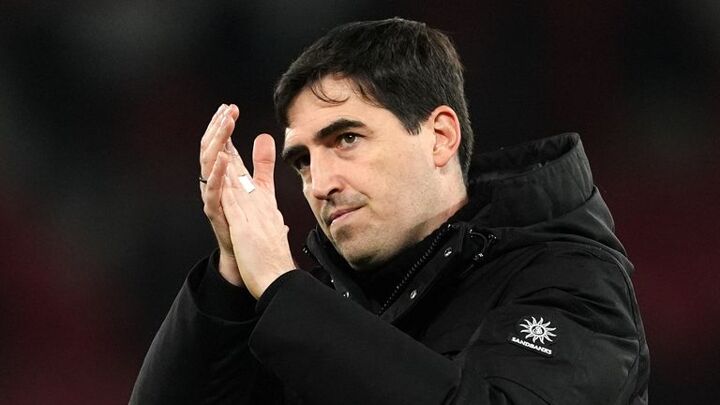
Iraola has only been in charge for just over two months having replaced Arne Slot in the Anfield dugout following the Reds' dismal Premier League title defence last season, with optimism high among the club's fans heading into the new campaign.
The Basque, 44, arrived on Merseyside with a glowing coaching reputation after three seasons at Bournemouth, the last of which saw the south coast club secure their highest-ever Premier League finish of sixth place.
In a new series called 'Boss with Jamie Carragher', Iraola tells the former Liverpool captain how he aims to turn around the club's fortunes after they lost 12 times in the top flight last season to finish fifth in the table, 12 months on from being crowned champions, as well as explaining in depth his coaching philosophy and how long it may take his players to adapt.
And the new man also looks ahead to his first competitive match as Liverpool boss when he takes his team to what is sure to be a bouncing St James' Park on Sunday afternoon in a game you can see live on Sky Sports Premier League.
At the moment, Liverpool supporters are getting a little bit nervous because of the lack of activity in the transfer market, so can you assure them you will you sign some players before the end of this transfer window?
We'll definitely sign players, yes. I hope more than one. The thing is, me as a coach selfishly, I want the players for the first day of pre-season so everyone is ready to go, but also I understand how this works.
Some days you have to wait until the end. The important picture is the one we have on September 1 and I hope, because it's true that we are still quite thin, that we can have more help from here until the end of the market.
What's the difference in getting players over the line for Liverpool compared to Bournemouth?
Probably the money, the level of the player is different, but the issues normally are the same.
Some deals you cannot do in the beginning, you have to wait and you have your hopes of 'let's think that this is possible. It's not possible today, maybe it's going to be possible later' and you have to be patient as a manager.
You learn with experience. Probably the first summers are very hard because you want your team ready to go straight away, but at the end, for me, the key is once the market is finished, we are happy with the team that we have.
Something that really fascinated me a couple of years ago about your team was a quote from Pep Guardiola, talking about your team and other teams in the Premier League, saying this is the future of football - do you agree?
I think you have to read the moments [in games]. For me, the key is to believe in the things that you are doing.
I think I'm here because the way we want to play is quite clear and you can identify it. And as you said, I'm not new in the league. More or less, the players, when you arrive, they suspect what you are going to demand from them.
This cannot change too much. I will need to adapt to be in Liverpool and to sometimes control a little bit more the games, if you want, but now I prefer to make mistakes, probably going more towards the other side than to more control situations, because I know that it's easier to fix than opposite.
You're going to have to learn to have maybe more control, so do you have to alter your training around that and do things slightly differently because you are managing one of the big boys rather than someone coming up against the bigger teams?
Yes that's mandatory because the same exercise with the Liverpool players, it evolves differently without me giving any different instruction because they play in a different way because there is more control naturally in the exercises.
The teams have certain tempos with the ball, certain tempos without the ball, and this is very difficult to change. I have to be the one not changing a little bit. We are used to doing these things.
Let's take the positive things about this, but we need something also different and that's what we are trying to do.
What I find interesting about your team, because you're very famous for pressing and how your teams are off the ball and you have a mixture, like a hybrid sort of system, of at times man-to-man marking and at other times, zone marking?
It's true, I always say, if you go straight away man to man, most of the teams will play long and then it's a matter of winning the second balls.
I want if they go long, to have one more than them so I want sometimes to give the plus one, but also you have to be aggressive enough to sometimes arrive to man-to-man situations. There is a lot of interpretation there in between, some players have to live in between opposition players, when it's worth it to risk and jump when it's not worth it.
It's not going to be the same against all the opposition, some positions you have to invite them to play more, others they will play, so you have to be even more aggressive.
This is the cat and mouse game we always play and the more we play, the more the players understand what we are trying to do. I think it's going to get better, but we have to go through these processes.
Your system at Bournemouth was fantastic. Obviously we've seen the results each year getting better, but you had a difficult start when you first went into Bournemouth. Does that show your way of playing, or in terms of without the ball, is it a lot of training work, a lot to get into the players and is it almost going to take time for that to come to fruition with Liverpool?
It's not just me, you can feel straight away the teams that have had the same manager for three, four, five seasons, they do the basics already very well, and then they add certain things from season to season.
But there is a structure, there is a floor in that team that always the performance will be, there will be a minimum.
That's the advantage, when you are in a place in the first year, you have to change a lot of things. Second year, you already have a base of players that already know it, they will help the ones that are in the third year, and my last two projects have been three years in Rayo Vallecano, three years in Bournemouth, so normally you go [about] improving, but I know also this is Liverpool, they are not going to wait 10 games until this gets going.
I know these demands and I want to think we are going to be probably not 100 per cent on Sunday, but good enough to get results.
I've seen a quote from you in that you said you didn't enjoy your playing career with Athletic Club as much as you should, or you were too hard on yourself, because it was your club and that's exactly what I used to think when I was a player at Liverpool?
When you play for your club, you feel responsible of everything and you think everyone is looking at you in every second, every moment.
You have to be perfect. You have to show the face that in that moment and you don't really play free - you overthink everything. You lose and you spend two days thinking 'I don't want to go to the street, I don't want to see anyone', and you don't really enjoy it.
I always say that I've enjoyed more my time as a manager because of this, because I think when you leave playing, there are one, two, three years when you understand maybe it wasn't as important. If you stop playing, nobody cares.
Now a lot of people don't recognise you and you regret a little bit not really having enjoyed those moments, because they are not going to come again. We cannot play anymore. Now it's probably late, and I wouldn't like this to happen when I'm a coach.
That's probably one of the things why I'm ready almost to take risks, because I don't feel that pressure that I felt when I was playing.
You mentioned about being a manager and taking more risk - would you class yourself as one of the riskier, you go for it more on the front foot and are more proactive?
I don't want also to be riskier. Riskier sounds like you are not effective - our approach is because we think it's the best way to win. I prefer to be a good team and win things than to be entertaining.
A lot of people say 'it's very entertaining to see', but I always say, I prefer that you tell me 'you are very good, you are solid' and I want to think that our teams and my teams always have been quite organised. They talk a lot about this chaos, but there is a lot of organisation there - there is a purpose on everything.
Everyone in the team, I want them to know what they are doing, but also what the team-mates are supposed to do, so when something doesn't work, everyone looks at the same player like, 'you should be here, you should be the one' and they learn from each other and this is the point where we need to arrive.
Now that everyone understands what everyone is doing, they can sometimes even solve situations without me intervening.
When you say it will take a time to arrive to that point, can you give us a timescale - is this something that you think would take a few months to bed in?
Whenever we arrive is not the end point. We will need to keep improving and football is always like this.
The things that you are doing are not enough anymore, so you have to do something extra and you have to do something better and quicker and this is the evolution.
How fast we will arrive to certain points... I think the quicker we understand things, the more complete as a team we can be.
We can change things live in games, we don't want to wait until half-time to change things because if you are ready, everyone understands, you can just do three things, and then we change the approach.
Sometimes I love it when players come to me, and they tell me 'no, they are doing this, I think we should do this' - that's the moment where you think 'OK, now we are getting it, we are there'.
Your style of football is probably a little bit direct, or the first pass forward, so it lends itself to maybe a more transitional game - is the big challenge for you as a coach, certainly at Liverpool now, to almost have a little bit more control of the game and be less transitional?
For me, it's about having the chances for ourselves. It's not about control, it's not about the amount of possession, I want us to be the team with the chances.
I will give you an example of Monaco. We lost 2-3, we were very good in the first half. I think we had the same possession, first half and second half.
In the first half, I think we had 15 shots or something like this. We were all over them. In the second half, we had exactly the same amount of possession, 51 to 52 per cent, but they were all over us.
So, it's not a matter of if we spend more time on the ball, it's a matter of arriving and having the chances and you feel it straight away.
I think there has to be a purpose in possession, which sometimes, like a lot of teams do, we have to rest on the ball. I prefer to rest on the ball than rest without the ball, because you are the one deciding when to start playing faster, but there will be moments that we have to control every phase.
Sunday at Newcastle, big atmosphere, but a new manager who likes to be aggressive - what are your thoughts on the game?
There has been a managerial change, but they want to keep the strength of Newcastle. With xG, I think they've been very good attacking the spaces, they have one of the quickest forward lines, so they will still be very good in transition like they've been the last year.
I love the atmosphere at St James' Park, so you have to be ready for a strong start, be at the level of the game and I hope we can impose our game and control the game as long as it goes.
This is the first in a new series called 'Boss with Jamie Carragher' - In this new series, Jamie Carragher interviews some of the Premier League's top managers, beginning with Liverpool boss Andoni Iraola.
Watch Newcastle vs Liverpool live on Sky Sports Premier League and Main Event from 4pm Sunday, kick-off 4.30pm.
 Liverpool
 Newcastle United
 AFC Bournemouth
 Jamie Carragher
All Comments (3)
Today 04:01
Today 01:53
Yesterday 20:23