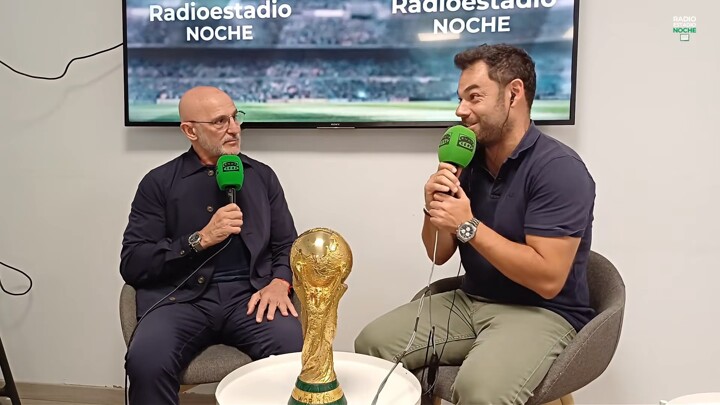
On August 24th, Spanish national team head coach Luis de la Fuente was a guest on the Spanish radio program "Radio Estadio Noche." During the show, he and the host revisited their "championship pact" from a year ago, reviewed the entire World Cup winning journey, discussed locker room management details, and outlined future tournament goals.
Host: Which match did you find the most difficult? Against Portugal or Belgium?
De la Fuente: I think every match was tough. For example, against France, if we look at the post-match analysis, the match against France was the one where we had the least trouble, the team performed most comprehensively, and we had the most control. But in all matches, we became the protagonists by taking control of the initiative. The game was under control from start to finish; we didn't encounter any chaotic situations. Of course, we also know that in top-level competitions like these, any small detail can change the outcome, but every match was within our control from beginning to end, which gave us great confidence and a sense of security.
Host: This confidence and sense of security were maintained under extreme tension, with heartbeats at 190. In every match, we were the rightful winners, but at certain moments...
De la Fuente: Football and life teach you that even against France, like in the Nations League semi-final, we were leading 5-1 in the 72nd minute, and the final score became 5-4. So we know that even a 2-0 lead against France shouldn't be taken lightly. And against Argentina, despite playing with one less man, the score was still 1-0, and they created many scoring opportunities; the game could have become 3-0.
You know, that was the situation at the time, and then they had that chance to equalize, fortunately Cubarsi made that crucial clearance. So, in football, anything can happen until the final whistle. This is also one of our mottos: focus must be at its maximum until the very last moment.
Host: A few days ago, we also learned about the penalties for the Argentine players after the final, such as Paredes being banned for 10 matches, Nahuel Molina for 7 matches, and Ayala for 3 matches. Did these penalties surprise you?
De la Fuente: Well, as I said before, the behavior of some players at that time was certainly not exemplary. It was absolutely not exemplary and intolerable, especially considering that over 2 billion people worldwide watched that match, and we conveyed such an image. This kind of behavior should never be tolerated.
As for the penalties, the relevant authorities made what they deemed to be reasonable decisions. But in any case, those actions were unacceptable. I reiterate, after a World Cup final, such attitudes are absolutely not allowed. And by the way, our players were victims in that situation and were not involved.
Host: Yes. So, now we are world champions, and we will be back in action in September. There are four matches coming up, which is also a training camp, one of FIFA's new rules. Clubs will definitely complain to you, but you can say it's none of your business (laughs) — after all, players will be away from their clubs for almost 20 days for international matches. That said, after becoming world champions, do you think it will be harder to exclude a world champion member from the squad for tactical reasons? Will this create a psychological burden for you?
De la Fuente: No, not at all. So far, it hasn't been a burden for me, and it won't be in the future. As I said earlier, the players are very aware of how I make decisions based on professional and personal levels. Our way of working here, and my personal code of conduct, is always to maintain the utmost honesty. Whether it's now, or twelve or thirteen years ago when I first started working with many of them, I've always done it this way.
Host: But after winning the championship, won't it become harder?
De la Fuente: No, because the starting point is the same: professionalism, understanding of the opponent, and honesty. First, honesty to myself, and then honesty to everything I represent.
Host: After all, people will always compare you with the 2010 generation. For a player, it's always hard to admit a few years later, "I really didn't handle my emotions well at the time; I should have reacted better."
De la Fuente: I believe our players are well-educated enough to understand and accept this. If they find it difficult to accept for a while, I can understand. But a few years later, the person who had those emotions might also say, like current players, "I wasn't good enough ten or twelve years ago." In any case, being left out doesn't mean we will hesitate when making decisions.
We won the European Championship before, and Viviane, Remiro, Morata, and Carvajal were also left out. Now, facing this World Champion squad, if at some point a decision needs to be made about someone, we will still adhere to the same standards. Otherwise, we would be deceiving ourselves and deceiving the players.
Host: I understand.
De la Fuente: And as I've said on other occasions, I'll emphasize it again: I will never abandon principles because of so-called "human relations," I assure you. Because I've always thought and acted this way, and the players understand. I've talked to them about this in many conversations; they know my thoughts and that my way of doing things now will be exactly the same as in the past.
Host: Your contract is until 2028, right? So now it's time to renew until 2030?
De la Fuente: To be honest, Exposito, I love my job very much. I feel there's a very good understanding between the Spanish Football Federation and myself. I know that when it's time to talk, we'll naturally sit down and talk.
Host: But no matter what happens, no matter the outcome of the European Championship, you will be the national team coach in 2030, right? I think you deserve it.
De la Fuente: If it were up to me, I've always said that throughout my career, I've been fortunate to always do what I want and be where I want to be. Whether as a player or a coach, I am now enjoying the best position in football, and being the coach of my country makes me incredibly proud and honored. I couldn't ask for more. Do I want to stay with the national team? Yes. Do I want to work until 2030? Yes. I even want to be there until 2034.
Host: You're already thinking beyond 2030 (laughs).
De la Fuente: Just kidding. My point is, in the short term, if we're talking about World Cups, how could I not want to lead the team in the next World Cup hosted on our home soil?
Host: The 1982 home World Cup for Santa María (then Spanish coach) wasn't very smooth.
De la Fuente: Those experienced people have mentioned that to me. But the past is the past; sometimes we look back at history to change it, to create a different outcome.
Host: Looking back at your journey, would you wish you were only 45 now, with another 30 years of coaching ahead of you?
De la Fuente: No, because if that were the case, I wouldn't be prepared enough to experience everything I've experienced since joining the Spanish Football Federation. I arrived here at the most opportune time. It's a learning process; I didn't know how to be a national team coach before, and I don't think anyone who hasn't been in this circle would understand.
You need to learn through personal experience, and from those colleagues who have helped me immensely — Meléndez, Santi, Lopetegui, Celades, and also David Gordo who is with us. I've learned a lot from these colleagues. If I had come at a different time, it might not have been the most suitable moment. Things always happen when they are supposed to, and this, like other opportunities in my life, came at the most appropriate time.
Host: If next summer, in 2027, assuming Simeone leaves Atlético Madrid and Atlético contacts you saying they want you to replace Simeone and start a new long-term coaching tenure, would that make you hesitate?
De la Fuente: No.
Host: You want to stay at the Federation no matter what?
De la Fuente: Yes, this is the highest stage. I am very happy, I am enjoying it, and I fully understand the direction we should follow. That is to say, to this day, nothing can make me waver about staying here, not even a high-salary offer from a big club. The only offer I truly want is to continue being part of the Spanish Football Federation family.
Host: Others might not think so, but that's your true feeling.
De la Fuente: What I'm saying is my true feeling, Exposito. For me, as a Spanish coach, the greatest honor is to coach my own national team. I've talked to other national team coaches, and many share my view; of course, some choose other paths, and that's fine, but I know very clearly what I want.
AF's PC site is now live! Browse full news, comments, match details and stats on your computer. Visit: www.allfootballapp.com
 France
 Spain
Spain
 Luis de la Fuente
All Comments (11)
Today 15:59
Today 15:49
Today 15:43
Today 15:41
Today 15:41
Today 15:39
Today 15:39
Today 13:51