According to Sky Sports' analysis, Manchester United's transfer activity this summer has left the team with insufficient squad depth, forcing over-reliance on core players and making it difficult to manage the intensity of three matches per week.
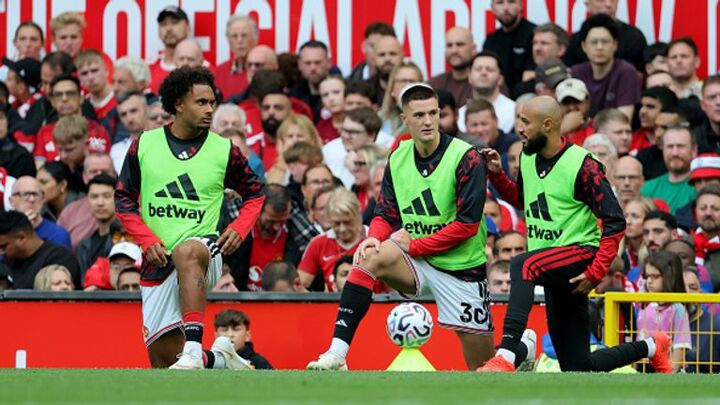
"This creates some pressure for Manchester United. They face Manchester City next week, and their European campaign kicks off midweek as well."
Michael Carrick's comments following Manchester United's 2-2 draw with Everton have proven prophetic. Although it's only September, his prediction was accurate. The pressure is already on Carrick, and this week feels like a pivotal moment in the season.
When the Premier League fixture list for the 2024/25 season was announced, Manchester United was statistically considered to have one of the easiest opening six matches. Halfway through, they've dropped more points than expected.
The forthcoming fixtures will only get tougher. As Neville noted, Manchester United play their first Champions League match on Thursday night against Sabah, Azerbaijan's champions, followed three days later by the season's first Manchester derby.
Given the nature of both opponents, Carrick is likely to rotate his squad on Thursday, meaning fans will get their first real glimpse of the team's depth—not just the quality of the first-team players, but whether the bench is strong enough.
The general consensus is that Manchester United's transfer activity this summer has left the team with insufficient squad depth, forcing over-reliance on core players and making it difficult to manage the intensity of three matches per week.
According to Transfermarkt, Manchester United has the second-largest squad in the Premier League. However, the problem lies in structural imbalance within that squad.
They have the most backup attackers, but midfield depth ranks only eighth, and defensive depth ranks tenth. Looking at specific positions, right-back depth is ninth, while left-back depth is eighteenth. Left-back has been a recurring concern due to Luke Shaw's injury history, creating long-term vulnerability at that position.
However, they have only themselves to blame for this issue. Since 2022, only Everton and Liverpool have invested less in defence than Manchester United.
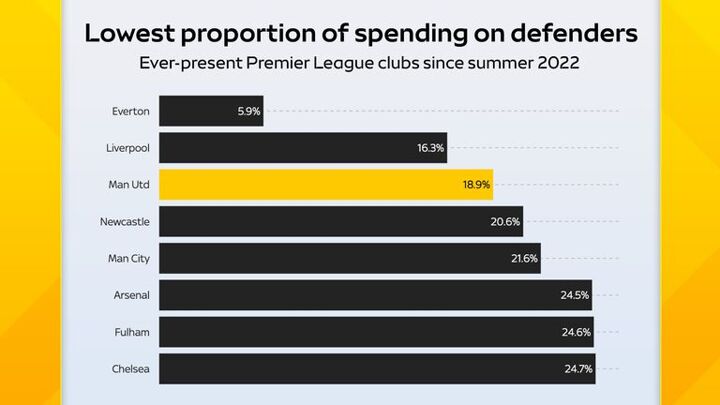
Squad imbalance is a critical issue, and another significant problem is the large gap between first-team players and replacements.
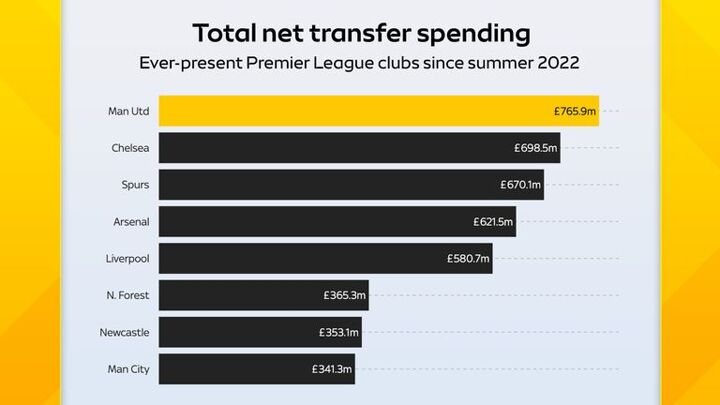
Although it may appear the club faces financial constraints, the undeniable fact is that Manchester United's net spending since 2022 is the highest among all Premier League clubs. Yet this investment has not translated into a genuinely competitive squad at this level.
Looking at the Everton match alone, Carrick made his first substitution in the 70th minute. The data comparison below shows some significant changes from that point onward, and illustrates how the data would have looked had Manchester United maintained their first-half performance throughout.
In summary, Manchester United's positioning changed after the substitutions. The team appeared more frequently in the opponent's half, but this didn't translate into more efficient attacking play, as the quality of passes in the final third decreased and the number of chances created also dropped.
They were also less engaged in duels, which in turn created pressure on themselves and gave the opposition more opportunities. Of course, Everton was chasing the game at that point, and the circumstances differed from the first 70 minutes, so the final 20 minutes couldn't be entirely comparable.
Nevertheless, this illustrates that when Carrick uses substitute players, they fail to perform adequately. Sandro is a clear exception, but one game-changing substitution doesn't mean the squad has sufficient depth.
This pattern wasn't limited to the Everton match alone but also appeared in the Hull City fixture.
You might look at these statistics and think: "Manchester United actually performed better after the substitutions." However, among the first-team players who faced Hull City, four were unavailable for the next two matches. Carrick needed to rotate more at the start of the season because players were still working on fitness. The substitutions in that match brought fresh legs closer to the first-team players who would face Ipswich and Everton.
This is the crux of the problem. Even if Carrick makes fewer than half the changes, performance still deteriorates. The players involved have no choice but to step up. Otherwise, Carrick faces significant risk this week, and potentially throughout the season.
Yoro, Dörgu, André Santos, or Sørloth all have good opportunities on Thursday night to prove their value to the team.
Of course, they all want to play in the derby, but the first European match must go well. If selected, the pressure on them will be as intense as on key players likely to start the Manchester City fixture.
Neville spoke about Carrick needing to win back fan trust. The same applies to the players mentioned above. Winning the opening Champions League match would provide temporary relief for many. If they fail to deliver, anxiety around Old Trafford will continue to mount.
แปลโดย AI
เว็บไซต์ AF เปิดตัวแล้ว! ดูข่าว ความคิดเห็น รายละเอียดแมตช์ และสถิติครบถ้วนบนคอมพิวเตอร์ของคุณ เยี่ยมชม: www.allfootballapp.com
 Manchester United
 Gary Neville
 Carrick
All Comments