
On June 1, The Telegraph published an article discussing Arsenal's recent victory parade.
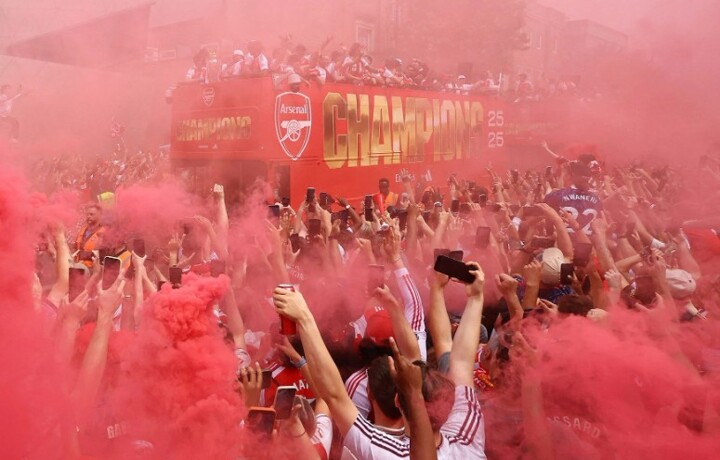
The media outlet noted that Arsenal's victory parade displayed a dynamic, diverse, and unprecedented fan base. Over the past two weeks, London appeared to have been "taken over" by a massive fan base whose passion had been reignited. They were enthusiastic, passionate, diverse, and enormous in scale. At least 800,000 Arsenal fans flooded the streets to participate in the victory parade.
According to police estimates at the scene, the actual number could approach 1-1.2 million, with some media reports even mentioning 1.5 million. This grand celebration took place in North London, bringing the city's traffic to a standstill. Underground stations were forced to close due to overcrowding. Streets were blocked in all directions. Tens of thousands of fans in red and white jerseys streamed toward Holloway Road, simply to catch a glimpse of the team and trophy. It was nearly impossible to secure a good viewing spot without arriving several hours early. Authorities eventually asked fans to disperse across different areas to prevent safety risks from excessive concentration in certain locations.
"These Streets Are Ours"
As sung in Louis Dunford's song "The Angel," the lyric "These streets are ours" felt particularly apt over the past two weeks. The city was almost entirely occupied by a revitalized, passionate fan base. They were joyful, enthusiastic, energetic, and incredibly diverse. Arsenal won the Premier League title again after 22 years. This wasn't merely a trophy; it was more like a cultural phenomenon explosion, one that exceeded even the most optimistic fans' imagination. The Metropolitan Police did not release official attendance figures, but officers on the ground estimated around 1 million, with social media estimates running even higher.
The celebration completely paralyzed North London in the afternoon. Underground stations closed due to overcrowding. Traffic came to a standstill. Crowds flooded Holloway Road. Countless fans simply wanted to see the team and trophy. The entire scene resembled a city-wide festival.
Arsenal has never been merely a football club. They are the third most successful team in English league history (by top division titles) and London's most successful team. Yet the scenes following this championship once again demonstrated their emotional impact across London and globally.
Arsenal's fan base spans all social classes and cultural backgrounds, including the Prime Minister of the UK, the Mayor of New York, financial professionals, numerous celebrities, as well as the working-class communities of North London and across England. While Emirates Stadium's regular audience tends toward the upper-middle class, the entire global fan base is remarkably broad. Arsenal has long held a special place within England's Black community.
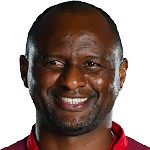
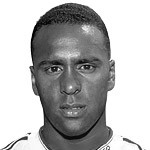
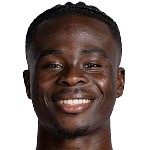
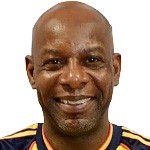
This is closely tied to the club's history of prominent Black players, such as David Rocastle and Michael Thomas. In the 1990s and 2000s, stars like Ian Wright, Sol Campbell, Patrick Vieira, and Thierry Henry emerged. In September 2002, under Arsène Wenger, Arsenal became the first English team to field nine Black players in a single match. Today, the team's core includes academy product Bukayo Saka. Arsenal's commercial department has also played a crucial role in driving youth fan growth.
Among global football clubs, few embrace the integration of "youth culture and football" as actively as Arsenal. They have launched numerous fashion collaborations, streetwear partnerships, and cross-genre projects. This strategy has been hugely successful, making Arsenal a key representative of London street culture. Simultaneously, Arsenal Women also represents world-class excellence.
In recent years, the club has hosted more women's football matches at Emirates Stadium, allowing more fans to experience women's football culture. Players like Leah Williamson and Alessia Russo, stars of England's national women's team, have also attracted many young fans to Arsenal. Arsenal also maintains a substantial global supporter base. Media analysis shows Arsenal is the most supported team in East Africa.
Following the championship, massive celebrations also erupted in Kenya, Nigeria, Uganda, and beyond. Yet for many fans, what mattered most was the 22-year wait. Older generations feared they might never see another championship. Younger generations had never experienced one. Three consecutive second-place finishes and a long history of "near misses," combined with external jokes about "collapse," made the emotional release of this championship intensely powerful.
Although they unfortunately lost the Champions League final, this did not diminish fan enthusiasm; rather, it united them further in supporting the team. Especially for Eberechi Eze and Gabriel, who missed their penalties, fans continued to show remarkable support. Throughout most of this season, Arsenal faced criticism from some neutral fans regarding their playing style and other reasons.
However, Arsenal need not rely on such external goodwill, as they already possess a revitalized fan base and a strong foundation of global support. Many new moments also emerged during the parade, such as players who had "lost their voices" singing from the float, Calafiori leading fans in song, the Empire State Building in New York announcing it would light up in red and white to celebrate Arsenal's victory, while some Islington residents expressed dissatisfaction, feeling their lives were disrupted.
One resident even stated there was insufficient consideration for those not participating in the parade. The parade gradually ended after approximately two and a half hours, but street celebrations continued for hours or even days.
From the players' side, Declan Rice said his voice was hoarse from shouting and expressed his love for the team and coach. David Raya thanked his parents for supporting his pursuit of his dreams and said the team's defense was key to winning the championship. Captain Ødegaard said this was a long-awaited moment and they must savour it. Havertz emphasized it was a proud season. Martinelli said it was a moment for both players and fans.
Throughout the parade, red smoke enveloped North London, fireworks and flares continuously lit the sky, and people even occupied rooftops to watch as the city transformed almost entirely into red.
From the club's leadership, one of the club's chairs, Josh Kroenke, also appeared on the float to celebrate with fans, symbolizing a significant improvement in the club's relationship with its supporters.
The Telegraph concluded that overall, Arsenal's victory parade was not merely a sports celebration but a city-wide cultural event. It showcased a massive, cross-class, cross-cultural global fan base, a team returning to the summit after 22 years, and a city completely immersed in a sea of red and white. As the lyrics say, "These streets are ours," and this time, all of London witnessed it become reality.
Diterjemahkan oleh AI.
 FC Arsenal
 Arsenal WFC
 Patrick Vieira
 Thierry Henry
 David Rocastle
 Ian Wright
 Bukayo Saka
 L. Williamson
 Michael Thomas
Alle Kommentare (94)
6-2 08:37
6-2 05:13
6-2 07:45
6-2 09:42
6-2 07:46