
The headset goes on and I am transported from a central London meeting room to the centre circle of a match simulation. I have selected the role of holding midfielder. I grip a controller in each hand, thumb hovering over the pass button.
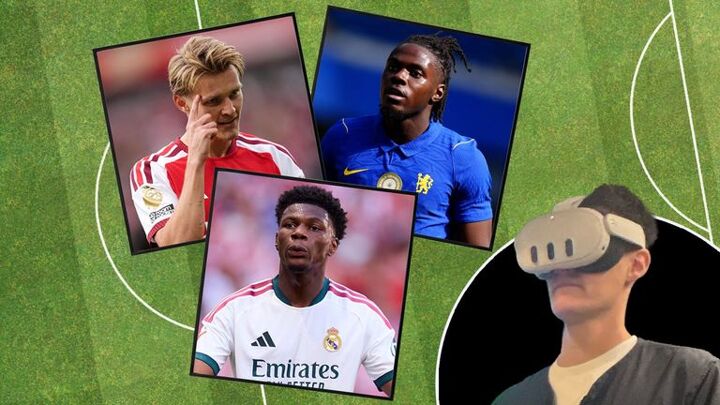
After a short countdown, a passage of build-up play begins at the feet of a virtual team-mate. My task is to receive the ball and choose the appropriate pass, all while every movement of my head, and every subsequent decision, is logged and analysed.
The technology, created by Be Your Best, is designed to train scanning, those little glances from side to side made by players to gather information about their surroundings which can be used to inform their decisions when they receive the ball.
Mercifully, my first attempt is at 80 per cent speed, allowing me to find my bearings. I start slowly as I am tackled while dwelling on the ball but feel smugly satisfied as I am praised for a 'critical scan' before finding a team-mate with a pass through the lines.
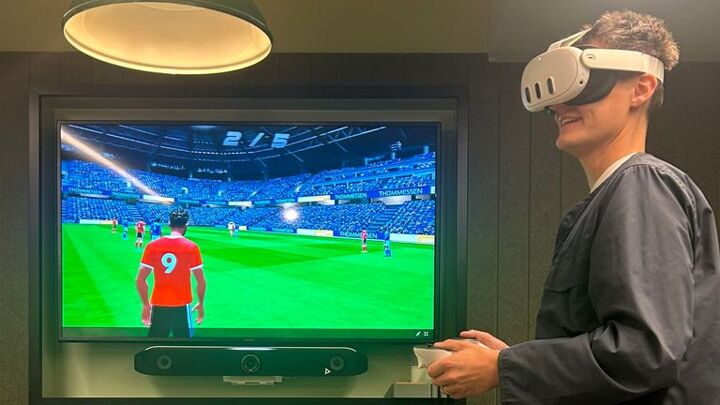
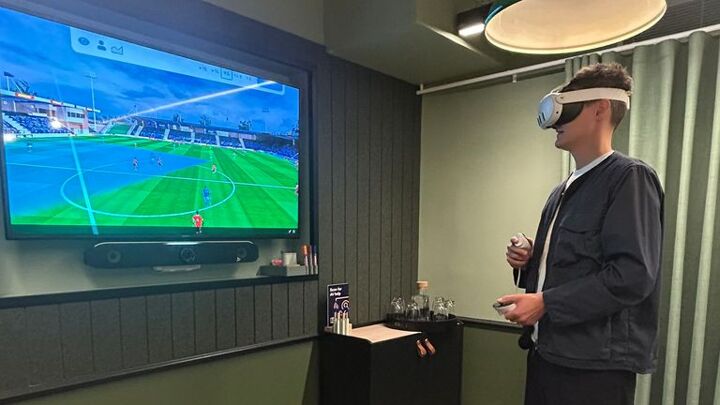
When the dial is turned up to 100 per cent, replicating the speed of a top-level game, I am given a reality check. I think better of trying the 120 per cent setting incorporated after a request from Martin Odegaard when he used the headset for the first time.
The Arsenal captain, renowned for his vision and speed of thought, is the type of player who fascinated Andreas Olsen, CEO of Be Your Best, when Olsen was an academy player at Viking FK in Norway.
"It was mind-blowing to me how some players just seemed like they had eyes in the backs of their heads," he tells Sky Sports.
"When it came to that skill, I felt like I didn't have the vocabulary to understand or describe what it was. I just remember wishing I was as good as them at understanding where the opponent's pressure was coming from and where the next pass should go."
It was around the same time, in the late 1990s and early 2000s, that Norwegian professor Geir Jordet began studying what would come to be known as scanning.
His research, focused on the period of 10 seconds before a player receives the ball, found that high scan rates were a defining feature of the world's best players.
"Those 10 seconds are critical," says Olsen. "It's all about making a decision before you get the ball. When you've already made that decision, you're not going to be surprised by what happens. All the pictures have been taken, so it's just about executing."
Barcelona and Spain legend Xavi Hernandez stood out as the most prolific scanner in Jordet's research. "He wasn't the fastest player on the pitch in his legs, but in his mind he was the fastest player, so he didn't need to be super quick," says Olsen.
"He made his decisions before he got the ball, and then the ball was gone. Or he turned left because he knew the pressure was coming from the right. Watch clips and you see it. He always covers the ball with his back because he knows where his opponent is."
Scanning is not a new concept. Frank Lampard recalls it being drilled into him as a boy by his father, who shouted the word "pictures" from the sidelines. But its importance is growing as the game becomes quicker and time available on the ball is squeezed.
Premier League tracking data shows players are sprinting much further per game, on average, than even a few years ago, continuing an upward trend as pressing proliferates and intensity increases.
"Arsene Wenger said we've solved all the physical aspects of football," says Olsen. "We know how to get faster and we know how to get stronger. We are really clear about that.
"But in a world where football is becoming way more physical, we also have to pay attention to how fast the mind works. It's not enough to be the strongest and fastest on the pitch anymore."
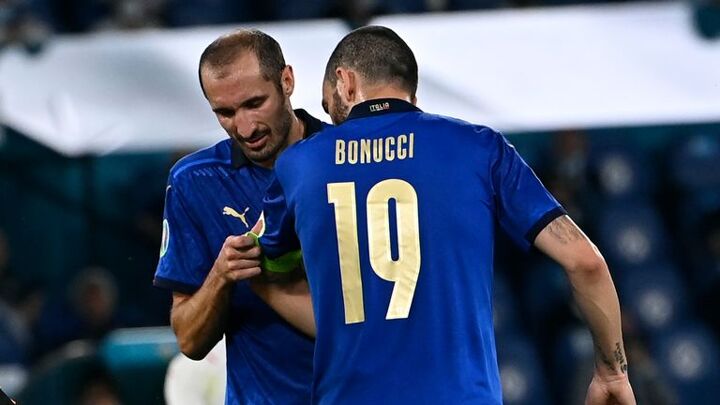
That applies to defenders as well as attackers. Dan Micciche, a former England and Arsenal youth coach working in Saudi Arabia's national team set-up, describes watching a defensive scanning masterclass from Giorgio Chiellini and Leonardo Bonucci.
"I was at Wembley, behind the goal where Italy were defending in the first half of the Euros semi-final against Spain in 2021," he tells Sky Sports. "Literally, all they did in the first half is what I would describe as skipping and scanning. They never really sprinted, even up the pitch or to the side, they were just jogging.
"Normally, we tell a centre-back or a defender to know where their man is. But it was as if those two knew where every player on the pitch was, and it gave them a sense of calm."
Most agree nowadays with the premise that situational awareness and scanning can be trained. But some are sceptical about the specific benefits of doing so using virtual reality.
"I always think the game is the best teacher, and the observation and feedback of a coach looking at the details," says Micciche. "You can improve players by asking good, open questions. What did you see? Why didn't you turn? Where was the space?
"It sounds very simple but it's not simple to do because, in our sport, we want everything instantly. We maybe rush to telling them, either in action, so they don't need to scan because we've made the decision for them, or by giving them the answer when we ask them because we don't have the patience for a longer dialogue.
"It's about spending time with a player and having a lens on individual actions. Also, I've seen players who just scan to please the coach. Are they actually observing their next move, or are they just thinking about how many times they move their heads?"
It is an issue Be Your Best have attempted to address in the development of their technology by measuring the timing of a player's scans while wearing the headset as well as the frequency, and by grading the quality of their decisions.
The company point to examples they say demonstrate the benefits. In a nine-week programme involving Germany U16 and U17 players, Olsen says scan rates improved by 28 per cent, while coaches reported better positioning in 80 per cent of the players.
They cite individual success stories too. Manchester City centre-back Marc Guehi is a user of the technology. Chelsea midfielder Romeo Lavia has even invested in the company.

And, most notably, in 2023, Real Madrid's Aurelien Tchouameni used the technology to familiarise himself with the centre-back position when told he would be drafted into the role during an injury crisis.
After helping the side keep a clean sheet in a 4-0 win over Osasuna, the midfielder posted about using the headset on social media.
Using it myself, it is easy to understand the appeal. I leave knowing my scanning still needs considerable work. Odegaard's 120 per cent setting will have to wait for another day. But I find myself intuitively checking my shoulders as I walk towards the station.
 FC Arsenal
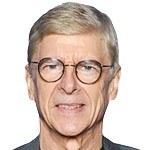 Arsène Wenger
 Martin Ødegaard
Alle Kommentare (1)